
Non-FictionStudent's ShortcutNewspapers
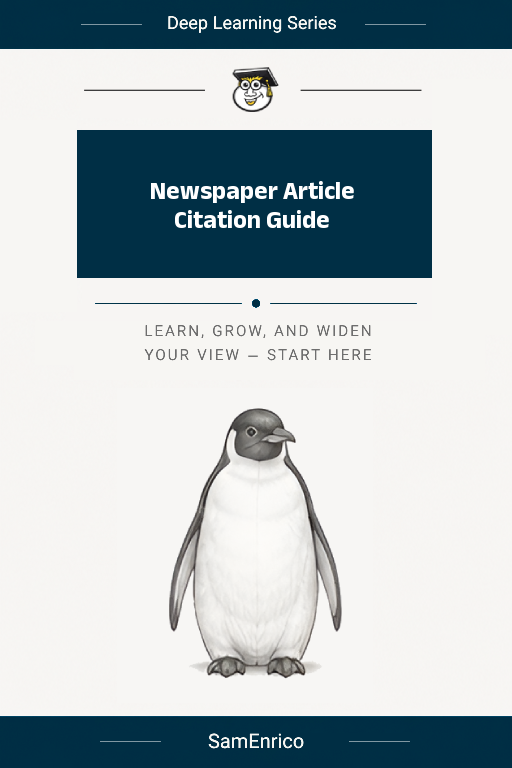
Newspaper Article Citation Guide eBook
Cite print and online newspaper articles including
Cite print and online newspaper articles including page numbers, section letters, and access dates.
Formats
Free sample
Chapter 1: Seven Undying Pieces--–- The email arrived at 11:42 PM on a Sunday. Miriam, a second-year law student at a respected East Coast university, had just submitted her appellate brief draft. The supervising attorney's response was four words: "Fix your newspaper citations." No explanation. No markup. Just four words that sent Miriam spiraling into a late-night research frenzy.
She had used the citation generator built into her word processor. She had assumed it was correct. And she had just learned, in the worst possible way, that citation software lies.Miriam's story is not exceptional. It is not even unusual. Across law schools, undergraduate dorms, graduate seminars, newsrooms, and corporate legal departments, thousands of writers every week lose points, lose credibility, lose contracts, and occasionally lose jobs because they cannot correctly cite a newspaper article.
The problem is not that these writers are lazy or unintelligent. The problem is that newspapers break every rule that writers learn for citing books and journals. And the standard resources students turn to for help—Purdue OWL, Citation Machine, Easy Bib, and even the official style guides themselves—bury newspaper citation rules in obscure subsections or, worse, provide contradictory examples.This book exists because you need a single, reliable, problem-solving resource that addresses exactly one thing: citing newspaper articles in the five major academic styles. No fluff. No tangents about citing You Tube videos or personal interviews.
Just newspapers. Print newspapers. Online newspapers. Database newspapers. Microfilm newspapers.
Newspapers with missing authors, missing dates, missing page numbers. Newspapers that jump from A1 to A6. Newspapers that exist only as scanned PDFs from 1932.Before we can fix any of those specific problems, you need to understand something that no citation generator will ever tell you: beneath the surface differences between APA, MLA, Chicago, CSE, and IEEE, every newspaper citation is built from the same seven undying pieces. Learn these pieces, and you can construct a correct citation in any style simply by rearranging them and applying that style's punctuation and formatting rules. Ignore these pieces, and you will remain dependent on broken citation generators forever.The Seven Pieces That Never Change Every newspaper article you will ever cite—whether it is yellowing newsprint from 1953 or a breaking story on a smartphone screen—contains seven core elements.
Some of these elements are obvious. Some are hidden. Some are deliberately misleading. But all seven exist, and your job is to find them.Let me name them for you now, in the order you should look for them, not in the order they will appear in your final citation. Memorize these.
They are your map out of citation hell.Piece One: The Author. Someone wrote the article. That someone might be a named reporter, a wire service (Associated Press, Reuters, Bloomberg), a staff writer, or no one at all. The author is the starting point of almost every citation. If you cannot identify the author, you need a fallback rule.
We will cover those fallbacks in this chapter and exhaustively in Chapter 11.Piece Two: The Publication Date. The article was published on a specific day, month, and year. For print newspapers, this date is printed on the front page. For online articles, it is trickier: websites often display "last updated" timestamps that are not the original publication date. You need the original date.
Always.Piece Three: The Article Title. The headline. This seems obvious, but newspaper headlines are messy. They contain colons, question marks, exclamation points, and sometimes entire phrases in all capital letters. Your job is to copy the headline exactly as it appears, then let your style guide tell you how to capitalize it.Piece Four: The Newspaper Name.
The publication that printed or hosted the article. The New York Times. The Wall Street Journal. The Chicago Tribune. The Guardian.
Some styles drop the word "The" from the newspaper name. Some styles keep it. Some styles add the city name in brackets when the newspaper's title is ambiguous (e.g., Post and Courier [Charleston]). But the name itself is constant.Piece Five: The Section Letter. This is the killer.
Unlike books and journals, which use simple page numbers, newspapers divide content into sections labeled with letters (A, B, C, D) or numbers (1, 2, 3). Page A1 is not page 1. Page B3 is not page 3. The section letter is part of the page number. Omit it, and your citation is incomplete.
Hyphenate it as "A-1," and you have signaled that you learned citation rules from a typewriter manual.Piece Six: The Page Number(s). The specific page or pages where the article appears. This may be a single page (A1), consecutive pages (B3-B5), or non-consecutive pages (A1, A6, A9). Some online articles have no page numbers at all. Some PDF replicas preserve the original print page numbers.
Your style guide will tell you how to handle each scenario.Piece Seven: The Access Information. This is the most variable piece. For print sources, access information is nothing—you hold the newspaper in your hands. For online sources, access information may include a URL, a DOI (Digital Object Identifier), a database name, a permalink, or an access date. Different styles treat these elements radically differently.
APA omits database URLs. MLA requires database names in italics. Chicago shrugs. CSE demands access dates when publication dates are missing. IEEE requires access dates for everything.Seven pieces.
That is all. Every newspaper citation in every style is just these seven pieces arranged in a different order with different punctuation and different rules about what to do when a piece is missing.Why Newspaper Citations Break (And Software Cannot Fix Them)Before we go deeper into the seven pieces, I need to explain why citation software fails so spectacularly at newspaper citations. This is not a technical limitation. It is a design flaw.Citation generators work by scraping metadata from web pages and databases. When you paste a URL into Citation Machine or click "Cite" in your library database, the software looks for machine-readable fields: "author," "title," "date," "page number." If those fields exist in a clean, standard format, the software can produce a decent citation.But newspaper metadata is almost never clean or standard.Here is what actually happens when a citation generator tries to cite a newspaper article from Pro Quest.
The database's metadata for page numbers might say "1" even though the original print page was "A1." The software does not know the difference. It outputs "p. 1." You lose points.Here is what happens when a citation generator tries to cite a newspaper article from a news website. The website's metadata might include two dates: "date Published" and "date Modified." The software might grab the wrong one. It outputs the "last updated" date instead of the original publication date.
You lose points.Here is what happens when a citation generator tries to cite a newspaper article with no author. The software does not know whether to move the title to the author position, use "Anonymous," or leave the author field blank. It guesses. It often guesses wrong. You lose points.Citation generators are useful tools for getting a rough draft of a citation.
They are not reliable for final submissions. The only person who can correctly identify the seven pieces and apply the…
This is the end of the free sample. Get the eBook to keep going. Buy now
About this book
Details
- Author
- Rodriquez Sabrina
- Publisher
- SamEnrico
- Language
- English
- Genre
- Non-Fiction, Student's Shortcut, Newspapers
- Released
- 2026-06-01
- Pages (approx.)
- 149
- Available as
- eBook, Audiobook

Read better in the ZLOADR app
Your eBooks on your phone or tablet. Sign in with your SamEnrico account and start reading.
More by Rodriquez Sabrina
 Hoffa Case DNA Evidence Possibility GuideRodriquez Sabrina$11.99
 Handling Difficult Bosses WorkbookRodriquez Sabrina$11.99
 Liars Body Language SignsRodriquez Sabrina$11.99
 Etsy Shop Sales ComparisonRodriquez Sabrina$11.99
 Remote Work Zoom EfficiencyRodriquez Sabrina$11.99
 Atomic Habits For Decision MakingRodriquez Sabrina$11.99
 Screen Time GuideRodriquez Sabrina$11.99
 Pressure Dressing ApplicationRodriquez Sabrina$11.99
 The Nobel Heist: Breaking the Code of GeniusRodriquez Sabrina$11.99
 The Green Visionary: Hasan Fathy and the Birth of Earth ArchitectureRodriquez Sabrina$11.99
 How to Produce Wireless Communication TerminalsRodriquez Sabrina$11.99
 Nigeria VAT Deregistration GuideRodriquez Sabrina$12.99
You may also like
 Hong Kong Handover 1997Dunn Johnnie$11.99
 Zumba For Postnatal Recovery CourseNeal Christian$11.99
 Zumba for BeginnersLadner Nikia$11.99
 YouTube Comment Mining GuideHumes Pandora$12.99
 Worry Box MeditationCarlin Rudy$11.99
 Workplace Stress MeditationNguyen Lynn$11.99
 Workplace Stress and Sleep RepairHawley Ivory$11.99
 Workplace Perfectionism CureDelaney Jeffry$11.99
 Workplace Injustice Anger GuideWallen Isabelle$11.99
 Work Addiction and Burnout LinkGreenwood Ester$11.99
 Women in Yoga and WellnessBeattie Galina$11.99
 Women in Stand Up ComedyChun Evangeline$11.99