
Non-FictionSelf-HelpTechnology
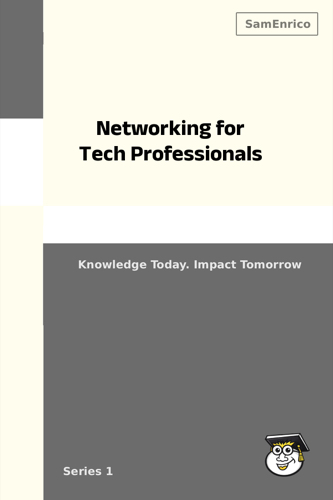
Networking for Tech Professionals eBook
Teaches hackathon networking and GitHub collaborat
Teaches hackathon networking and GitHub collaboration for developers.
Formats
Free sample
Chapter 1: The Contribution Paradox--–- The rejection letter arrived on a Tuesday. Sarah had spent three weeks preparing for the senior developer interview at a company she had admired since college. She had rewritten her resume five times. She had practiced coding challenges until they felt like second nature. She had even bought a new webcam for the virtual interview, because she wanted to look professional.
The feedback came in a brief, impersonal email: "While your technical skills are strong, we have decided to move forward with candidates whose experience more closely aligns with our needs." Sarah closed her laptop and stared at the wall. She had done everything right. She had followed every piece of career advice she had ever received. And still, she had lost to someone she would never meet.What Sarah did not know, as she sat in her apartment feeling defeated, was that the person who got the job had never submitted a resume. They had never filled out an application.
They had never done a coding challenge. Instead, six months earlier, they had fixed a documentation error in the company's open source library. The fix was small—a single broken link in the README file. But the maintainer, who happened to be the company's lead architect, noticed the contribution. When a position opened on his team, he did not post a job listing.
He did not review applications. He simply messaged the contributor on Git Hub and asked, "Are you interested in working with us full time?"This is the contribution paradox. The developer who actively applies for jobs competes against hundreds of other applicants. The developer who contributes to open source is discovered. One plays a lottery.
The other builds an asset that appreciates over time.Why Everything You Learned About Networking Is Wrong If you grew up in the traditional professional world, you were taught a specific set of rules for career advancement. Update your resume regularly. Tailor each application to the job description. Network by attending industry events and collecting business cards. Connect with recruiters on Linked In.
Send follow-up emails after interviews. Practice your elevator pitch. These rules are not malicious. They were designed for a world where information moved slowly, where credentials mattered more than demonstrated ability, and where the only way to evaluate a candidate was through interviews and references.That world no longer exists.In software development, the barriers to demonstrating competence have collapsed. Twenty years ago, if you wanted to prove you could write code, you needed a degree, a portfolio of private work, or an employer willing to vouch for you.
Today, you can submit a Pull Request to the Linux kernel, the Python standard library, or React itself. Your work can be reviewed by the same maintainers who review contributions from senior engineers at Google, Microsoft, and Amazon. Your code does not need a resume. It speaks for itself.The traditional networking model assumes that relationships must precede opportunities. You meet someone, you build rapport, and eventually they think of you when a role opens.
This model fails for most developers because it requires a kind of social performance that feels exhausting and inauthentic. Worse, it prioritizes the wrong signal. A person who is skilled at conversation can appear more competent than a person who is skilled at coding. The networker wins over the builder, even when the builder produces better work.Code-first networking reverses this entirely. The work comes first.
The relationship emerges from the work. And the opportunity arrives not because you asked for it, but because someone who saw your work decided you were worth contacting. This is not a theoretical distinction. It is a practical strategy that has launched thousands of careers, including some of the most successful developers I have known.The Cost of Traditional Job Searching Let me put some numbers around this problem. According to data from job search platforms, the average corporate job posting receives 250 applications.
Of those, only four to six candidates will receive an interview. One will receive an offer. Your resume, no matter how well written, is competing against hundreds of others. The odds are not in your favor.But here is the hidden cost that no one talks about. The effort required to submit 250 applications is enormous.
Each application requires customizing your resume, writing a cover letter, filling out forms, and often completing a preliminary assessment. A conservative estimate is one hour per application. Two hundred fifty hours of work for a single offer. That is six full weeks of forty-hour weeks, spent doing work that produces no lasting asset.Now compare that to contributing to open source. A single well-crafted Pull Request takes anywhere from thirty minutes to several hours, depending on the complexity.
But that PR does not disappear after you submit it. It becomes a permanent part of your professional record. Every maintainer who reviews it sees your name. Every future employer who searches for your contributions finds it. Every time the project releases a new version, your name appears in the changelog for that fix.The math is simple.
Two hundred fifty hours of job applications produce one offer and 249 rejections. Two hundred fifty hours of open source contributions produce a portfolio of work that continues to generate opportunities for years. Which investment would you rather make?The Trust Equation Revisited In the preface to this book, I introduced the Trust Equation as a framework for understanding how professional relationships form. Now let me apply it specifically to the difference between traditional networking and code-first networking.Traditional networking relies primarily on Intimacy, the smallest component of the trust equation. You meet someone, you share your background, you try to find common ground.
This builds a thin layer of trust, but it is fragile. Without repeated interaction, without visible evidence of competence, that trust evaporates quickly.Code-first networking builds Credibility and Reliability first, through visible contributions. When you submit a clean PR with passing tests, you demonstrate Credibility. When you respond to review comments promptly and make requested changes, you demonstrate Reliability. By the time you interact with a maintainer directly, the trust foundation is already solid.
The conversation is not about establishing credibility. It is about deepening an existing relationship.This is why code-first networking is more efficient. It front-loads the difficult work of proving competence into asynchronous contributions that scale. You can build Credibility with dozens of maintainers simultaneously, through parallel contributions to different projects. Traditional networking requires you to build Intimacy one conversation at a time.The Myth of the Self-Made Developer One of the most damaging myths in our industry is the idea of the self-made developer.
The lone genius who codes in isolation, produces a breakthrough product, and achieves success without help. This myth is perpetuated by media stories of founders who dropped out of college and built billion-dollar companies. What the stories leave out is the network of mentors, collaborators, investors, and early employees who made those breakthroughs possible.No successful developer works alone. Every significant project in open source is the result of collaboration. Even Linus Torvalds, the creator of Linux, did not write the entire kernel himself.
He wrote the first version, and then thousands of contributors built upon it. His success is not a story of…
This is the end of the free sample. Get the eBook to keep going. Buy now
About this book
Details
- Author
- Fitzgerald Terrence
- Publisher
- SamEnrico
- Language
- English
- Genre
- Non-Fiction, Self-Help, Technology
- Released
- 2026-06-07
- Pages (approx.)
- 136
- Available as
- eBook, Audiobook

Read better in the ZLOADR app
Your eBooks on your phone or tablet. Sign in with your SamEnrico account and start reading.
More by Fitzgerald Terrence
 Drug Dependency Treatment Center GuideFitzgerald Terrence$11.99
 Dream of Flying MeaningFitzgerald Terrence$11.99
 Self Hypnosis For Lacrosse ShootingFitzgerald Terrence$11.99
 The Financial Stress BreathingFitzgerald Terrence$11.99
 Cancer Parent CaregivingFitzgerald Terrence$11.99
 Anapanasati for First RespondersFitzgerald Terrence$11.99
 Liberian Civil War EscapeFitzgerald Terrence$11.99
 Email Sending AnxietyFitzgerald Terrence$11.99
 Whispers of the Marid: The Djinn King’s CurseFitzgerald Terrence$11.99
 The Pink Panther Heist: A Diamond in the RoughFitzgerald Terrence$11.99
 The Harmonic Crown: Black Composers of the Classical EpochFitzgerald Terrence$11.99
 Ultimate Handbook Guide to Liyang : (China) Travel GuideFitzgerald Terrence$11.99
You may also like
 Hong Kong Handover 1997Dunn Johnnie$11.99
 Zumba For Postnatal Recovery CourseNeal Christian$11.99
 Zumba for BeginnersLadner Nikia$11.99
 YouTube Comment Mining GuideHumes Pandora$12.99
 Worry Box MeditationCarlin Rudy$11.99
 Workplace Stress MeditationNguyen Lynn$11.99
 Workplace Stress and Sleep RepairHawley Ivory$11.99
 Workplace Perfectionism CureDelaney Jeffry$11.99
 Workplace Injustice Anger GuideWallen Isabelle$11.99
 Work Addiction and Burnout LinkGreenwood Ester$11.99
 Women in Yoga and WellnessBeattie Galina$11.99
 Women in Stand Up ComedyChun Evangeline$11.99