
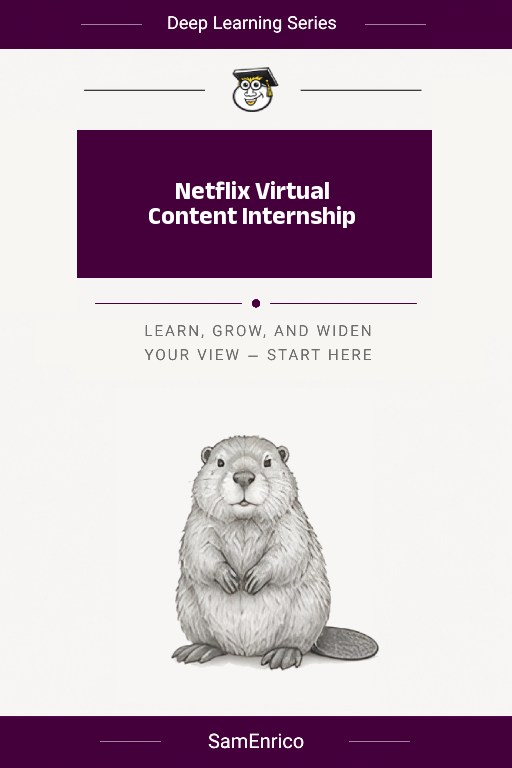
Non-FictionStudent's ShortcutMedia InternshipsContent Strategy
Netflix Virtual Content Internship eBook
Land a remote role with Netflix's content strategy
by Ford Virgil
Land a remote role with Netflix's content strategy team by building a recommendation analysis project and cultural memo.
Formats
Free sample
Chapter 1: No Rules, No Resume--Most candidates fail before they ever submit an application. Not because they lack skills, not because they lack ambition, but because they apply using the logic of every other company on earth. They write cover letters that ask for permission. They format resumes that list tasks instead of decisions. They wait for instructions that will never come.
And then they wonder why Netflix never calls back.This chapter is not about fixing your resume. It is about burning your old understanding of what a job application is and rebuilding it from first principles. Netflix operates on a radically different set of assumptions about work, authority, accountability, and failure. If you apply using traditional logic, you signal that you haven't done the homework. Worse, you signal that you need to be managed.
And at Netflix, needing to be managed is the single fastest way to be filtered out.Let me tell you something that will sound harsh but is actually liberating: Netflix does not want to teach you how to work. They want to hire someone who already knows. They do not want to tell you what to do. They want to see what you have already done. They do not want to read your plea for a chance.
They want to see your proof.This is the central thesis of this entire book, and it must land here, in Chapter 1, before we go anywhere else: You do not ask for permission at Netflix. You demonstrate. You do not request guidance. You show what you have already built. You do not explain why you deserve a chance.
You present the work that makes the chance obvious.Most business books about careers are built on a model of humility and deference. Send the thank-you note. Follow the application instructions perfectly. Wait your turn. Those books are written for companies that value obedience.
Netflix does not. Netflix values judgment, autonomy, and the ability to act without a net. The candidates who get hired are not the ones who followed the rules most carefully. They are the ones who proved they did not need rules in the first place.So let us begin by unlearning everything you think you know about job applications. And let us replace it with something far more useful: the cultural logic of Netflix, taught not as abstract philosophy but as a practical framework for every decision you will make in this process.The Evolution of a Culture Engine Netflix did not arrive at its famous culture by accident.
It was engineered deliberately, and it has evolved as the company grew from three hundred people to over fourteen thousand. Understanding this evolution matters because it reveals that the culture is not a static set of commandments. It is a living system that changes to solve the problems of scale.The original 2009 culture deck, titled "Freedom and Responsibility," became one of the most famous business documents of the twenty-first century. It was shared publicly, viewed millions of times, and praised by everyone from Sheryl Sandberg to Marc Benioff. The core idea was simple but radical: hire brilliant people, give them freedom, and hold them responsible for results.
No approval chains. No time tracking. No dress codes. No vacation policy. Just adults making good decisions.That deck worked brilliantly for a company of a few thousand people.
But as Netflix grew past ten thousand employees, something interesting happened. The leadership team realized that the original deck was being misinterpreted. Newer employees saw "Freedom and Responsibility" and heard "do whatever you want." They saw the absence of rules and assumed the absence of standards. That was never the intention.So in 2024 and 2025, Netflix released an updated Culture Memo. The new framework shifted from "Freedom and Responsibility" to "People Over Process." On the surface, this seems like a subtle change.
In practice, it is a fundamental recalibration.Here is what stayed the same: the belief that brilliant people do not need to be managed. Here is what changed: the explicit acknowledgment that freedom without clarity is chaos. The new memo is more prescriptive about what excellence looks like. It gives people more guidance about how to exercise their judgment. It does not add rules.
But it adds context.For candidates, this evolution has one crucial implication: you cannot just say you want freedom. You have to prove you understand what freedom is for. Freedom at Netflix is not the freedom to be lazy. It is the freedom to act on good judgment. And good judgment requires understanding the business, the user, the data, and the trade-offs.
The candidates who get hired are not the ones who say "I'm a self-starter." They are the ones who demonstrate that they have already started, already built, already decided, and already learned from what happened next.The Keeper Test: Risk, Failure, and the One Big Mistake The most famous element of Netflix culture is also the most misunderstood. The "Keeper Test" has been described in business media as ruthless, cold, and even cruel. Managers are asked: "If this person wanted to leave, would you fight to keep them?" If the answer is no, the person is given a generous severance and shown the door.That sounds terrifying. And it is intended to sound terrifying. But the reality is more nuanced and, for candidates, more useful.The 2024-2025 memo adds a second question to the Keeper Test: "Knowing everything I know today, would I hire this person again?" This second question is actually more revealing than the first.
You might fight to keep someone you have grown attached to, even if their performance is merely adequate. But it is much harder to convince yourself that you would hire them again from scratch, with the benefit of hindsight and no emotional attachment.Here is what the memo says explicitly, and this is worth memorizing: Netflix will "stick with employees through short-term bumps" and evaluate people on their "whole record, rather than focusing on the mistakes or bets that didn't pay off." This is not a license for perpetual mediocrity. But it is an acknowledgment that bold action produces occasional failure, and that punishing failure punishes boldness.This creates what I call the One Big Failure framework. Netflix tolerates a single large failure that comes from a well-reasoned, high-judgment bet. In fact, they may even celebrate it as a learning opportunity.
What they do not tolerate is a pattern of small failures that come from cautious, approval-seeking, indecisive behavior.Think about the difference. A product manager who launches an experiment that fails because the hypothesis was wrong but the methodology was sound—that person gets a high-five and a chance to run the next experiment. A product manager who asks permission for every small decision, escalates every problem, and never takes a risk—that person fails the Keeper Test even if nothing ever goes wrong.Why? Because Netflix is in the business of making hundreds of decisions every day. They cannot afford to have every decision routed through a manager.
They need people who can decide, act, and adapt without supervision. The person who never fails is probably the person who never decides anything meaningful. The person…
This is the end of the free sample. Get the eBook to keep going. Buy now
About this book
Details
- Author
- Ford Virgil
- Publisher
- SamEnrico
- Language
- English
- Genre
- Non-Fiction, Student's Shortcut, Media Internships, Content Strategy
- Released
- 2026-05-29
- Pages (approx.)
- 145
- Available as
- eBook, Audiobook

Read better in the ZLOADR app
Your eBooks on your phone or tablet. Sign in with your SamEnrico account and start reading.
More by Ford Virgil
 Academic Researcher Distraction GuideFord Virgil$11.99
 Listening Without Interrupting GuideFord Virgil$11.99
 Bipolar ECT GuideFord Virgil$11.99
 Small Talk for Doctors and NursesFord Virgil$11.99
 The Happiness FearFord Virgil$11.99
 IFTTT Reminder RecipesFord Virgil$11.99
 Study Myth BustingFord Virgil$11.99
 EQ for Negotiation SkillsFord Virgil$11.99
 The Sea Between UsFord Virgil$11.99
 The Scandal That Shook the Regency: The Secret Letters of Lady Caroline LambFord Virgil$11.99
 The Enlightenment's Arsenal: How Western Thinkers Defeated PlagueFord Virgil$11.99
 Gold Rush Ghosts: The Phantom Fortunes of the KlondikeFord Virgil$11.99
You may also like
 Hong Kong Handover 1997Dunn Johnnie$11.99
 Zumba For Postnatal Recovery CourseNeal Christian$11.99
 Zumba for BeginnersLadner Nikia$11.99
 YouTube Comment Mining GuideHumes Pandora$12.99
 Worry Box MeditationCarlin Rudy$11.99
 Workplace Stress MeditationNguyen Lynn$11.99
 Workplace Stress and Sleep RepairHawley Ivory$11.99
 Workplace Perfectionism CureDelaney Jeffry$11.99
 Workplace Injustice Anger GuideWallen Isabelle$11.99
 Work Addiction and Burnout LinkGreenwood Ester$11.99
 Women in Yoga and WellnessBeattie Galina$11.99
 Women in Stand Up ComedyChun Evangeline$11.99