
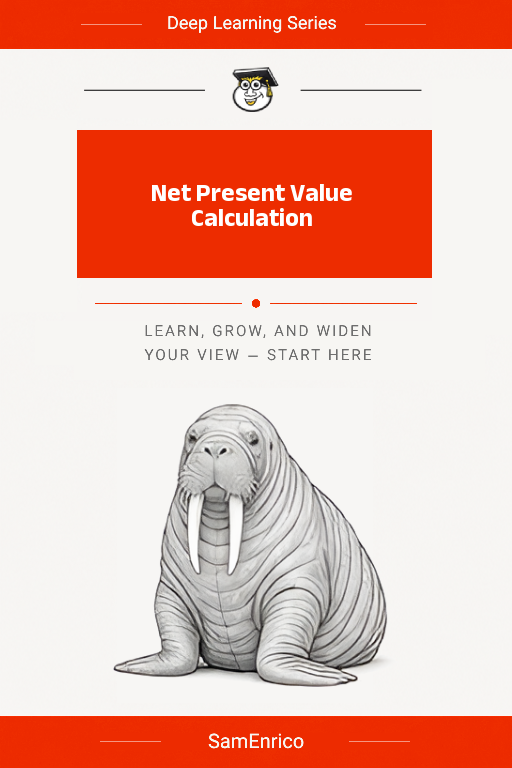
Net Present Value Calculation eBook
Discount future cash flows to present value and su
by Wetzel Angla
Discount future cash flows to present value and subtract initial investment, learning to accept projects with positive NPV.
Formats
Free sample
Chapter 1: The Million-Dollar Flaw--Every day, somewhere in the world, a smart, well-educated, experienced business leader makes a decision that destroys over a million dollars of shareholder wealth. They do not do this because they are incompetent. They do not do it because they are lazy or unethical. They do it because their brain is wired to prefer a dollar today over two dollars tomorrow, and no one ever taught them the simple mathematical cure.This chapter is that cure.Before we calculate a single number, before we open Excel or pick up a financial calculator, we must understand a truth so fundamental that most finance textbooks bury it in formulas and forget to emphasize its raw, practical power: A dollar today is worth more than a dollar tomorrow. Not because of inflation, though inflation matters.
Not because of risk, though risk matters. But because of a single, unassailable fact: if you have a dollar today, you can invest it and turn it into more than a dollar tomorrow. The person who promises you a dollar tomorrow is asking you to give up that opportunity. And unless they compensate you for it, you are being robbed.The Parable of the Two Business Partners Let me tell you a story. It is a true story, though the names have been changed.In 2007, two partners, Maria and James, ran a successful mid-sized manufacturing company.
They had an opportunity to purchase a new production line for 2million.Themachinewouldgenerate2 million. The machine would generate 2million.Themachinewouldgenerate600,000 in additional annual profit for five years. James, the operations-focused partner, did the math in his head: 600,000timesfiveyearsequals600,000 times five years equals 600,000timesfiveyearsequals3 million. Subtract the 2millioncost,andyouget2 million cost, and you get 2millioncost,andyouget1 million in profit. "It's a million-dollar winner," he told Maria.
"Let's buy it."Maria, who had taken a single finance course twenty years earlier, hesitated. "What about the time value of money?" she asked.James waved his hand dismissively. "That's academic nonsense. Money is money. A dollar is a dollar."They bought the machine.
Five years later, they had indeed received 3millionincash.But Mariacouldnotshakethefeelingthatsomethingwaswrong.Shehiredafinancialanalysttoreviewthedecision.Theanalystcalculatedtheactualreturn,accountingforthefactthatthe3 million in cash. But Maria could not shake the feeling that something was wrong. She hired a financial analyst to review the decision. The analyst calculated the actual return, accounting for the fact that the 3millionincash.But Mariacouldnotshakethefeelingthatsomethingwaswrong.Shehiredafinancialanalysttoreviewthedecision.Theanalystcalculatedtheactualreturn,accountingforthefactthatthe600,000 received in year five was worth far less than the 600,000receivedinyearone.Usingareasonablecostofcapitalof10600,000 received in year one. Using a reasonable cost of capital of 10%, the analyst determined that the present value of the 600,000receivedinyearone.Usingareasonablecostofcapitalof103 million stream was actually 2.27million.Subtractthe2.27 million.
Subtract the 2.27million.Subtractthe2 million investment, and the true economic profit was 274,000—not274,000—not 274,000—not1 million.The machine had created value, but only a quarter of what James had thought. Worse, the analyst discovered that if the cost of capital had been 12% instead of 10%—a reasonable adjustment given the industry's risk—the project would have destroyed value. James had gotten lucky. He had accepted a project that barely cleared the bar, believing it was a home run."I cannot tell you how many clients I have seen make this exact mistake," the analyst told them. "They add up future cash flows as if a dollar in year five is the same as a dollar today.
Then they compare that sum to the initial investment. And they call it profit."That sum is called the nominal sum or the undiscounted total. It is not profit. It is not even a real number for decision-making purposes. It is an illusion.The Two Drivers of Time Value Why is a future dollar worth less than a present dollar?
Textbooks often give you three reasons: opportunity cost, inflation, and risk. But inflation, while important, is not fundamental to the concept of time value. Inflation is a specific economic condition that can be zero or even negative (deflation) in some periods. Opportunity cost and risk, however, are universal and inescapable. They apply in every economy, in every currency, in every time period.Opportunity cost is the returns you forgo by not having money available to invest elsewhere.
If you lend me 100todayand Ipromisetoreturn100 today and I promise to return 100todayand Ipromisetoreturn100 in one year, you have lost the opportunity to invest that 100inagovernmentbondthatpays5100 in a government bond that pays 5%. I have effectively taken 100inagovernmentbondthatpays55 from your pocket—not literally, but economically. To make you whole, I must pay you at least the risk-free rate of return. Anything less, and you are subsidizing me.This is not a theoretical nicety. It is the basis for every interest rate, every bond yield, every stock return in human history.
The opportunity cost of capital is the single most important number in finance, because it represents the minimum return an investment must generate to not destroy value.Risk is the uncertainty that future cash flows will materialize as promised. A government bond has near-zero risk of default. A loan to your cousin's startup has very high risk. The discount rate—the number we use to bring future cash flows back to the present—must increase with risk. A safe project might be discounted at 5%.
A risky venture might require 25% or more. If you discount a risky project at a safe rate, you will wildly overstate its value and accept projects that should be rejected.Here is the crucial insight that separates professionals from amateurs: these two drivers work together. Opportunity cost sets the floor (the risk-free rate). Risk adds a premium on top. The total discount rate is the sum of the risk-free rate and the risk premium.
You cannot use the same discount rate for a bond and a biotech startup. Yet this is exactly what many managers do, using their company's weighted average cost of capital (WACC) for every project regardless of risk. That is a recipe for disaster.The Golden Rule That Changes Everything Now we arrive at the single most important sentence in this book. Memorize it. Write it on a sticky note and put it on your monitor.
Carve it into your desk if you must:Net Present Value = Present Value of Future Cash Flows – Initial Investment.From this simple equation emerges the Golden Rule of Finance:If NPV > 0, accept the project. It creates value.If NPV < 0, reject the project. It destroys value.If NPV = 0, you are indifferent. The project earns exactly the required return.That is it. That is the entire decision rule.
Everything else in this book—every formula, every spreadsheet, every advanced technique—exists to help you calculate these three numbers correctly.Notice what the Golden Rule does not say. It does not say "accept if the project feels profitable." It does not say "accept if you have done similar projects before." It does not say "accept if the payback period is less than three years." It does not say "accept if the internal rate of return is higher than the company's hurdle rate." All of those are shortcuts. Some are harmless. Most are dangerously misleading. Many have destroyed billions of dollars of wealth.I will prove this to you with a simple example.The Coffee Shop Fallacy Imagine you are considering opening a coffee shop.
You estimate the following:Initial investment (equipment, renovations, deposits): $100,000Annual net cash flow (after all expenses and taxes): $30,000Project life: 5…
This is the end of the free sample. Get the eBook to keep going. Buy now
About this book
Details
- Author
- Wetzel Angla
- Publisher
- SamEnrico
- Language
- English
- Genre
- Non-Fiction, Student's Shortcut
- Released
- 2026-06-01
- Pages (approx.)
- 157
- Available as
- eBook, Audiobook

Read better in the ZLOADR app
Your eBooks on your phone or tablet. Sign in with your SamEnrico account and start reading.
More by Wetzel Angla
 The Villain Voice BehindWetzel Angla$11.99
 Stress and Chronic SinusitisWetzel Angla$11.99
 The Growth Mindset for Social SkillsWetzel Angla$11.99
 Morning Pages for CreativesWetzel Angla$11.99
 Lower Pay Acceptance GuideWetzel Angla$11.99
 Debt Paydown Schedule ModelingWetzel Angla$11.99
 Dating Confidence for SeniorsWetzel Angla$11.99
 The Golden Ledger: A Love Story in NumbersWetzel Angla$11.99
 The Last Transmission: The Titanic's Final BroadcastWetzel Angla$11.99
 A Collector's Handbook to the Turner Mk IiWetzel Angla$11.99
 Whistleblower Protection Risks ManualWetzel Angla$12.99
 How to Produce Costume Special EffectsWetzel Angla$11.99
You may also like
 Hong Kong Handover 1997Dunn Johnnie$11.99
 Zumba For Postnatal Recovery CourseNeal Christian$11.99
 Zumba for BeginnersLadner Nikia$11.99
 YouTube Comment Mining GuideHumes Pandora$12.99
 Worry Box MeditationCarlin Rudy$11.99
 Workplace Stress MeditationNguyen Lynn$11.99
 Workplace Stress and Sleep RepairHawley Ivory$11.99
 Workplace Perfectionism CureDelaney Jeffry$11.99
 Workplace Injustice Anger GuideWallen Isabelle$11.99
 Work Addiction and Burnout LinkGreenwood Ester$11.99
 Women in Yoga and WellnessBeattie Galina$11.99
 Women in Stand Up ComedyChun Evangeline$11.99