
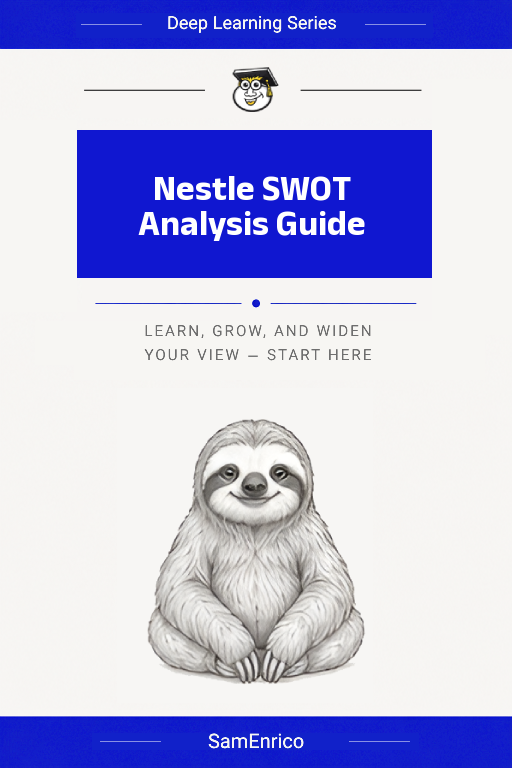
Non-FictionStrategic AtlasFood
Nestle SWOT Analysis Guide
Analyze food portfolio breadth, pet care growth, w
Analyze food portfolio breadth, pet care growth, water business divestiture, and health perception shifts.
Formats
About this book
Free sample
Chapter 1: The Great Rationalization--The year is 2025. Nestlé, the world's largest food and beverage company, is in the middle of the most radical portfolio transformation in its 158-year history. Under CEO Philipp Navratil, the company is slashing more than 250 brands from its sprawling roster—reducing its portfolio from nearly 400 brands to approximately 150. This is not a slow death by a thousand cuts. This is strategic amputation performed with surgical precision.
Ice cream is being carved out via the Froneri joint venture. The legendary water business—Perrier, S.Pellegrino, Vittel—is being sold off in pieces. Legacy confectionery brands are being divested or de-emphasized. What remains is a leaner, sharper, more deliberate company built on just four strategic pillars: Coffee, Pet Care, Nutrition, and Food/Snacks.For decades, Nestlé’s strategy was one of benevolent sprawl. If a food or beverage category existed, Nestlé wanted to be in it—or at least own a brand that competed in it.
The logic was simple: diversification reduces risk. If coffee had a bad year, ice cream would carry the quarter. If frozen meals slumped, chocolate would compensate. This conglomerate model worked beautifully for most of the 20th century and the first two decades of the 21st. Nestlé grew into a CHF 90 billion giant with operations in 186 countries, a portfolio that touched everything from infant formula to pizza, from bottled water to veterinary diets.But somewhere around 2023, the model broke.
The costs of sprawl began to exceed the benefits of diversification. Supply chain complexity ballooned. Retail negotiations became endless, with hundreds of brands competing for the same finite shelf space. Management attention fragmented across categories that had little in common operationally or strategically. And perhaps most damagingly, Nestlé’s critics—from activist investors to ESG rating agencies—began to ask a question that the company could no longer answer convincingly: What do you actually stand for?The Thesis of This Chapter This chapter argues that breadth without coherence is a liability, not a strength.
Nestlé’s decision to slash 250 brands is not an admission of weakness. It is a strategic discipline—a recognition that focus is…
This is the end of the free sample. Get the eBook to keep going. Buy now
Contents
- Chapter 1
- Chapter 2
- Chapter 3
- Chapter 4
- Chapter 5
- Chapter 6
- Chapter 7
- Chapter 8
- Chapter 9
- Chapter 10
- Chapter 11
- Chapter 12
Details
- Author
- Belanger Afton
- Publisher
- SamEnrico
- Language
- English
- Genre
- Non-Fiction, Strategic Atlas, Food
- Released
- 2026-05-30
- Pages (approx.)
- 146
- Available as
- eBook, Audiobook

Read better in the ZLOADR app
Your eBooks on your phone or tablet. Sign in with your SamEnrico account and start reading.
More by Belanger Afton
 RNA Vaccine Future ProspectsBelanger Afton$11.99
 TM And Religion Compatibility GuideBelanger Afton$11.99
 Yahoo's Oath Brand DamageBelanger Afton$11.99
 Self Esteem After Partner's SuccessBelanger Afton$11.99
 Remote Team EQ ManagementBelanger Afton$11.99
 The Maestro of Medicine: Ignaz Semmelweis and the Birth of Antiseptic SurgeryBelanger Afton$11.99
 Understanding Myasthenia Gravis CongenitalBelanger Afton$17.99
 AI Financial Data Backup GuideBelanger Afton$12.99
 A 3-Part Series Each Part the Length of an Election Cycle's Final PushBelanger Afton$11.99
 How to Start a Mushroom Growing (cultivated) Business (Beginners Guide)Belanger Afton$11.99
You may also like
 Hong Kong Handover 1997Dunn Johnnie$11.99
 Zumba For Postnatal Recovery CourseNeal Christian$11.99
 Zumba for BeginnersLadner Nikia$11.99
 YouTube Comment Mining GuideHumes Pandora$12.99
 Worry Box MeditationCarlin Rudy$11.99
 Workplace Stress MeditationNguyen Lynn$11.99
 Workplace Stress and Sleep RepairHawley Ivory$11.99
 Workplace Perfectionism CureDelaney Jeffry$11.99
 Workplace Injustice Anger GuideWallen Isabelle$11.99
 Work Addiction and Burnout LinkGreenwood Ester$11.99
 Women in Yoga and WellnessBeattie Galina$11.99
 Women in Stand Up ComedyChun Evangeline$11.99