
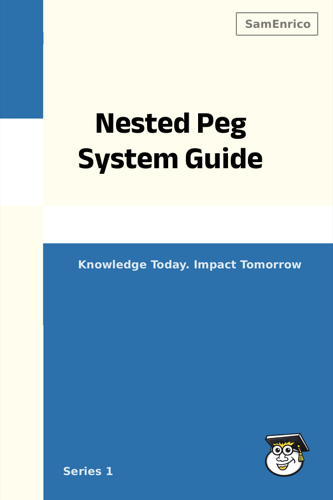
Nested Peg System Guide eBook
Place pegs inside other pegs for hierarchical memo
by Ward Earnest
Place pegs inside other pegs for hierarchical memory organization and detail.
Formats
Free sample
Chapter 1: The Memory Ceiling...–- You have already hit your memory ceiling. You just do not know it yet.Think about the last time you tried to memorize something genuinely complex. Not a grocery list of twelve items. Not a phone number you repeated under your breath until it stuck. Not even the bullet points for a work presentation.
Think about something truly layered—a legal statute with exceptions nested inside exceptions. A medical diagnosis tree where one symptom leads to five possibilities, each with three contraindications. The plot of a 500-page novel with seventeen characters, each with their own backstory and relationships.What happened?If you are like most people, you probably did one of three things. First, you tried repetition: reading the same passage over and over until your eyes glazed over. Second, you attempted to create a story or a mnemonic, but found that by the tenth item, the story became so convoluted that you forgot the beginning by the time you reached the end.
Third, you simply gave up and decided that some information is "just too much to memorize."None of these outcomes is your fault. You have been trained to use the wrong tools for the job.This book exists because of a simple, startling observation that took me ten years to fully understand: the standard memory techniques taught in every best-selling memory book work beautifully for flat lists but collapse entirely when faced with hierarchical information. And most of the information you actually need to remember in professional, academic, or technical settings is not flat. It is hierarchical.Let me prove this to you right now.The Twelve-Item Test Take sixty seconds to memorize the following list in order. Use any technique you want—repetition, visualization, a story, whatever comes naturally.Milk Bread Eggs Butter Apples Chicken Rice Onions Garlic Cheese Tomatoes Lettuce I will wait.If you have read any memory book before, you probably visualized a story: a carton of milk pouring over bread, which was squished into eggs, which rolled into butter, which fell onto apples, and so on.
That works beautifully. You can probably recall all twelve items right now with minimal effort.Now try this instead. Take sixty seconds to memorize the following information, which contains exactly the same number of discrete facts but organized hierarchically.The Human Digestive System (Simplified):Mouth – contains teeth (for mechanical breakdown) and saliva (contains amylase, which breaks down starches)Esophagus – uses peristalsis (rhythmic muscle contractions) to move food to stomach Stomach – contains gastric juices (hydrochloric acid and pepsin, which breaks down proteins) – food stays here for 2-4 hours – produces chyme (semi-liquid mixture)Small Intestine – divided into three parts: duodenum (receives bile and pancreatic juices), jejunum (absorption of nutrients), ileum (absorption of vitamin B12 and bile salts) – contains villi and microvilli (increase surface area for absorption)Large Intestine – absorbs water and electrolytes – houses gut bacteria (produce vitamin K and some B vitamins) – stores feces in rectum before elimination What happened this time? If you tried the same story method, you probably found that the linear narrative collapsed under its own weight. You cannot tell a story where a tooth turns into an enzyme that turns into a muscle contraction that turns into hydrochloric acid that turns into three parts of an intestine.
The information is not linear. It is nested. Teeth are inside the mouth. The duodenum is inside the small intestine. Amylase is inside saliva, which is inside the mouth.
This is a tree structure, not a chain.And that is the problem that this book solves.Why Standard Peg Systems Hit a Ceiling Before we can build a nested peg system, we must understand exactly where the standard systems stop working. Every major memory book teaches some variation of the peg system—associating numbers with concrete images. Chapter 2 of this book will walk you through the shape pegs (1 = candle, 2 = swan, 3 = handcuffs) and the rhyme pegs (1 = bun, 2 = shoe, 3 = tree). Chapter 3 will introduce alphabet pegs and the Major System for 00-99.These systems are genuinely powerful for what they do. A person with a well-developed set of 100 pegs can memorize a list of 100 random nouns in under twenty minutes and recall them forward, backward, and at random.
That is an astonishing feat of human memory, and if you master nothing else from this book, mastering those foundational pegs will already put you in the top 1% of memorizers.But here is the limitation that no one tells you about.A standard peg system gives you one slot per number. Peg 1 holds one image. Peg 2 holds one image. Peg 3 holds one image. If you want to store the fact that the mouth contains teeth and also contains saliva, you cannot put both inside Peg 17.
You would need two separate pegs. And if you want to store the fact that saliva contains amylase, you would need a third peg. And if you want to store the fact that amylase breaks down starches, you would need a fourth peg.You see the problem. A flat peg system treats every discrete fact as equal, which means it explodes in size when faced with a hierarchical structure. The digestive system example above contains approximately 25 discrete facts.
A standard peg system would require 25 pegs to store them. That is fine for a single small topic. But a typical medical textbook chapter contains hundreds of facts. A legal code contains thousands. A technical manual for a complex machine contains tens of thousands.You cannot memorize tens of thousands of discrete pegs.
No one can. The cognitive load of maintaining 10,000 distinct images is impossible.What you can do is memorize a hierarchy of pegs—a small number of master pegs, each containing a moderate number of sub-pegs, each containing a small number of sub-sub-pegs. This is the nested peg system.The Architecture of Nesting Let me give you a preview of what you will learn in this book. By Chapter 6, you will be able to take the digestive system example and store it using exactly five master pegs instead of twenty-five discrete slots.Here is how it works at a high level.First, you assign a master peg to the entire digestive system. Using the shape system from Chapter 2, Peg 4 is a sailboat.
You imagine a sailboat floating in a sea of stomach acid. That is your anchor—every time you think "digestive system," you see that sailboat.Inside that sailboat, you place three sub-pegs for the three main stages: mouth, esophagus, and stomach. But wait—the small intestine and large intestine also exist. So actually, you need five sub-pegs. Using the abstract nesting technique from Chapter 6, you create Peg 4-1 (mouth), Peg 4-2 (esophagus), Peg 4-3 (stomach), Peg 4-4 (small intestine), and Peg 4-5 (large intestine).Now, each of those sub-pegs contains further detail.
Peg 4-1 (mouth) contains two sub-sub-pegs: Peg 4-1-1 (teeth) and Peg 4-1-2 (saliva). Peg 4-1-2 (saliva) contains Peg 4-1-2-1 (amylase). Peg 4-1-2-1 (amylase) contains Peg 4-1-2-1-1 (breaks down starches).You have just stored twenty-five discrete facts using only five master pegs. The total number of distinct images you needed to create was five (the master sailboat) plus a few dozen sub-images—but crucially, those sub-images are not competing for…
This is the end of the free sample. Get the eBook to keep going. Buy now
About this book
Details
- Author
- Ward Earnest
- Publisher
- SamEnrico
- Language
- English
- Genre
- Non-Fiction, Self-Help
- Released
- 2026-06-07
- Pages (approx.)
- 145
- Available as
- eBook, Audiobook

Read better in the ZLOADR app
Your eBooks on your phone or tablet. Sign in with your SamEnrico account and start reading.
More by Ward Earnest
 Remote Review Language PhrasebookWard Earnest$11.99
 Stress And Nail Biting DamageWard Earnest$11.99
 Biotech Capital Deployment ForecastWard Earnest$11.99
 Trigger Self Care After ActivationWard Earnest$11.99
 The Last Voyage of the Flying Dutchman: A Ghost Ship’s CurseWard Earnest$11.99
 Understanding Parainfluenza Virus Type 3 Antenatal InfectionWard Earnest$17.99
 How to Start a Paint and Coating Manufacturing BusinessWard Earnest$11.99
 Executive Mentor LinkedIn GuideWard Earnest$12.99
 Technology Sector ESG BenchmarkWard Earnest$12.99
 Electron Beam Sterilization ValidationWard Earnest$11.99
You may also like
 Workplace Stress MeditationNguyen Lynn$11.99
 Volcano Monitoring ScientistCox Alexis$11.99
 The Tech Professional NetAguiar Nevada$11.99
 The Morning Metta RitualCanales Anya$11.99
 The Chunking Memory TechniqueClanton Hyacinth$11.99
 The Beginner Mistake FixAmmons Cassondra$11.99
 Surrendering to What IsGrimm Reatha$11.99
 Self Hypnosis for Fear of FireBillups Eli$11.99
 Road Rage for Professional DriversBrackett Janise$11.99
 Psychiatric Ward Nurse StressDunning Wyatt$11.99
 Observation vs Evaluation NVCTimmons Alda$11.99
 Networking for Nonprofit ProfessionalsPoole Jesse$11.99