
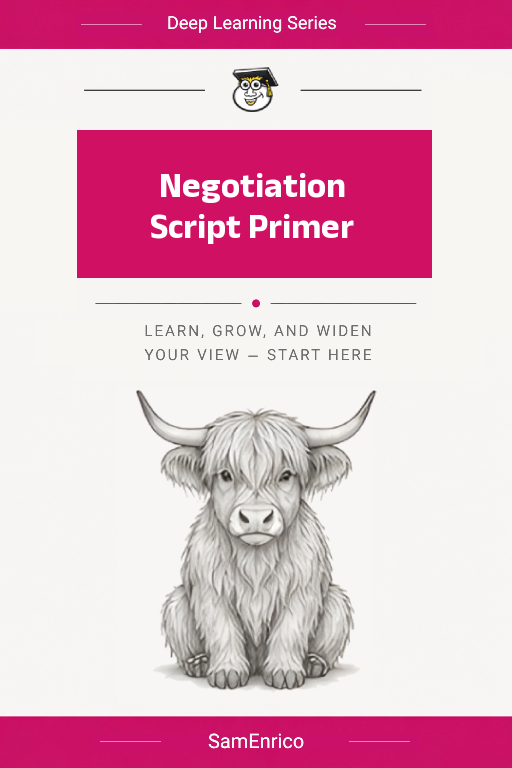
Non-FictionFirst 30 DaysNegotiation
Negotiation Script Primer eBook
Negotiate price and terms using scripts for anchor
by Lerner Randy
Negotiate price and terms using scripts for anchoring, conceding, and closing.
Formats
Free sample
Chapter 1: The $47,000 Stutter---– The first time I lost money because I didn’t have a script, I was twenty-four years old, sitting across from a vendor who smelled fear the way a shark smells blood. His name was Gary, and he sold software that my startup desperately needed. I had done no research. I had no walkaway price. I had no script.
When he said “thirty-eight thousand dollars,” I heard myself say “okay” before my brain could stop my mouth. Later that night, I found a competitor offering the exact same product for nineteen thousand. I had overpaid by nineteen thousand dollars on a single deal. That was the first time. The second time was worse.
The third time, I stopped counting. By the time I started tracking my losses, I had given away approximately forty-seven thousand dollars across seven years of negotiations—not because I was stupid, not because I was weak, but because I kept believing the myth that great negotiators are born, not built.That myth is a lie. And it is an expensive one.This book exists because forty-seven thousand dollars is the price I paid for spontaneity. You will pay less—or more, depending on how quickly you embrace what follows. The difference between losing and winning in any price conversation is not charisma, intelligence, or quick thinking.
The difference is a piece of paper with words on it. A script. Something you wrote down beforehand so that when your heart rate spikes and the other person names a number that makes your stomach drop, you do not have to invent a response from thin air. You simply read the next line.Every successful negotiator you have ever admired uses scripts. The ones who claim they don’t are either lying or have internalized their scripts so deeply that the words feel like instinct.
But instinct is just memorized pattern recognition. And memorized patterns come from repetition, not from magic. This book gives you the patterns. Your job is to repeat them until they become yours.Before we go any further, let me tell you what this chapter will do. It will demolish the myth of the natural negotiator.
It will explain why your brain actively works against you during price conversations. It will introduce you to the psychological forces that shape every negotiation—forces you cannot see but can certainly script for. And it will give you your first script: the internal statement that separates people who overpay from people who walk away. By the end of this chapter, you will understand why spontaneity is a tax on the unprepared, and you will have a tool that immediately changes how you show up to any price conversation.Let us begin with the science of why your mouth moves faster than your mind.The Cognitive Load Trap Your working memory is a bottleneck. Psychologists have known this since George Miller published his famous paper “The Magical Number Seven, Plus or Minus Two” in 1956.
The human brain can hold approximately seven discrete pieces of information in conscious awareness at any given moment. When you are calm, sitting at your desk, with no stakes and no pressure, seven slots feel like plenty. You can think about price, terms, delivery, quality, relationship, alternatives, and timing—all at once.Now put yourself across a table from someone who just named a number twice your budget. Your heart rate jumps. Your palms sweat.
Your brain, interpreting this as a threat, redirects resources away from your prefrontal cortex (responsible for complex reasoning) and toward your amygdala (responsible for fight or flight). Suddenly, your seven slots shrink to three. Maybe two. You can feel yourself losing the ability to hold multiple variables in your head. You forget your BATNA.
You forget your walkaway price. You forget that you planned to ask for a concession on payment terms. All you can think about is the number they just said and the number you wanted, and the gap between them feels like a canyon you have to cross with a single sentence.This is cognitive load. And it is the single greatest enemy of successful negotiation.When your working memory is overloaded, you default to one of three behaviors: you concede (to escape the pressure), you freeze (saying nothing, which feels humiliating), or you react emotionally (“that’s ridiculous,” which burns the relationship). None of these outcomes serve you.
Each one is a direct consequence of trying to think on your feet in a high-stakes moment.Scripts solve cognitive load. Not because scripts are magical incantations, but because scripts outsource your decision-making to a previous version of yourself—the version who was calm, who had time, who could think through all seven slots without a sweating forehead. When you have a script, you do not need to invent. You do not need to calculate. You simply execute.
The script holds the strategy so your brain can focus on listening, observing, and adapting.Here is a metaphor that will stick with you: Imagine driving a car in heavy rain at night. If you had to consciously think about every micro-adjustment of the steering wheel, every pressure change on the gas pedal, every mirror check, you would crash within a minute. But you do not think about those things. You have automated them through repetition. Driving feels like instinct, but it is actually a script—a deeply internalized sequence of responses to predictable inputs.
Negotiation is exactly the same. The only difference is that most people never bother to internalize the scripts. They show up to the rainstorm having never practiced driving at all.The Three Pillars of Every Price Conversation Every negotiation over price and terms rests on three structural moments. Miss any one of them, and you leave money on the table. The entire book is organized around these three pillars, so let me define them clearly now.The first pillar is anchoring.
Anchoring is the act of naming the first number. That number, whether reasonable or ridiculous, becomes a psychological magnet. Every subsequent number is compared to it. If you name a high anchor, the final price will drift upward. If you let the other person anchor first, their number becomes the gravitational center of the entire conversation.
Anchoring is not optional. Either you do it intentionally, or it is done to you.The second pillar is conceding. Conceding is the act of giving ground on price or terms. Most people treat concessions as defeats—moments when they lost something. That framing is toxic.
Concessions are not defeats; they are tools. But like any tool, they can be used well or poorly. A strategic concession is small, labeled, reciprocal, and conditional. A desperate concession is large, unlabeled, unilateral, and unconditional. This chapter will teach you the difference.
Later chapters will give you exact scripts for each type.The third pillar is closing. Closing is the act of securing commitment. Most negotiations fall apart not because the parties disagree on price, but because neither person knows how to say “this is the moment we decide.” Closing scripts remove ambiguity. They assume the deal is done and ask only about the logistics of the agreement. Without…
This is the end of the free sample. Get the eBook to keep going. Buy now
About this book
Details
- Author
- Lerner Randy
- Publisher
- SamEnrico
- Language
- English
- Genre
- Non-Fiction, First 30 Days, Negotiation
- Released
- 2026-06-01
- Pages (approx.)
- 152
- Available as
- eBook, Audiobook

Read better in the ZLOADR app
Your eBooks on your phone or tablet. Sign in with your SamEnrico account and start reading.
More by Lerner Randy
 Remote Work Evenings Off GuideLerner Randy$11.99
 Resentment Release Daily GuideLerner Randy$11.99
 The Deep Squat MobilityLerner Randy$11.99
 Plant Based Lectin Concerns ManualLerner Randy$11.99
 James Buchanan Dithering DecadeLerner Randy$11.99
 Love in the Time of Cold War: The Kennedy-Khrushchev SummitLerner Randy$11.99
 Understanding Crystal Deposit DiseaseLerner Randy$17.99
 Transaction Management AnalystLerner Randy$11.99
 IP Deadline Management ToolsLerner Randy$12.99
 How to Become a ScraperLerner Randy$11.99
You may also like
 Hong Kong Handover 1997Dunn Johnnie$11.99
 Zumba For Postnatal Recovery CourseNeal Christian$11.99
 Zumba for BeginnersLadner Nikia$11.99
 YouTube Comment Mining GuideHumes Pandora$12.99
 Worry Box MeditationCarlin Rudy$11.99
 Workplace Stress MeditationNguyen Lynn$11.99
 Workplace Stress and Sleep RepairHawley Ivory$11.99
 Workplace Perfectionism CureDelaney Jeffry$11.99
 Workplace Injustice Anger GuideWallen Isabelle$11.99
 Work Addiction and Burnout LinkGreenwood Ester$11.99
 Women in Yoga and WellnessBeattie Galina$11.99
 Women in Stand Up ComedyChun Evangeline$11.99