
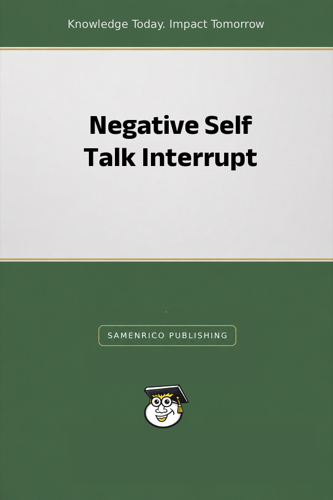
Negative Self Talk Interrupt eBook
Catch and replace critical inner voices using cogn
by Kraus Aliza
Catch and replace critical inner voices using cognitive restructuring.
Formats
Free sample
Chapter 1: The Voice That Pays No Rent--The worst tenant you will ever have is already living inside your head, and you have never once asked it to leave.It moved in sometime during your childhood—perhaps earlier, perhaps later—without a lease, without a deposit, and without your permission. It speaks to you in a voice that sounds like your own, which is precisely why you have always believed it. It tells you that you are not enough, that you are falling behind, that everyone else has figured out something you have not. It wakes you at 2:00 AM to review every mistake you made in the past decade. It interrupts your successes with a quiet whisper: That was luck.
You will be found out soon. It narrates your failures with a smug satisfaction: See? I told you so.This voice has a name. Psychologists call it the inner critic. Neuroscientists call it the default mode network.
Ancient Stoics called it the prohairesis gone wrong. But here is what you need to call it: a squatter.A squatter is someone who occupies a property without legal right, pays no rent, follows none of your rules, and damages the furniture. Your inner critic is exactly that. It has taken up residence in the most valuable real estate you will ever own—your conscious awareness—and it has convinced you that it belongs there. Worse, it has convinced you that it is protecting you.
It says, If I weren't here to criticize you, you would become lazy, arrogant, and complacent. It says, My harshness is what keeps you motivated. It says, You need me.Everything in that sentence is a lie.The Great Paradox: Why Your Brain Built a Bully Let us begin with a paradox that will either relieve you or enrage you, depending on how long you have been listening to this voice. Here it is: Your inner critic is not a flaw. It is a feature.
It is not a sign that you are broken, weak, crazy, or uniquely damaged. It is a sign that your brain is doing exactly what evolution designed it to do—scanning for threats—but in a modern world where the threats are no longer predators in the bushes but instead social rejection, career failure, and identity collapse.To understand this, you need to meet your brain's default mode network, or DMN. The DMN is a collection of interconnected brain regions—the medial prefrontal cortex, the posterior cingulate cortex, and the angular gyrus, among others—that becomes active precisely when you are not focused on an external task. When you are washing dishes, walking to the train, lying in bed unable to sleep, or staring out a window, your DMN lights up like a Christmas tree. Its job, evolutionarily speaking, was to keep you alive by simulating possible futures.
Is that rustle in the bushes a predator? Should I save more food for winter? Does that person in the tribe intend to harm me?Your ancestors who had a more active DMN were more likely to survive because they worried enough to prepare. Your ancestors who were blissfully unconcerned about tomorrow were eaten by wolves. You are the descendant of chronic worriers.
Congratulations.Here is the problem. The modern world does not have predators in the bushes. But your DMN does not know that. It is running ancient software on modern hardware. So it takes the same threat-detection machinery and turns it inward.
Instead of scanning the environment for external threats, it scans your self-concept for internal threats. Did I say something stupid in that meeting? Does my partner secretly resent me? Am I as competent as people think? What if I lose my job?
What if I die alone?This inward-turning threat detection is what psychologist Ethan Kross, in his groundbreaking research on the subject, calls chatter. Chatter is the循环, negative, self-focused rumination that fills the gaps between your focused tasks. Chatter is the voice that wakes you at 2:00 AM. Chatter is the voice that reviews your social mistakes in excruciating detail. Chatter is the voice that tells you that you are not good enough, smart enough, thin enough, rich enough, or loved enough.And here is the cruelest part of the paradox: the more you try to suppress chatter, the louder it becomes.
Research by Daniel Wegner at Harvard demonstrated what he called the "ironic process theory": when you try not to think of a white bear, you cannot stop thinking of a white bear. When you try to silence your inner critic, you give it more attention, and attention is the fuel it burns. You cannot win a war against your own brain by fighting it head-on. You have to outsmart it.Constructive Self-Evaluation vs. Destructive Chatter Before we go any further, we need to draw a line that most self-help books erase entirely.
Not all self-directed critical thinking is bad. In fact, some of it is essential. The ability to evaluate your own performance, identify areas for improvement, and adjust your behavior accordingly is a hallmark of emotional intelligence and cognitive flexibility. Let us call this constructive self-evaluation.Constructive self-evaluation sounds like this:I need to prepare more thoroughly for client meetings. My last presentation had gaps in the data.I was short with my partner tonight.
I was tired, but that is not an excuse. I will apologize in the morning.That project did not go as planned. Let me review what I could have done differently.Notice the features of constructive self-evaluation. It is specific (not "I am bad at everything" but "my last presentation had gaps"). It is time-bound (not "I always fail" but "that project did not go as planned").
It leads to action (not rumination but "I will apologize" or "let me review"). And crucially, it does not attack your identity. It addresses your behavior.Now let us contrast that with destructive chatter. Destructive chatter sounds like this:I am such an idiot. Everyone in that meeting knew I was unprepared.
I am a fraud.I am a terrible partner. I do not deserve love. I ruin everything.I cannot do anything right. Why do I even try?Notice the features of destructive chatter. It is global ("I am an idiot" instead of "I made an error").
It is permanent ("I always fail" instead of "that project failed"). It leads to paralysis (rumination instead of action). And it attacks your identity ("I am a fraud," "I am terrible").The difference between constructive self-evaluation and destructive chatter is the difference between a coach who wants you to improve and a bully who wants you to feel small. Constructive self-evaluation is useful. Destructive chatter is not.
And yet, for most people, the inner critic does not know how to do constructive self-evaluation. It only knows how to bully. It was never taught another way.This entire book is the instruction manual for teaching it another way.The 3-Second Rule: Your First Interrupt If you cannot stop the voice from starting, and if fighting it only makes it louder, what can you do?The answer is simpler than you think, and it is the foundation of everything that follows in this book.…
This is the end of the free sample. Get the eBook to keep going. Buy now
About this book
Details
- Author
- Kraus Aliza
- Publisher
- SamEnrico
- Language
- English
- Genre
- Non-Fiction, Self-Help, Cognitive Behavioral
- Released
- 2026-06-09
- Pages (approx.)
- 149
- Available as
- eBook, Audiobook

Read better in the ZLOADR app
Your eBooks on your phone or tablet. Sign in with your SamEnrico account and start reading.
More by Kraus Aliza
 The Turning the Mind GuideKraus Aliza$11.99
 Daily Shutdown RitualKraus Aliza$11.99
 Cocaine Anonymous ExplainedKraus Aliza$11.99
 Sales Presentation TechniquesKraus Aliza$11.99
 Alcohol Detox MedicationsKraus Aliza$11.99
 Jimmie Durham Artist ActivistKraus Aliza$11.99
 Identity Based Habits GuideKraus Aliza$11.99
 The Last Masterpiece: How a Forgotten Genius Outbid the WorldKraus Aliza$11.99
 The Art of War: Alexander the Great's Strategic GeniusKraus Aliza$11.99
 How to Produce Eggshell Alkyd Interior PaintKraus Aliza$11.99
 A Collector's Handbook to the Hupmobile Aerodynamic 8Kraus Aliza$11.99
 Time Blocking Performance MetricsKraus Aliza$12.99
You may also like
 Workplace Cognitive DistortionsFrancisco Thi$11.99
 The Anger Antecedent ChecklistDumas Gaylord$11.99
 Mindfulness Based Stress Reduction WorkbookTibbs Delisa$11.99
 Imposter Thoughts JournalMccloud Zulema$11.99
 Disappointment Proof MindsetLemus Waltraud$11.99
 Negative Self Talk Rewiring GuideByrne Sulema$11.99
 Fear Of Failure Origins GuideCloud Elli$11.99
 Rewiring Negative Self Talk DailyGilchrist Chun$11.99
 Binge Eating Freedom WorkbookDorn Jonie$11.99
 Alcohol Craving Management WorkbookGoldstein Daren$11.99
 Self Talk Rewiring GuideShaffer Ressie$11.99
 Conquering Imposter Syndrome WorkbookDoan Sarina$11.99