
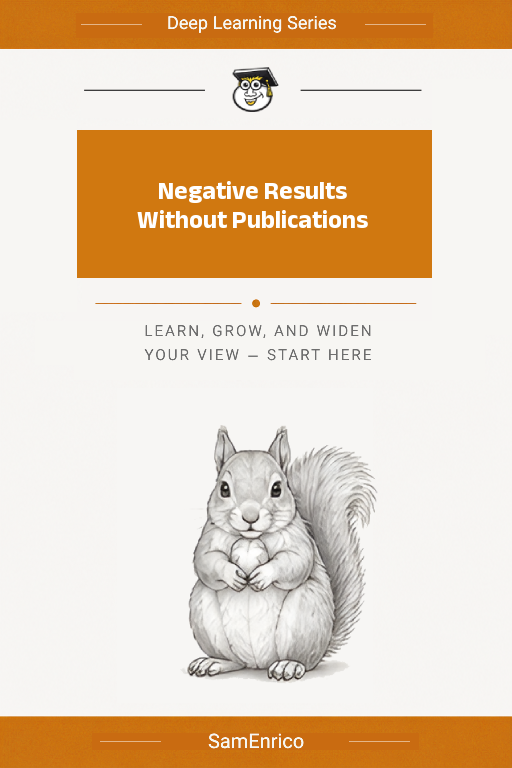
Negative Results Without Publications
Share null findings on preprint servers as evidenc
Share null findings on preprint servers as evidence of comprehensive hypothesis testing.
Formats
About this book
Free sample
Chapter 1: The Buried Evidence...--Imagine, for a moment, that you are a medical researcher. You have spent three years and two million dollars of public money testing whether a new drug lowers blood pressure in a high-risk population. Your hypothesis was elegant, your methods were sound, your sample size was justified, and your preregistration was posted online before the first patient was enrolled. Then you ran the analysis. The p-value was 0.24.
The confidence interval crossed zero. The effect, if it exists at all, is too small to measure with your well-powered design. You have found nothing.Now ask yourself: where does this result go?If you answer "into a peer-reviewed journal," you are either naive or lying. The journals that rejected your previous positive papers will now reject this null finding with a form letter that reads, in effect: "This study does not report a significant effect. We do not find it suitable for publication." Your department chair, who evaluates you on publication count, will sigh and say, "Can you reframe the introduction to find something?" Your graduate student, who needs a first-author paper to graduate, will cry in your office.
And you, the honest scientist, will do what scientists have done for seventy years: you will drag the file into a folder labeled "Dead Ends" and you will never speak of it again.This is the File Drawer Problem. It is the single most consequential failure of modern science, and almost no one is talking about it.The Silent Epidemic The File Drawer Problem has a simple definition and a devastating implication. The definition: studies that fail to find statistically significant results are systematically less likely to be published than studies that do find significant results. The implication: the published scientific literature is not a representative sample of all conducted research. It is a biased sample—one that systematically overrepresents positive findings and systematically underrepresents null findings.How large is this bias?
In 1990, psychologist Robert Rosenthal estimated that the average journal in psychology published 95 percent positive results. In 2015, a systematic review of multiple disciplines found that…
This is the end of the free sample. Get the eBook to keep going. Buy now
Contents
- Chapter 1
- Chapter 2
- Chapter 3
- Chapter 4
- Chapter 5
- Chapter 6
- Chapter 7
- Chapter 8
- Chapter 9
- Chapter 10
- Chapter 11
- Chapter 12
Details
- Author
- Lister Lekisha
- Publisher
- SamEnrico
- Language
- English
- Genre
- Non-Fiction, Student's Shortcut
- Released
- 2026-05-29
- Pages (approx.)
- 146
- Available as
- eBook, Audiobook

Read better in the ZLOADR app
Your eBooks on your phone or tablet. Sign in with your SamEnrico account and start reading.
More by Lister Lekisha
 Cohort Analysis Validation MethodLister Lekisha$11.99
 Carson Marine Biology RootsLister Lekisha$11.99
 Bipolar Long Term Recovery GuideLister Lekisha$11.99
 TikTok Envy Recovery GuideLister Lekisha$11.99
 Addressing Racial InsensitivityLister Lekisha$11.99
 The Artistic Teen Self EsteemLister Lekisha$11.99
 Habit Tips GuideLister Lekisha$11.99
 Patrick MoynihanLister Lekisha$11.99
 Perfectionism Burnout LinkLister Lekisha$11.99
 The Last Broadcast of the Forgotten Pirate Radio StationLister Lekisha$11.99
 Sand and Steel: The Desert Storm Campaign That Redefined WarLister Lekisha$11.99
 Excalibur’s Shadow: The Forgotten Lady of the LakeLister Lekisha$11.99
You may also like
 Hong Kong Handover 1997Dunn Johnnie$11.99
 Zumba For Postnatal Recovery CourseNeal Christian$11.99
 Zumba for BeginnersLadner Nikia$11.99
 YouTube Comment Mining GuideHumes Pandora$12.99
 Worry Box MeditationCarlin Rudy$11.99
 Workplace Stress MeditationNguyen Lynn$11.99
 Workplace Stress and Sleep RepairHawley Ivory$11.99
 Workplace Perfectionism CureDelaney Jeffry$11.99
 Workplace Injustice Anger GuideWallen Isabelle$11.99
 Work Addiction and Burnout LinkGreenwood Ester$11.99
 Women in Yoga and WellnessBeattie Galina$11.99
 Women in Stand Up ComedyChun Evangeline$11.99