
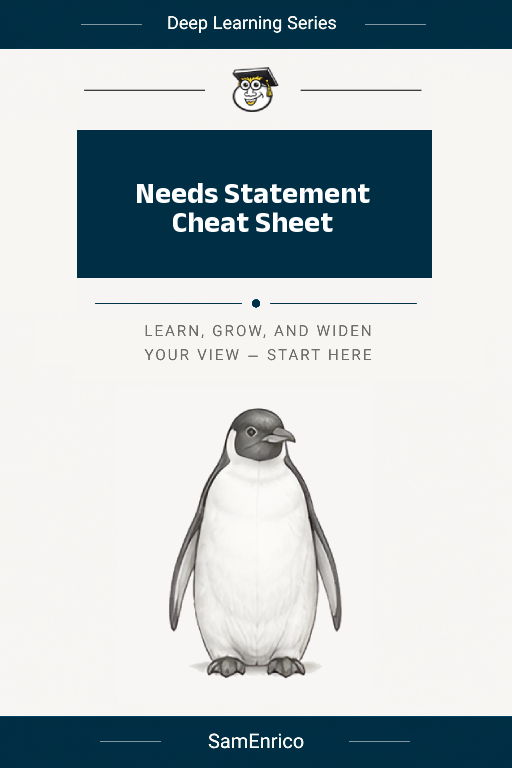
Needs Statement Cheat Sheet eBook
Write compelling problem statements using data sou
by Grove Alanna
Write compelling problem statements using data sources and community voices.
Formats
Free sample
Chapter 1: The Numbing Effect--–- Every grant reviewer has a moment they never talk about. It happens around the third or fourth proposal of the day, usually after lunch, often when the coffee has gone cold. They turn the page, see a paragraph that begins “According to the U.S. Census Bureau, 35.7 percent of residents live below the federal poverty line, compared to 22.1 percent of residents in the surrounding county and 12.8 percent statewide,” and something in their brain simply... stops.
They are not being cruel. They are not being lazy. They are being human.This is the numbing effect, and it is the single greatest threat to your needs statement.Before you write another word of your proposal, before you open that spreadsheet or conduct another interview, you need to understand why your carefully researched, rigorously cited, absolutely true statistics are probably boring your reviewer to the point of inaction. And you need to learn the fix—a fix so simple it fits in a single sentence.The Psychology of Empty Numbers Psychologists have known for decades that the human brain does not process large numbers or abstract statistics the way we think it does. In a landmark study, researchers asked participants to donate money to save starving children in Africa.
When presented with a single child’s name, photo, and story, people donated generously. When presented with statistics about millions of starving children, they donated significantly less. When presented with both the single child and the statistics, they donated somewhere in the middle—but still less than the single child alone.This is called psychic numbing. It is the brain’s evolutionary defense mechanism against overwhelming information. Your amygdala, the part of your brain responsible for emotional processing, lights up when you see a person in distress.
It goes quiet when you see a percentage sign.Here is what that means for your grant proposal: The sentence “Maria sends her son to bed hungry three nights a week” triggers an emotional response. The sentence “35.7 percent of residents are food insecure” triggers a statistical response. The first sentence makes the reviewer feel something. The second sentence makes the reviewer think something. Thinking is slower than feeling.
Feeling is what opens the wallet.But here is the twist that most grant writers get wrong: You cannot abandon statistics. Funders need numbers. Program officers need to justify their decisions to boards and budget committees. A single story, no matter how compelling, is just an anecdote. It proves nothing about scale, sustainability, or systemic need.
You need both.The problem is not that you have statistics. The problem is that you lead with them. The problem is that you stack them. The problem is that you present data the way you would present evidence in a court of law—cold, chronological, and cumulative—when you should be presenting it the way a documentary filmmaker would: story first, evidence second, and evidence always attached to a human consequence.The Three Traits of Success Drawing from the best practices of leading grant writers and data storytellers—particularly the framework popularized in Because Data Can’t Speak for Itself—every successful needs statement contains three elements. Think of them as three legs of a stool.
Remove any one, and the stool collapses.People. Your needs statement must center on specific human beings. Not “residents,” not “the community,” not “stakeholders.” A person with a name, an age, a circumstance, and a voice. This does not mean you must use a real name—pseudonyms and composite characters are acceptable when ethically sourced (see Chapter 3). But it does mean you must write as if you are describing someone you know.
Because you should be.Purpose. Your needs statement must answer the question “Why now?” with specificity. Not “because the problem is urgent,” but because a specific gap exists between current conditions and acceptable standards. Purpose is the bridge between emotion and action. It tells the reviewer not just that something is wrong, but that something can be made right.Persistence.
Your needs statement must acknowledge that the problem has persisted despite existing efforts. This is not pessimism; it is credibility. Funders know that poverty, disease, and educational failure did not appear yesterday. Pretending otherwise insults their intelligence. Persistence means showing the trajectory—not just where things are, but where they are heading if nothing changes.The most common failure mode of needs statements is not missing one of these elements entirely.
It is leading with the wrong one. Most grant writers lead with Purpose (“The purpose of this proposal is to address food insecurity”) or Persistence (“For fifteen years, rates have remained stagnant”). Almost no one leads with People. That is a mistake.The Neurological Hook Let me show you what this looks like in practice. Read the following two opening paragraphs and notice what happens inside your own body.Version A: “According to the latest American Community Survey data, 35.7 percent of residents in the South Side live below the federal poverty line.
This represents a 4.2 percent increase since 2018 and is more than double the statewide average of 12.8 percent. Furthermore, food insecurity rates among children in this zip code have reached 42 percent, compared to 18 percent in adjacent zip codes. These disparities demand immediate intervention.”Version B: “When Maria’s seven-year-old son asks for seconds at dinner, she has a choice: give him the extra rice and go hungry herself, or say no and listen to him cry. Three nights a week, she says yes. Two nights a week, she says no.
On the sixth night, when the cupboard is empty, she sends him to bed with a glass of water and a lie: ‘We’ll have a big breakfast tomorrow.’ Maria lives in the South Side, where 35.7 percent of residents live below the poverty line—more than double the statewide average. And her son is one of 42 percent of children in this zip code who don’t know where their next meal is coming from.”What happened when you read Version A? If you are like most people, your eyes moved across the words, your brain registered the numbers as “evidence,” and you felt... nothing. Or perhaps you felt a vague sense of obligation, the way you feel when you read a charity appeal on a subway poster.
You acknowledged the problem without being moved by it.Now what happened when you read Version B? You saw Maria. You saw her son. You felt the choice she has to make. You might have even felt a flash of something in your chest—frustration, sadness, recognition.
And then, only after you were already feeling something, you saw the same statistics. But this time, they were not abstract. They were attached to Maria. They were attached to her son.This is the neurological hook. Stories activate the limbic system—the ancient, emotional part of your brain that processes fear, joy, and empathy.
Numbers activate the prefrontal cortex—the newer, logical part of your brain that analyzes, compares, and justifies. Neither is better than the other. But the limbic system processes information faster. Emotion arrives before logic. If you want the logic to land, you must first open the door with emotion.The Blah…
This is the end of the free sample. Get the eBook to keep going. Buy now
About this book
Details
- Author
- Grove Alanna
- Publisher
- SamEnrico
- Language
- English
- Genre
- Non-Fiction, Professional's Cheat Sheet, Needs Assessment
- Released
- 2026-06-01
- Pages (approx.)
- 152
- Available as
- eBook, Audiobook

Read better in the ZLOADR app
Your eBooks on your phone or tablet. Sign in with your SamEnrico account and start reading.
More by Grove Alanna
 The Night Of The MurdersGrove Alanna$11.99
 British Empire Canada HistoryGrove Alanna$11.99
 Social Security for Singles GuideGrove Alanna$11.99
 Pomodoro for Data ScientistsGrove Alanna$11.99
 Peg System For Bird IdentificationGrove Alanna$11.99
 Death Dreams in ChildrenGrove Alanna$11.99
 Reconstruction of Delayed DeathsGrove Alanna$11.99
 Dream Journaling for Spiritual GrowthGrove Alanna$11.99
 Whispers of the Vanishing: The Last Speakers of the Ainu LanguageGrove Alanna$11.99
 The Secret Deal That Made LeBron: How a Teenage Phenom and a Savvy Agent Changed the NBA ForeverGrove Alanna$11.99
 How to Produce Pottery and Sculpting MaterialsGrove Alanna$11.99
 How to Produce Drip Coffee MakersGrove Alanna$11.99