
Non-FictionInformativeEducational
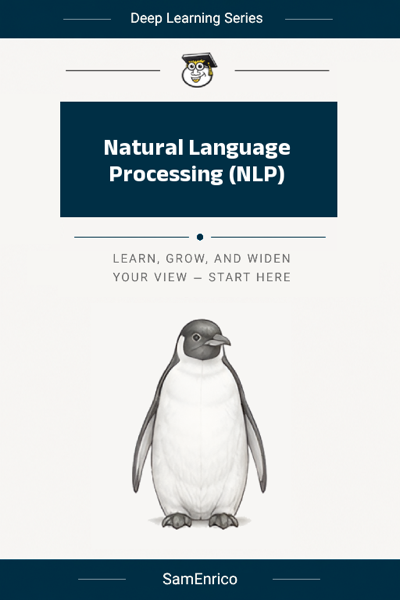
Natural Language Processing (NLP) eBook
A Coursebook on Natural Language Processing (NLP)
A Coursebook on Natural Language Processing (NLP)
Formats
Free sample
Chapter 1: The Language Illusion...–- Here is a sentence that changes everything about how you see artificial intelligence: A computer can read every book ever written, every tweet ever posted, every legal contract ever signed, and still have no idea what any of it means.Read that sentence again. Let it land.We are surrounded by miracles of language technology. Your phone finishes your sentences. Your email client suggests replies. Chat GPT writes essays and code and bad poetry.
Search engines find exactly what you want from billions of pages in milliseconds. It is easy to believe that machines have learned to understand language the way humans do.They haven't.What they have learned is something far stranger, far more useful, and — if you want to build systems that actually work — far more important to understand.This book is not a celebration of how well NLP works. It is a guided tour of how it actually works, including the mess, the failures, and the brilliant hacks that make the impossible merely difficult. By the time you finish this chapter, you will see every chatbot, every translation, and every "intelligent" text field with new eyes. You will understand why the hardest problem in artificial intelligence is not teaching a robot to walk or a computer to see.
It is teaching a machine to understand what you just said.The $500 Million Mistake In 2019, a major bank deployed what its press release called "the most advanced natural language processing system in financial services." The system was designed to read customer support emails and automatically route them to the correct department: complaints, account questions, fraud reports, or loan inquiries.The system worked beautifully in testing. It achieved 94% accuracy on a held-out dataset of labeled emails. The bank's executives celebrated. The vendor received an industry award.Within three days of going live, the system had routed a customer's detailed fraud report — "Someone stole my identity and opened three credit cards in my name, please help" — to the "product feedback" queue. The customer received an automated reply thanking them for their suggestion.
They closed their accounts and posted about the experience on social media. The story went viral.The bank lost an estimated $500 million in market value over the following week. Not because the technology failed — 94% accuracy is genuinely impressive. But because the 6% of failures were catastrophic in ways that no one had anticipated.This is the hidden reality of natural language processing. The successes are invisible.
The failures are spectacular. And almost every failure traces back to the same fundamental challenge: ambiguity.The Three Faces of Ambiguity Human language is not a programming language. It does not have unambiguous syntax, clear variable bindings, or deterministic execution. Every sentence you speak or write is a tiny miracle of compression, packing enormous meaning into a handful of sounds or symbols. The cost of this compression is ambiguity.Definition: Ambiguity occurs when a single linguistic form (a word, phrase, or sentence) can be interpreted in multiple ways.
Human listeners resolve ambiguity effortlessly using context, world knowledge, and shared assumptions. Machines have none of these unless we explicitly provide them.There are three distinct types of ambiguity that every NLP practitioner must recognize. Miss any one, and your system will fail in ways that surprise and embarrass you.Lexical Ambiguity: When Words Have Multiple Meanings The simplest form of ambiguity is also the most pervasive. Most English words have multiple definitions. The word "bank" can mean a financial institution, the side of a river, or the action of tilting an aircraft.
The word "light" can mean illumination, not heavy, pale in color, or to ignite. The word "run" has over sixty distinct definitions in the Oxford English Dictionary.Consider this sentence: "I went to the bank."Did the speaker deposit money, fish from the shore, or fly a plane? You cannot know without additional context. A human listener would ask for clarification or infer from the surrounding conversation. A naive NLP system must guess.The problem becomes even more challenging when multiple ambiguous words interact.
"The bank raised its rates" strongly suggests a financial institution. "The bank eroded after the storm" suggests a river. But a system that has only seen "bank" in financial contexts will confidently misinterpret the second sentence.Real-world consequence: Early airline reservation systems frequently misinterpreted "I want to fly from Buffalo to Rochester" as a request about flying insects because "fly" was more commonly a noun in their training data. The fix required tens of thousands of annotated examples teaching the system the airline context of "fly."Syntactic Ambiguity: When Structure Splits Lexical ambiguity affects individual words. Syntactic ambiguity affects how words combine into phrases and sentences.
The same sequence of words can often be parsed into multiple grammatical structures, each with a different meaning.The classic example used in linguistics textbooks (and recycled endlessly until we replace it here) is "The horse raced past the barn fell." This is called a garden path sentence because your brain initially parses "raced past the barn" as the main verb, only to discover at the final word "fell" that you need to reparse entirely. (The correct parse: "The horse [that was] raced past the barn fell." The horse didn't race; it was raced.)But garden path sentences are laboratory curiosities. The real danger of syntactic ambiguity appears in phrases that are perfectly plausible under multiple parses.Example: "I saw the man with the telescope."Does the telescope belong to the man (the man has a telescope, and I saw him)? Or is the telescope my instrument for seeing (I used a telescope to see the man)? Both readings are grammatical.
Both are sensible. A human might ask for clarification or infer from context. A machine makes a choice based on training statistics — and often chooses wrong.Real-world consequence: Medical NLP systems that extract information from clinical notes frequently misparse phrases like "patient with fever and rash" versus "patient with fever and family history of rash." The attachment of "with" phrases changes the meaning dramatically. One well-documented system incorrectly flagged patients as having rare genetic conditions because it attached "with [condition]" to the patient rather than to the relevant symptom.Pragmatic Ambiguity: When Meaning Depends on Context The most subtle and dangerous ambiguity is pragmatic. Here, the sentence is unambiguous at the word level and the syntax level, but the intended meaning depends on context, shared knowledge, and social convention.Example: "Can you pass the salt?"Literally, this is a yes/no question about ability.
Do you possess the physical capability to pass the salt? A literal-minded machine would answer "Yes" and wait for further instructions. Every human recognizes this as a polite request to actually pass the salt.Example: "It's cold in here."Literally, a statement about ambient temperature. In context, it might be a request to close a window, turn up the heat, or offer a jacket. Or it might be a complaint.
Or it might be an explanation for why the speaker is wearing a coat indoors. Or it might be a hint to end the meeting early.Pragmatic ambiguity is the reason that sentiment analysis is harder than it looks. The sentence "Yeah, right" can…
This is the end of the free sample. Get the eBook to keep going. Buy now
About this book
Details
- Author
- Cochran Terese
- Publisher
- SamEnrico
- Language
- English
- Genre
- Non-Fiction, Informative, Educational
- Released
- 2026-05-11
- Pages (approx.)
- 140
- Available as
- eBook, Audiobook

Read better in the ZLOADR app
Your eBooks on your phone or tablet. Sign in with your SamEnrico account and start reading.
More by Cochran Terese
 Self Hypnosis For Ultimate FrisbeeCochran Terese$11.99
 The Financial Stress JournalCochran Terese$11.99
 Drug Dependency Relapse Prevention PlanCochran Terese$11.99
 Networking for Military VeteransCochran Terese$11.99
 Anapanasati for RefugeesCochran Terese$11.99
 Naked in Public DreamCochran Terese$11.99
 Jerry Seinfeld CarCochran Terese$11.99
 Falls Prevention for ParentsCochran Terese$11.99
 Date Nerves Grounding GuideCochran Terese$11.99
 The Star Map of the Dogon: Africa's Ancient AstronomersCochran Terese$11.99
 Enkidu's Awakening: The Untamed Heart of Gilgamesh's BrotherCochran Terese$11.99
 How to Become a Agent-contract ClerkCochran Terese$11.99
You may also like
 Hong Kong Handover 1997Dunn Johnnie$11.99
 Zumba For Postnatal Recovery CourseNeal Christian$11.99
 Zumba for BeginnersLadner Nikia$11.99
 YouTube Comment Mining GuideHumes Pandora$12.99
 Worry Box MeditationCarlin Rudy$11.99
 Workplace Stress MeditationNguyen Lynn$11.99
 Workplace Stress and Sleep RepairHawley Ivory$11.99
 Workplace Perfectionism CureDelaney Jeffry$11.99
 Workplace Injustice Anger GuideWallen Isabelle$11.99
 Work Addiction and Burnout LinkGreenwood Ester$11.99
 Women in Yoga and WellnessBeattie Galina$11.99
 Women in Stand Up ComedyChun Evangeline$11.99