
Non-FictionHealth & WellnessLearning
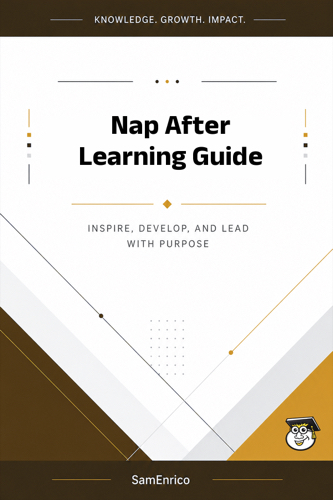
Nap After Learning Guide eBook
Consolidate new information with post study rest.
by Glynn Carli
Consolidate new information with post study rest.
Formats
Free sample
Chapter 1: The 50% Heist--–- You sit down to learn something new. Perhaps it is a chapter of a textbook, a set of vocabulary words for an upcoming exam, a technical skill for your job, or even just the name of a person you met at a party. You concentrate. You highlight. You reread the difficult passage three times.
You feel the satisfying click of understanding, that small dopamine hit that says, "Yes, I have learned this." Thirty minutes later, you close the book, proud of your effort. Sixty minutes after that, you try to recall what you studied. The words are hazy. The key concept you underlined twice is now a ghost. The name you repeated silently to yourself ten times has evaporated.
You have been robbed, and you did not even hear the thief enter the room.The Most Expensive Hour You Never Track The thief is not laziness. It is not a lack of intelligence. It is not a poor memory passed down through your genetics. The thief is a well-documented, relentlessly predictable feature of how the human brain processes information, and its name is the Forgetting Curve. First described by the German psychologist Hermann Ebbinghaus in 1885, the Forgetting Curve is the mathematical reality that, in the absence of deliberate intervention, human memory decays exponentially.
Within one hour of learning something new, you will forget approximately 50 percent of it. Within twenty-four hours, you will forget 70 to 80 percent. Within thirty days, unless you have reviewed the material repeatedly, you will retain as little as 2 to 3 percent.Let those numbers land. You are not bad at remembering. You are human.Ebbinghaus discovered this by serving as his own experimental subject, a level of dedication that involved memorizing thousands of nonsense syllables (meaningless three-letter combinations like "ZOF" and "KAE") and then testing himself at various intervals.
He plotted the resulting data on a graph that showed a steep, terrifying drop in retention within the first hour, followed by a gradual leveling off. The shape of that curve has been replicated hundreds of times across every conceivable learning domain: foreign language vocabulary, medical terminology, mathematical proofs, musical sequences, and even motor skills like typing or golf swings. The curve is not a theory. It is a fact of neural biology.Yet, the typical response to noticing this forgetting is not to change the rest protocol. It is to cram more.
Students pull all-nighters before exams, convinced that more hours of study will override the forgetting. Professionals attend back-to-back training sessions without breaks, believing that intensity equals retention. Language learners download apps that drill them with flashcards every ten minutes, hoping that sheer repetition will burn the words into their brains. All of these strategies share a fatal flaw: they treat the brain as if it were a hard drive that simply needs more data input, when in fact it is a biological organ that requires specific conditions to save anything at all.The Medical Student Who Studied Twelve Hours a Day Consider the case of Sarah, a second-year medical student at a competitive university. I have changed her name, but her story is real and representative of thousands of learners who hit a wall that effort alone cannot break.
Sarah studied twelve hours per day, six days per week. She used colored highlighters, digital flashcards, recorded lectures, practice exams, and every productivity app recommended by her peers. She slept five to six hours per night because, as she put it, "sleep is for people who have finished their work." She failed her first set of board exams. Not by a small margin. By a devastating margin that put her academic future in jeopardy.She came to a learning specialist in despair.
"I don't understand," she said. "I studied harder than anyone I know. I put in more hours than the people who passed. My brain just won't hold onto the information."The specialist asked her to describe a typical study day. Sarah walked through her schedule: wake at 5:00 AM, study anatomy from 6:00 to 9:00 AM, review flashcards during breakfast, study pathology from 9:30 AM to 12:30 PM, eat lunch while watching a recorded lecture, study pharmacology from 1:00 to 4:00 PM, take a thirty-minute break (during which she scrolled Instagram), study clinical cases from 4:30 to 7:30 PM, dinner while answering emails, then review everything from 8:00 to 11:00 PM before collapsing into bed.
The specialist noticed one glaring absence in the entire fourteen-hour day. "When do you rest?" he asked."I take breaks," Sarah said. "I just told you, I take thirty minutes at 4:00 PM.""What do you do in that thirty minutes?""I scroll my phone. Check messages. Watch a few short videos.
You know, a brain break."The specialist explained what Sarah did not yet know: her "brain break" was not a break at all. Scrolling social media kept her prefrontal cortex engaged, her dopamine circuits firing, and her Default Mode Network—the brain's consolidation system—completely suppressed. She was not resting. She was simply switching from one form of cognitive load to another. Worse, her all-nighters and chronic sleep deprivation meant that even when she finally closed her eyes, her brain lacked the deep sleep architecture required to transfer the day's information from temporary storage to permanent memory.The specialist proposed a radical experiment.
For one month, Sarah would reduce her total study time from twelve hours to eight hours. She would insert ten minutes of genuine wakeful rest (eyes closed, no screens, no input) after every fifty-minute study block. She would take a twenty-minute power nap at 2:00 PM each day. And she would protect eight hours of overnight sleep, not as a luxury but as a non-negotiable component of her learning protocol.Sarah was skeptical. "You want me to study less and sleep more?
That is the opposite of what everyone else is doing.""Everyone else is failing," the specialist said. "Do you want to be right or do you want to pass?"She agreed to try. Thirty days later, she retook a practice version of the board exam. Her score improved by 34 percent. Thirty days after that, she passed the actual exam on her third attempt.
She is now a practicing physician. When she lectures to new medical students, she tells them the same thing the specialist told her: "You don't have a memory problem. You have a rest problem."Why Cramming Makes Everything Worse The instinct to cram more study time when forgetting occurs is so deeply ingrained that it feels like common sense. If you are not retaining information, the logic goes, you need to review it more frequently. But this logic collapses under the weight of what neuroscience has discovered about the brain's two distinct learning modes: encoding and consolidation.Encoding is the process of getting information into your brain.
This is what happens when you read a textbook, listen to a lecture, watch a tutorial, or practice a skill. During encoding, your hippocampus—a small, seahorse-shaped structure buried deep in your temporal lobe—acts as a temporary notepad. It writes down what is happening right now. But the hippocampus has severe limitations. Its capacity is small, roughly equivalent to holding a phone number in your working memory while you walk to the phone.…
This is the end of the free sample. Get the eBook to keep going. Buy now
About this book
Details
- Author
- Glynn Carli
- Publisher
- SamEnrico
- Language
- English
- Genre
- Non-Fiction, Health & Wellness, Learning
- Released
- 2026-06-06
- Pages (approx.)
- 146
- Available as
- eBook, Audiobook

Read better in the ZLOADR app
Your eBooks on your phone or tablet. Sign in with your SamEnrico account and start reading.
More by Glynn Carli
 Rock Climber Hypnosis GuideGlynn Carli$11.99
 Acupuncture for Erectile DysfunctionGlynn Carli$11.99
 Group Creativity For Educators GuideGlynn Carli$11.99
 Self Hypnosis for Menstrual PainGlynn Carli$11.99
 The Dubai Emergency ContactsGlynn Carli$11.99
 Remote Conflict Resolution SkillsGlynn Carli$11.99
 Portable Dental X Ray DisasterGlynn Carli$11.99
 The Pill Pushers: Europe's Deadly Healthcare Fraud EmpireGlynn Carli$11.99
 The Flavor Revolutionaries: How Black Chefs and Entrepreneurs Built Global CuisineGlynn Carli$11.99
 How to Produce Denture CleanersGlynn Carli$11.99
 How to Produce PillboxesGlynn Carli$11.99
 How to Become a Melter ClerkGlynn Carli$11.99
You may also like
 Hong Kong Handover 1997Dunn Johnnie$11.99
 Zumba For Postnatal Recovery CourseNeal Christian$11.99
 Zumba for BeginnersLadner Nikia$11.99
 YouTube Comment Mining GuideHumes Pandora$12.99
 Worry Box MeditationCarlin Rudy$11.99
 Workplace Stress MeditationNguyen Lynn$11.99
 Workplace Stress and Sleep RepairHawley Ivory$11.99
 Workplace Perfectionism CureDelaney Jeffry$11.99
 Workplace Injustice Anger GuideWallen Isabelle$11.99
 Work Addiction and Burnout LinkGreenwood Ester$11.99
 Women in Yoga and WellnessBeattie Galina$11.99
 Women in Stand Up ComedyChun Evangeline$11.99