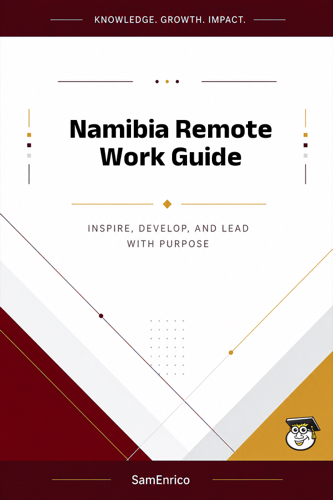
Namibia Remote Work Guide eBook
Highlights Windhoek as an offbeat, low cost, safe
Highlights Windhoek as an offbeat, low cost, safe base for African remote work.
Formats
Free sample
Chapter 1: The Unseen Opportunity--In the quiet hours of a Tuesday morning, while thousands of remote workers crowd into overpriced coworking spaces in Lisbon, Bangkok, and Medellín, a different kind of professional sits down to work in Windhoek. Her internet connection hums steadily at twenty-four megabits per second—fast enough for video calls, cloud uploads, and the endless Slack notifications that define modern work. Outside her window, the Namibian sun burns through a sky so blue and clear that it feels almost artificial. The air is dry and thin at 1,650 meters above sea level, carrying the scent of dust and jacaranda blossoms. She pays less than four hundred dollars for her furnished apartment in a quiet suburb where neighbors greet each other and children walk to school alone.
Tonight, she will join a community dinner with other remote professionals, sharing stories and strategies over grilled meat and cold Namibian beer. Tomorrow, she will drive two hours into the bush and watch elephants drink from a waterhole while answering emails from her laptop.This scene is not hypothetical. It is happening right now, in 2026, as a quiet migration of location-independent workers discovers what the safari brochures have never mentioned: Namibia, and specifically its capital city Windhoek, has become one of the world's most compelling bases for remote work. Not because it is the cheapest. Not because it has the fastest internet.
But because it offers something that the crowded nomad hotspots have lost: genuine opportunity without the crowds, safety without the paranoia, and adventure without the sacrifice of professional productivity.The Problem with the Nomad Mainstream The global digital nomad phenomenon has transformed from a niche lifestyle into a mainstream movement. By 2026, an estimated thirty-five million remote workers identify as digital nomads, generating over seven hundred billion dollars in economic impact annually -10. This explosive growth has created a predictable pattern: once-undiscovered destinations become overcrowded, prices rise, local resentment builds, and the very qualities that attracted nomads in the first place—authenticity, affordability, space—evaporate.Consider Lisbon. A decade ago, the Portuguese capital offered a perfect blend of European infrastructure, mild climate, and reasonable costs. Today, a furnished one-bedroom apartment in a central neighborhood costs upwards of two thousand dollars per month.
Coworking desks are booked weeks in advance. Restaurants cater to English-speaking tourists more than locals. The Portuguese government has even restricted new short-term rental licenses in response to housing shortages driven by digital nomads and expats -10.Medellín tells a similar story. The "City of Eternal Spring" became the unofficial capital of Latin American remote work, celebrated for its pleasant climate, low costs, and vibrant culture. But success bred saturation.
By 2025, popular neighborhoods like El Poblado had become so dominated by foreign remote workers that locals began referring to them as "gringo bubbles." Prices for accommodation doubled in five years. Safety concerns, once well-managed, resurfaced as economic inequality widened.Bali, Chiang Mai, Barcelona, Mexico City—the pattern holds across continents and cultures. Once a destination reaches critical mass in the digital nomad community, a predictable cycle begins: prices rise, authenticity erodes, and the pioneers move on to find the next undiscovered frontier.Namibia represents that frontier in 2026. But unlike many emerging nomad destinations that lack the infrastructure to support remote work, Namibia arrives with a foundation that is surprisingly, almost unexpectedly, solid.Why Namibia, and Why Now The most immediate answer lies in government policy. In October 2022, Namibia officially launched its Digital Nomad Visa, joining a small but growing list of African nations (including Mauritius, Cape Verde, and the Seychelles) that actively court remote workers -7.
But Namibia's approach differs from its neighbors in two critical ways. First, the visa is straightforward and accessible: applicants must demonstrate a minimum monthly income of two thousand dollars for singles or three thousand dollars for couples, provide six months of bank statements, and submit a police clearance certificate from their country of origin -2-7. Second, the visa explicitly clarifies that remote workers are not subject to Namibian income tax on income earned from foreign sources -6. This tax advantage alone makes Namibia significantly more attractive than many European nomad destinations, where complex tax residency rules can create unexpected liabilities.The visa itself allows a stay of six months, with the possibility of a single six-month extension, for a total potential stay of one year -7. The application fee is just sixty-two dollars for an individual or one hundred twenty-four dollars for a family, payable upon arrival -7.
The application process is conducted entirely online via email to the Namibia Investment Promotion and Development Board (NIPDB) at nomadvisa@nipdb.com -7. For a bureaucracy that still requires paper forms for many government services, this digital-first approach represents meaningful modernization.But visa policy alone does not make a destination. The deeper question is whether Namibia can actually support the work that remote professionals need to do. The answer, like most things in Namibia, is complicated but ultimately encouraging.The Infrastructure Reality Let us address the elephant in the room: Namibia is not Singapore. The country's internet infrastructure has faced real challenges, including a series of outages in early 2026 caused by equipment failures, power issues, and copper theft -3.
Anyone who tells you otherwise is either misinformed or selling something. However, data from the Ookla Speedtest Global Index for mid-2026 shows that Namibia's average fixed broadband speeds range from twelve to fifteen megabits per second in urban areas, with peaks above twenty-four megabits in well-connected neighborhoods like Klein Windhoek and Eros -3-8.To put these numbers in perspective: a typical Zoom video call requires three to four megabits per second for high-definition video. Streaming Netflix in 4K requires about fifteen megabits. Cloud file transfers, voice calls, and most project management tools require even less. The practical reality is that Namibia's internet speeds are sufficient for virtually all remote work tasks, provided you secure a quality connection in a good location.
The challenge is not speed but consistency. Namibia experiences occasional outages and slowdowns, particularly during peak evening hours when local traffic saturates available bandwidth.This is where smart planning makes all the difference. Remote workers who succeed in Namibia treat connectivity not as a given but as a resource to be actively managed. They test internet speeds before signing leases. They maintain backup connections through mobile data plans from both major providers, MTC and Telecom Namibia.
They invest in small uninterruptible power supplies to ride through brief outages. They structure their workdays to accommodate local connectivity patterns, scheduling bandwidth-heavy tasks for off-peak hours -6.The Safety Question For many potential nomads, particularly those who have never visited sub-Saharan Africa, safety represents the single greatest barrier to considering Namibia. The images that dominate Western media—poverty, conflict, disease—create a mental map of the continent that bears little resemblance to the lived reality of its more stable nations.Namibia ranks as the third-safest country in Africa according to the 2026 Global Peace Index, with a GPI score of 1.789 and a global ranking of fiftieth out of 163 countries -4. For comparison, this places Namibia above countries including Brazil, India, Turkey, and the United States. The country's low population density—just over 2.5 million people in an area…
This is the end of the free sample. Get the eBook to keep going. Buy now
About this book
Details
- Author
- Portillo Valeri
- Publisher
- SamEnrico
- Language
- English
- Genre
- Non-Fiction, Business Brief, African Markets
- Released
- 2026-06-09
- Pages (approx.)
- 127
- Available as
- eBook, Audiobook

Read better in the ZLOADR app
Your eBooks on your phone or tablet. Sign in with your SamEnrico account and start reading.
More by Portillo Valeri
 IBS Differential Diagnosis GuidePortillo Valeri$11.99
 Ferry Waiting Rage ManagementPortillo Valeri$11.99
 The Freelance Productivity SystemPortillo Valeri$11.99
 The Interruption Recovery Log WorkbookPortillo Valeri$11.99
 Body Language PersuasionPortillo Valeri$11.99
 Whiplash Associated Disorder ExercisesPortillo Valeri$11.99
 Media Circus Case StudyPortillo Valeri$11.99
 Teen Self Esteem and RejectionPortillo Valeri$11.99
 Echoes of the Forgotten: The Unsung Heroes of the 1960 Valdivia EarthquakePortillo Valeri$11.99
 The Two Faces of the Silk Road: How a 19th-Century Explorer and a 21st-Century Hacker Redefined TradePortillo Valeri$11.99
 The Silent Hunters of the Pacific: Japan's I-Boats in World War IIPortillo Valeri$11.99
 How to Start a Motorcycle Business (Beginners Guide)Portillo Valeri$11.99