
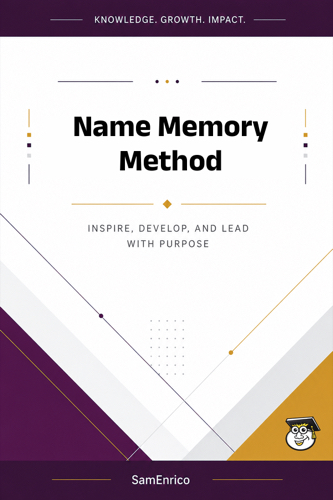
Non-FictionSelf-HelpSocial Skills
Name Memory Method eBook
Use loci and peg techniques to remember names and
by Bottoms Dona
Use loci and peg techniques to remember names and faces at social events.
Formats
Free sample
Chapter 1: The Hidden Lie--–- You have been telling yourself a lie. Probably for years. Probably for decades. And every time you walk into a room full of strangers, that lie tightens around your chest like a second pair of ribs. The lie sounds like this: “I’m just bad with names.”It feels true, doesn’t it?
It feels like a permanent fact about you, as fixed as your height or your shoe size. You’ve said it so many times at parties, at networking events, at back-to-school nights, at weddings, at reunions. “Sorry, I’m terrible with names.” “Don’t take it personally—I never remember anyone’s name.” “I can remember a face forever, but names? Gone in three seconds.”Here is the truth that will change everything: There is no such thing as being “bad with names.”That statement is not a motivational platitude. It is a neurological fact.
Your brain is not broken. Your memory is not defective. You do not suffer from a unique cognitive disability that makes names slide off your consciousness like water off wax. What you suffer from is a failure of technique, a failure of attention, and a failure of belief. And all three of those failures are fixable.This chapter will dismantle the lie, piece by piece, until you see clearly that you already possess the hardware for perfect name recall.
You just haven’t been given the software. By the end of this chapter, you will have completed a simple self-experiment that proves—to your own skeptical mind—that your memory is far more powerful than you have ever given it credit for.The Anatomy of Embarrassment Let us begin with a story. Not a theoretical one. A real one.A few years ago, I attended a weekend-long wedding celebration for a close college friend. There were eighty-seven guests.
Many of them I had met before—some at previous weddings, some at holiday parties, some at the very college we had all attended together. On the first night, at the welcome dinner, I was introduced to a woman named Claire. She was the sister of the groom. We spoke for twelve minutes about her work as a pediatric nurse, her recent move to Portland, and her dog, a three-legged rescue named Waffles. Twelve minutes.
I remembered her face perfectly. I remembered her dog’s name. I remembered the city she moved from (Boston). I remembered that her favorite TV show was The Great British Bake Off.The next morning, at the brunch, I saw her across the room. She waved.
I waved back. And as she walked toward me, smiling, her name vanished from my mind as completely as if it had never existed. I went through the entire conversation—another eight minutes—without saying her name once. I used “hey” and “you” and “so tell me more about…” like a verbal contortionist. She knew.
Of course she knew. The slight tilt of her head, the flicker in her eyes. She could see me pretending.I left that brunch not angry at my memory, but ashamed of myself. I had spent twelve minutes with this woman. I had laughed at her stories.
I had asked follow-up questions. And I could not produce her name to save my life.That night, I lay in my hotel room and asked myself the question that had haunted me for years: Why? Why can I remember useless facts—the lyrics to 1990s commercial jingles, the batting average of a baseball player I haven’t thought about in twenty years, the exact layout of my childhood bedroom—but I cannot remember the name of a kind person who just spent twelve minutes talking to me?The answer, I would eventually learn, is not that my memory was bad. The answer is that I had never learned how to use it properly.Recognition vs. Recall: The Crucial Distinction To understand why you are not “bad with names,” you must first understand a fundamental distinction in cognitive psychology: the difference between recognition and recall.Recognition is the ability to know that you have encountered something before.
When you see a face and think, “I know that person, but I can’t remember their name,” you are experiencing successful recognition and failed recall. Your brain has correctly identified the stimulus as familiar. The pattern-matching machinery in your temporal lobe has fired perfectly. You recognize the face. You just cannot retrieve the label.Recall is the ability to actively produce information from memory without external cues.
It is a far more demanding neurological process. Recall requires that you have encoded the information deliberately, that you have stored it in an organized way, and that you have consolidated it through repetition or strong association. Recall is not automatic. Recall requires work—or, more precisely, recall requires the right kind of work.Here is what most people do not understand: Your brain is excellent at recognition and mediocre at recall by default. That is not a flaw.
That is a design feature. Evolution did not care whether you remembered the name of the person who shared a watering hole with you last week. Evolution cared whether you recognized the face of a predator or a potential mate. Recognition kept you alive. Recall was secondary.So when you forget a name, you are not experiencing a malfunction.
You are experiencing the default setting of the human brain. The problem is not that your memory is broken. The problem is that you have been expecting your memory to perform a high-level recall task without giving it the tools it needs.The Ten Myths of Memory Drawing from the foundational work of memory researcher Kenneth Higbee, let us systematically dismantle the myths that have been holding you back. Each of these myths is widely believed. Each of them is false.Myth 1: Memory is a single thing.False.
You have multiple memory systems: short-term, long-term, episodic, semantic, procedural, and more. Being “bad” at recalling names does not mean you are bad at remembering directions, or recipes, or song lyrics, or where you parked the car. The systems are separate. A weakness in one is not a weakness in all.Myth 2: Some people are born with bad memories.False. No one is born with a “bad memory.” Infants learn language, recognize faces, and remember routines.
The differences between adults come from training, attention, and technique—not innate capacity.Myth 3: As you age, memory always declines.False. Some types of memory slow down with age, particularly speed of retrieval. But other types—associative memory, pattern recognition, accumulated knowledge—can improve. Many memory champions are over forty. Some are over sixty.Myth 4: Memory works like a video recording.False.
Memory is reconstructive, not reproductive. You do not play back a recording. You rebuild an event from fragments. This is why two witnesses to the same car accident remember different details. Your memory of a name is not “lost”; it is a set of fragments that may be missing the key associative link.Myth 5: Forgetting means the memory is gone.False.
Most forgetting is retrieval failure, not storage failure. The information is still in your brain. You just cannot find the…
This is the end of the free sample. Get the eBook to keep going. Buy now
About this book
Details
- Author
- Bottoms Dona
- Publisher
- SamEnrico
- Language
- English
- Genre
- Non-Fiction, Self-Help, Social Skills
- Released
- 2026-06-09
- Pages (approx.)
- 134
- Available as
- eBook, Audiobook

Read better in the ZLOADR app
Your eBooks on your phone or tablet. Sign in with your SamEnrico account and start reading.
More by Bottoms Dona
 Insurance Payout Diamond HeistBottoms Dona$11.99
 Understanding Bipolar Spectrum ContinuumBottoms Dona$11.99
 The Group Affinity DiagramBottoms Dona$11.99
 Gacy's Execution WitnessesBottoms Dona$11.99
 College Stress Relief HandbookBottoms Dona$11.99
 Retirement Assets ABLE AccountsBottoms Dona$11.99
 RLS Work AccommodationsBottoms Dona$11.99
 Birth Control PMS EffectsBottoms Dona$11.99
 The Architect of the Cosmos: Imhotep and the Birth of Egyptian ScienceBottoms Dona$11.99
 The Last Broadcast: How Radio Silence Shattered a NationBottoms Dona$11.99
 Echoes from the Edge: The Kitt Peak Telescope and the Cosmic Frontier (1980s-1990s)Bottoms Dona$11.99
 How to Become a Mine InspectorBottoms Dona$11.99
You may also like
 Hong Kong Handover 1997Dunn Johnnie$11.99
 Zumba For Postnatal Recovery CourseNeal Christian$11.99
 Zumba for BeginnersLadner Nikia$11.99
 YouTube Comment Mining GuideHumes Pandora$12.99
 Worry Box MeditationCarlin Rudy$11.99
 Workplace Stress MeditationNguyen Lynn$11.99
 Workplace Stress and Sleep RepairHawley Ivory$11.99
 Workplace Perfectionism CureDelaney Jeffry$11.99
 Workplace Injustice Anger GuideWallen Isabelle$11.99
 Work Addiction and Burnout LinkGreenwood Ester$11.99
 Women in Yoga and WellnessBeattie Galina$11.99
 Women in Stand Up ComedyChun Evangeline$11.99