
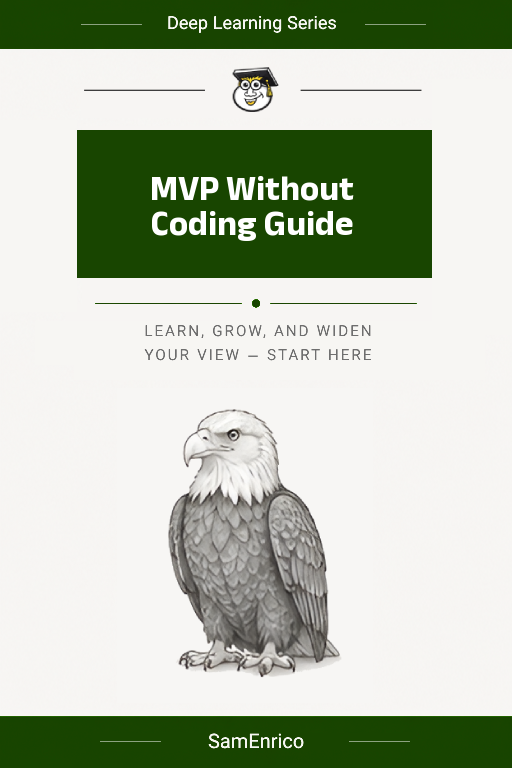
MVP Without Coding Guide eBook
Build a no-code MVP to validate your idea. Use fre
Build a no-code MVP to validate your idea. Use free tools like Airtable, Glide, or Bubble.
Formats
Free sample
Chapter 1: The Founder’s Lie--–- Every aspiring entrepreneur has heard the same seductive whisper. It comes from successful founders on podcasts, from well-meaning mentors, and from the quiet voice of your own ego. The whisper says: “If you build it, they will come.”This is the Founder’s Lie. And it has destroyed more startups than bad code, broken marketing, and empty bank accounts combined.You have been told that the hard part is building the product. That once you have a working app, customers will magically appear.
That your job is to hire a developer, learn to code, or scrape together $50,000 for an agency. That everything before launch is preparation, and everything after launch is success.This chapter exists to murder that lie.The Graveyard of Good Intentions Let us begin with a number that should terrify you: 90 percent.According to CB Insights, which analyzed over 2,000 startup failures, 90 percent of startups fail. But the reason is not what you think. It is not that founders couldn’t code. It is not that their technology was broken.
It is not that their team was lazy or their marketing was weak.The number one reason startups fail, cited by 42 percent of failed founders, is this: no market need.They built something nobody wanted.Let that sink in. Nearly half of all failed startups spent months—sometimes years—building a product that their target customers simply did not care about. They coded features. They designed logos. They incorporated LLCs.
They bought domains. They did everything right except the only thing that matters: they never checked if anyone wanted what they were building.The Founder’s Lie tells you that building is the hard part. The data tells you that building something nobody wants is easy. The hard part is being brave enough to check before you build.The Developer Trap Here is how most aspiring founders start their journey. They have an idea—a good one, or at least one they have convinced themselves is good.
They write it on a napkin or save it in a notes app. Then they face a decision.Option one: Hire a developer. This costs anywhere from 30,000to30,000 to 30,000to150,000 for a basic MVP. Most people do not have this money. So they do nothing.
The idea dies.Option two: Learn to code. This takes six to twelve months of dedicated study. Most people do not have this time. So they do nothing. The idea dies.Option three: Find a technical co-founder.
This requires convincing a skilled developer to work for equity instead of cash. Most people cannot make this convincing argument because they have no traction, no revenue, and no proof that the idea works. So they do nothing. The idea dies.Notice the pattern? Every traditional path to building software ends with the same result for most people: nothing.But for the tiny minority who actually manage to build something—who scrape together the money, or learn Python, or convince a friend to code at night—a new trap awaits.
By the time they launch, they have invested so much time, money, and emotional energy that they cannot admit the idea might be bad.This is called sunk cost fallacy. It is the psychological bias that makes you finish a terrible movie because you already paid for the ticket. It makes you stay in a bad relationship because you have already been together for years. And it makes you keep building a product nobody wants because you have already spent $50,000 and six months of your life.The developer trap does not just delay you. It imprisons you.The No-Code Revolution There is another way.
It does not require $50,000. It does not require a computer science degree. It does not require convincing a developer to work for free.It requires only that you stop believing the Founder’s Lie.Welcome to the no-code revolution. Over the past five years, a new generation of tools has emerged that allows anyone—literally anyone—to build functional software using visual interfaces instead of programming languages. Airtable replaces databases.
Glide turns spreadsheets into mobile apps. Bubble builds complex web applications with drag-and-drop workflows. Zapier connects everything together.These tools have a free tier. Every single one of them. You can build, launch, and validate an MVP without spending a dollar on software.But here is what most no-code books get wrong.
They treat no-code as a technical alternative to coding. They teach you how to use the tools. They show you where to click. They give you templates and tutorials and step-by-step instructions.That is not enough.Because the problem has never been technical. The problem has always been psychological.
You do not need to learn Airtable. You need to unlearn the Founder’s Lie.Iteration Speed: The Only Metric That Matters Let me introduce you to the only metric that matters in early-stage startups: iteration speed.Iteration speed is how fast you can go from idea to feedback to improved idea. A traditional developer takes three months to build one version of a product. A no-code founder can build and test ten different versions in the same three months.Why does this matter? Because your first idea is almost certainly wrong.You do not know which feature matters most.
You do not know which customer segment will pay. You do not know which pricing model converts. You do not know anything—and the only way to learn is to launch something, watch what happens, and change it.Iteration speed is not about being fast. It is about being less wrong, faster.Imagine two founders. Founder A hires a developer and spends six months building a polished app with fifteen features.
They launch to silence. No one signs up. Now they have a beautiful, expensive, completely useless product. To change direction, they need another six months and another $50,000.Founder B uses no-code tools. In one week, they build an ugly landing page with a single button.
They post it in a Reddit community. Fifty people click the button. Ten enter their email. Founder B learns that the button text matters. They change it.
Twenty people enter their email. They learn that the problem is real. They build a simple Glide app in two days. Ten people pay $10. They have validation and revenue.Founder A is still waiting for the developer to finish the login screen.Iteration speed is not a technical advantage.
It is a survival advantage.The 7-Day Sprint This book operates on a single, non-negotiable timeline: 7 days from idea to launch.Not 30 days. Not 60 minutes. Not “build it tonight.” Those promises are as dishonest as the Founder’s Lie. Building a real MVP takes focused work. It takes planning.
It takes grit. But it does not take months. It takes one week.Here is exactly how your 7 days will break down:Days 1-2: Validate You will not open Airtable, Glide, or Bubble. You will not design a logo. You will not name your company.
You will do one thing: prove that a specific group of people has a painful problem they will pay to solve. You will do this with a one-page website, a $50 ad…
This is the end of the free sample. Get the eBook to keep going. Buy now
About this book
Details
- Author
- Roche Alejandra
- Publisher
- SamEnrico
- Language
- English
- Genre
- Non-Fiction, Startup Guide, Lean Methodology
- Released
- 2026-06-01
- Pages (approx.)
- 123
- Available as
- eBook, Audiobook

Read better in the ZLOADR app
Your eBooks on your phone or tablet. Sign in with your SamEnrico account and start reading.
More by Roche Alejandra
 The IBS in Children GuideRoche Alejandra$11.99
 Owning Your SuccessRoche Alejandra$11.99
 The Values And Mission Alignment Decision MakingRoche Alejandra$11.99
 Parental Anger and Financial StressRoche Alejandra$11.99
 Incubation For Grief Processing GuideRoche Alejandra$11.99
 Whispers of the First Fire: The Maori Creation ChantRoche Alejandra$11.99
 Understanding ThrombocytopeniaRoche Alejandra$17.99
 Payment Culture IntelligenceRoche Alejandra$12.99
 Regional Engineering ManagerRoche Alejandra$11.99
 How to Become a Plate GaugerRoche Alejandra$11.99
You may also like
 Lean Business Plan TemplateSwart Jannette$11.99
 No Money Idea Validation GuideLevy Joel$12.99
 Zero Cost Pivot GuideJoyner Cammie$12.99
 Solution Interview TechniqueCreech Blythe$12.99
 Reddit Validation MethodBarnette Ellie$12.99
 Quora Question ValidationMcmanus Jenifer$12.99
 Problem Interview TechniqueCordero Mafalda$12.99
 LinkedIn Poll ValidationMojica Gavin$12.99
 Google Forms Survey GuidePuente Micah$12.99
 Free YouTube Channel GuideNixon Odette$12.99
 Free Video Validation GuideMcallister Tosha$12.99
 Free Validation Template PackGrubbs Delicia$12.99