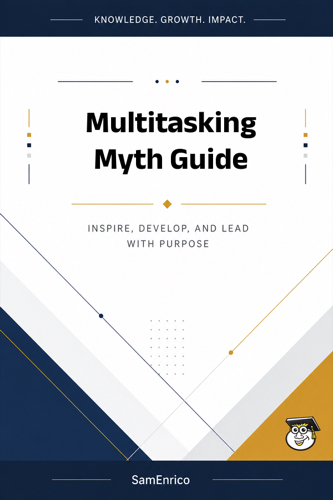
Multitasking Myth Guide Audiobook
undefined
by Mull Dorla
undefined
Formats
Free sample
Chapter 1: The Expensive Party Trick--–- In 2016, a thirty-four-year-old software developer named Mateo sat down at his desk at 9:00 AM, determined to finish a critical code deployment by noon. He opened his IDE, pulled up the deployment script, and began reviewing the final lines. Three minutes later, a Slack notification pinged. He glanced at it—a teammate asking a quick question about a different project. He typed a brief response, which took forty-five seconds.
Then he returned to the deployment script.But he did not simply resume. First, he had to remember where he had stopped. He scrolled up, found his place, reread the last two lines, and continued. Two minutes after that, his email chimed. A marketing manager needed approval on a landing page.
Mateo opened the email, skimmed the request, typed “Looks good,” and sent it. He returned to the deployment script. Again, he had to reorient. Again, he lost time.This pattern repeated for three hours. By noon, the deployment script was not finished.
Mateo felt exhausted, scattered, and vaguely guilty. He had worked continuously for three hours. He had answered fourteen Slack messages, responded to six emails, and even checked Twitter twice. But the one thing that mattered—the deployment script—remained incomplete.Mateo decided to track his time the next day. He installed a simple timer and clicked it every time he switched tasks.
At the end of the day, he reviewed the data. He had switched tasks 147 times in eight hours. Each switch cost him an average of twenty-three seconds of refocusing time. That added up to 3,381 seconds—fifty-six minutes—spent not doing work, but recovering from the act of switching. Add the latency of disengagement and activation, and the total exceeded ninety minutes.
An hour and a half of his day had vanished into a cognitive black hole.Mateo’s story is not unusual. It is not extreme. It is, by the standards of the modern workplace, completely normal. And that is the problem.This chapter reveals the true cost of switchtasking—the habit of rapidly toggling between conscious tasks that we mistakenly call multitasking. You will learn the switching cost theory, the 28% Tax that steals nearly two and a half hours from every workday, and the urgency illusion that keeps you trapped in a cycle of perpetual distraction.
By the end of this chapter, you will understand not just that switchtasking is expensive, but exactly how expensive—down to…
This is the end of the free sample. Get the Audiobook to keep going. Buy now
About this book
Details
- Author
- Mull Dorla
- Publisher
- SamEnrico
- Language
- English
- Genre
- Non-Fiction, Self-Help / Cognitive
- Released
- 2026-06-06
- Pages (approx.)
- 135
- Available as
- eBook, Audiobook

Listen in the VoxFlicks app
Audiobooks and audio dramas wherever you go. Sign in with your SamEnrico account and press play.
More by Mull Dorla
 Methamphetamine in LGBTQ NightlifeMull Dorla$11.99
 Gambling Addiction and Depression ComorbidityMull Dorla$11.99
 Guilt Versus Shame GuideMull Dorla$11.99
 Alcohol Seizure PreventionMull Dorla$11.99
 Pregnancy Loss HelplinesMull Dorla$11.99
 Gambling Addiction And ParentingMull Dorla$11.99
 Child Suicide Grief GuideMull Dorla$11.99
 Tangaroa and Hina: The Tide That BindsMull Dorla$11.99
 Silent Visions: The Hidden Pioneers of Latin America's First FilmsMull Dorla$11.99
 Growing AthamantaMull Dorla$11.99
 Student CV for Europe GuideMull Dorla$12.99
 Freemium Data Rollover FeatureMull Dorla$12.99