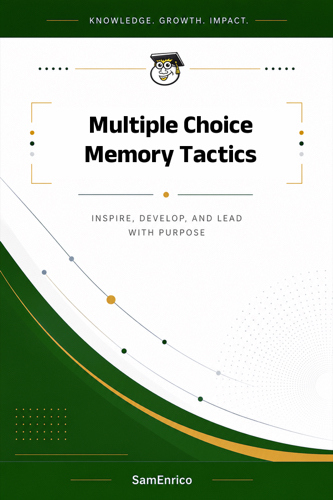
Multiple Choice Memory Tactics Audiobook
Eliminates distractors and cues recall.
by Wingate Minh
Eliminates distractors and cues recall.
Formats
Free sample
Chapter 1: The 68% Confession--–- I failed a test that I should have aced. Not by a small margin, but by a humiliating gap that made me question whether I had learned anything at all. The exam was multiple choice. The subject was one I had studied for six weeks. And when I saw my score—68%, barely above guessing—I did something I had never done before: I walked back to my dorm room, sat on the floor, and stared at the wall for an hour.The worst part was not the grade.
The worst part was the certainty I had felt while taking the test. Every question seemed familiar. Every answer option looked plausible. I had read the textbook, highlighted the key passages, and reviewed my notes three times. By every measure of traditional studying, I had done the work.
And yet, when the test maker presented me with four options, I consistently picked the wrong one. Not because I didn't know the material. Because I didn't understand how multiple choice actually works.This book exists because of that 68%. In the years that followed, I dedicated myself to understanding the strange, counterintuitive psychology of multiple-choice testing. I analyzed thousands of questions from the SAT, LSAT, MCAT, bar exam, nursing boards, and college final exams.
I interviewed test makers, cognitive psychologists, and high-scoring students. And I discovered a truth that most educators never tell you: multiple-choice tests do not measure knowledge. They measure recognition under deception.The Great Misunderstanding Every year, millions of students walk into examination rooms believing they understand what is about to happen. They believe that if they have studied hard enough, the correct answer will somehow reveal itself. They believe that multiple choice is easier than essay tests because the answer is "right there" on the page.
They believe that their first instinct is usually correct. Every single one of these beliefs is wrong.The fundamental misunderstanding begins with the difference between two types of memory: recall and recognition. Recall is what happens when someone asks you, "What is the capital of South Dakota?" and you generate the answer "Pierre" from scratch, with no cues or prompts. Recognition is what happens when someone shows you a list of four cities—Sioux Falls, Rapid City, Pierre, Aberdeen—and you identify the correct one. Recognition is neurologically easier because the correct answer itself acts as a retrieval cue.
Your brain does not have to search through its entire catalog; it only has to verify which of the presented…
This is the end of the free sample. Get the Audiobook to keep going. Buy now
About this book
Details
- Author
- Wingate Minh
- Publisher
- SamEnrico
- Language
- English
- Genre
- Non-Fiction, Self-Help, Test Strategy
- Released
- 2026-06-06
- Pages (approx.)
- 131
- Available as
- eBook, Audiobook

Listen in the VoxFlicks app
Audiobooks and audio dramas wherever you go. Sign in with your SamEnrico account and press play.
More by Wingate Minh
 Franchising Your Local Brand Across Borders Gray MarketWingate Minh$11.99
 Sleep Optimization for TestosteroneWingate Minh$11.99
 NVC For Perfectionism GuideWingate Minh$11.99
 Alcoholism in the Workplace Recovery GuideWingate Minh$11.99
 Stimulant Nutrition GuideWingate Minh$11.99
 Senior Cohousing Business ModelWingate Minh$11.99
 Clomiphene For MenWingate Minh$11.99
 The Last Stand at Dien Bien Phu: Vietnam's Valley of ShadowsWingate Minh$11.99
 Love and Ashes: A Sarajevo Romance Amid the SiegeWingate Minh$11.99
 How to Produce Colored Rubbing Oil StainWingate Minh$11.99
 Mastering The Art of Daitō-ryū Aiki-jūjutsu (大東流合気柔術)Wingate Minh$11.99
 EU VAT Cross Border Refund PrimerWingate Minh$12.99