
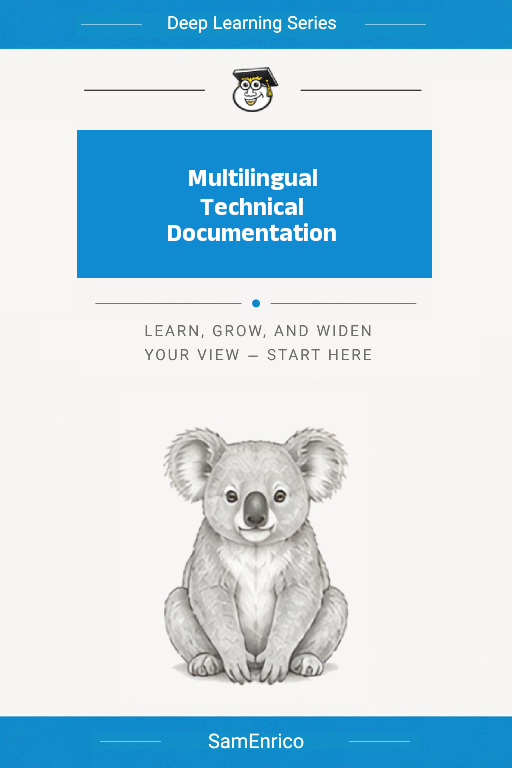
Non-FictionAI OperatorContent Engineering
Multilingual Technical Documentation eBook
Translate and localize technical content using AI.
Translate and localize technical content using AI. Maintain accuracy across languages and regions.
Formats
Free sample
Chapter 1: The Translation Trap...--–- The email arrived at 11:47 PM on a Tuesday. Maria, the localization manager for a medical device company, had just finished reviewing the Spanish version of a 200-page surgical robot manual. Her team of seven linguists had spent three weeks on it. The AI vendor had promised 95% automation. She had achieved 30%.
The next morning, her CEO forwarded a customer complaint: a distributor in Mexico City had found three separate errors in the emergency shutdown procedure. One of them—a mistranslation of "press and hold for five seconds" as "press five times"—could have caused equipment damage. Fortunately, no patient was harmed. But Maria knew the next mistake might not be so forgiving.This book is for everyone who has received that email. For every technical writer who has watched a perfectly good English sentence become a confusing mess in German.
For every localization engineer who has spent hours fixing placeholders that AI models refused to leave alone. For every product manager who has delayed a global launch because the Japanese documentation was still "in review." And for every executive who has wondered why, in the age of artificial intelligence, translating technical content remains so stubbornly, expensively, and dangerously difficult.The problem is not that AI translation doesn't work. It works beautifully for hotel reviews, social media posts, and news articles. The problem is that technical documentation is fundamentally different from these text types—and the traditional approaches to translation, including the ones currently being retrofitted for AI, were never designed for technical content. We are trying to solve a precision engineering problem with a statistical tool, and we are surprised when the results fall short.This chapter will dismantle the foundational assumptions that have led us into this trap.
It will explain why the traditional "Translate → Edit → Publish" model, which served the industry for decades, is now actively harmful when applied to generative AI and neural machine translation. It will introduce the modular, multi-stage pipeline that replaces this legacy approach. And it will provide an economic framework for understanding why investing in architectural quality is not a cost but a competitive advantage.But first, we need to understand how we got here.The Legacy Model: Designed for Humans, Not Machines The traditional localization workflow, which still dominates most organizations, follows a simple linear path: a human translator (or increasingly a machine translation engine) produces a draft, an editor reviews it for accuracy and style, and a publisher pushes it to production. This model emerged in the 1980s and 1990s, when translation was performed by humans using Computer-Assisted Translation (CAT) tools that stored previously translated sentences in Translation Memories (TMs). The workflow made sense for its time.
Human translators could infer context from surrounding text, ask clarifying questions, and apply judgment to ambiguous phrases. Rule-based machine translation (RBMT), when used, produced predictable if clunky output that followed explicit grammatical rules.But large language models (LLMs) are not rule-based systems, and they are not human translators. They are probabilistic engines that generate text by predicting the most likely next token based on patterns learned from billions of examples. This is simultaneously their greatest strength and their greatest weakness for technical documentation. They are fluent and fast, but they have no understanding of the content they translate.
They cannot distinguish between a critical safety instruction and a marketing slogan unless explicitly told to do so. They hallucinate—inventing terms, swapping synonyms, and dropping placeholders—because they are optimized for fluency, not for precision.The Translate → Edit → Publish model assumes that errors can be caught and fixed in the editing stage. For human translation, this is often true. A skilled editor can catch a mistranslated term or a grammatical error. For AI translation, this assumption fails catastrophically.
AI errors are not random; they are systematic. If an AI consistently mistranslates a particular term because its training data contained conflicting examples, editing a few instances does not fix the underlying problem. The next batch of content will contain the same error. Editors become firefighters, extinguishing the same blazes in every document, every release, every language. The cost does not scale linearly with volume; it scales exponentially.The Three Failure Modes of Legacy AI Translation Through hundreds of client engagements and production deployments, we have observed three consistent failure modes when organizations apply legacy workflows to AI translation.
Understanding these failures is the first step to designing a better architecture.Failure Mode One: Context Blindness Consider the word "Open." In a file menu, it should become "Abrir" in Spanish. In an electrical circuit diagram, describing a switch that completes a circuit, it becomes "Abierto" (closed vs. open has opposite meanings in electrical contexts—a complication that even human translators sometimes miss). In an application state, describing a customer support ticket, it might become "Pendiente" or "En curso." The AI has no way of knowing which meaning is correct unless you tell it. The legacy workflow provides no mechanism for supplying this context.
The translator or editor must infer it from the surrounding text, but if the surrounding text is also ambiguous—or if the string appears in isolation, as UI strings often do—the error is baked in before anyone sees it.One of our clients, a Saa S company, spent six months trying to figure out why their German users consistently misunderstood the "Reset" button in their analytics dashboard. The English label was unambiguous: "Reset" meant "restore default settings." The AI translated it as "Zurücksetzen," which is technically correct. But in German software interfaces, "Zurücksetzen" is also used for "delete" or "clear." Users were clicking the button expecting to clear their data and instead losing their custom configurations. The error was not in the translation—the word was correct. The error was in the failure to provide context: the button appeared next to user-generated data, and the AI had no way of knowing that the intended meaning was "restore defaults" rather than "clear."Failure Mode Two: Terminological Hallucination Technical documentation depends on consistent terminology.
A "driver" must always be translated the same way. An "error code" must never be translated at all. A product name like "Salesforce" must remain identical across all languages. LLMs have no inherent respect for these constraints. They treat terminology as suggestions rather than rules.A financial services client discovered that their AI translation pipeline had translated "vesting schedule" as three different terms across three different sections of the same employee handbook.
In English, the term was identical in all three locations. In Spanish, one section used "calendario de adquisición," another used "programa de derechos adquiridos," and a third used "cronograma de consolidación." All three were technically correct translations of "vesting schedule" in isolation. But in a legal document, inconsistency creates ambiguity, and ambiguity creates liability.Even worse than synonym substitution is outright invention. LLMs sometimes generate terms that do not exist in the target language because their training data contains a plausible-sounding but incorrect pattern. One medical translation vendor reported that their AI consistently translated "subcutaneous injection" as "inyección subcutánea" (correct) but translated "intramuscular injection" as "inyección intermuscular" (incorrect—the correct term is "intramuscular").
The AI had invented a plausible but non-standard term because its training data contained a pattern of using "inter-" as…
This is the end of the free sample. Get the eBook to keep going. Buy now
About this book
Details
- Author
- Baumgartner Erich
- Publisher
- SamEnrico
- Language
- English
- Genre
- Non-Fiction, AI Operator, Content Engineering
- Released
- 2026-06-01
- Pages (approx.)
- 154
- Available as
- eBook, Audiobook

Read better in the ZLOADR app
Your eBooks on your phone or tablet. Sign in with your SamEnrico account and start reading.
More by Baumgartner Erich
 Familial Migraine GuideBaumgartner Erich$11.99
 Active Listening For HR ProfessionalsBaumgartner Erich$11.99
 Lunch Break Recovery TechniquesBaumgartner Erich$11.99
 Meth Employment Re entry GuideBaumgartner Erich$11.99
 The Butcher of Buenos Aires: The Gruesome Reign of Cayetano Santos GodinoBaumgartner Erich$11.99
 Learn to Play the PibgornBaumgartner Erich$11.99
 How to Start a Dental Clinic (health Service) Business (Beginners Guide)Baumgartner Erich$11.99
 Credit AdministratorBaumgartner Erich$11.99
You may also like
 Hong Kong Handover 1997Dunn Johnnie$11.99
 Zumba For Postnatal Recovery CourseNeal Christian$11.99
 Zumba for BeginnersLadner Nikia$11.99
 YouTube Comment Mining GuideHumes Pandora$12.99
 Worry Box MeditationCarlin Rudy$11.99
 Workplace Stress MeditationNguyen Lynn$11.99
 Workplace Stress and Sleep RepairHawley Ivory$11.99
 Workplace Perfectionism CureDelaney Jeffry$11.99
 Workplace Injustice Anger GuideWallen Isabelle$11.99
 Work Addiction and Burnout LinkGreenwood Ester$11.99
 Women in Yoga and WellnessBeattie Galina$11.99
 Women in Stand Up ComedyChun Evangeline$11.99