
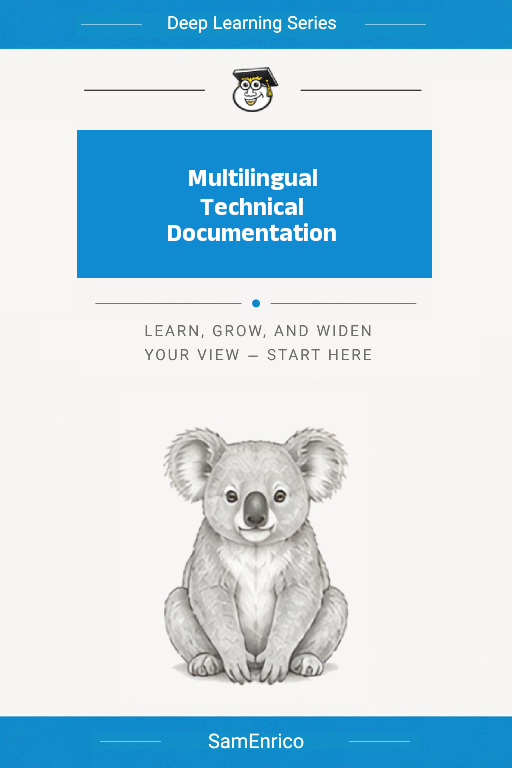
Non-FictionAI OperatorContent Engineering
Multilingual Technical Documentation Audiobook
Translate and localize technical content using AI.
Translate and localize technical content using AI. Maintain accuracy across languages and regions.
Formats
Free sample
Chapter 1: The Translation Trap...--–- The email arrived at 11:47 PM on a Tuesday. Maria, the localization manager for a medical device company, had just finished reviewing the Spanish version of a 200-page surgical robot manual. Her team of seven linguists had spent three weeks on it. The AI vendor had promised 95% automation. She had achieved 30%.
The next morning, her CEO forwarded a customer complaint: a distributor in Mexico City had found three separate errors in the emergency shutdown procedure. One of them—a mistranslation of "press and hold for five seconds" as "press five times"—could have caused equipment damage. Fortunately, no patient was harmed. But Maria knew the next mistake might not be so forgiving.This book is for everyone who has received that email. For every technical writer who has watched a perfectly good English sentence become a confusing mess in German.
For every localization engineer who has spent hours fixing placeholders that AI models refused to leave alone. For every product manager who has delayed a global launch because the Japanese documentation was still "in review." And for every executive who has wondered why, in the age of artificial intelligence, translating technical content remains so stubbornly, expensively, and dangerously difficult.The problem is not that AI translation doesn't work. It works beautifully for hotel reviews, social media posts, and news articles. The problem is that technical documentation is fundamentally different from these text types—and the traditional approaches to translation, including the ones currently being retrofitted for AI, were never designed for technical content. We are trying to solve a precision engineering problem with a statistical tool, and we are surprised when the results fall short.This chapter will dismantle the foundational assumptions that have led us into this trap.
It will explain why the traditional "Translate → Edit → Publish" model, which served the industry for decades, is now actively harmful when applied to generative AI and neural machine translation. It will introduce the modular, multi-stage pipeline that replaces this legacy approach. And it will provide an economic framework for understanding why investing in architectural quality is not a cost but a competitive advantage.But first, we need to understand how we got here.The Legacy Model: Designed for Humans, Not Machines The traditional localization workflow, which still dominates most organizations, follows a simple linear path: a human translator (or increasingly a machine translation engine) produces a…
This is the end of the free sample. Get the Audiobook to keep going. Buy now
About this book
Details
- Author
- Baumgartner Erich
- Publisher
- SamEnrico
- Language
- English
- Genre
- Non-Fiction, AI Operator, Content Engineering
- Released
- 2026-06-01
- Pages (approx.)
- 154
- Available as
- eBook, Audiobook

Listen in the VoxFlicks app
Audiobooks and audio dramas wherever you go. Sign in with your SamEnrico account and press play.
More by Baumgartner Erich
 Familial Migraine GuideBaumgartner Erich$11.99
 Active Listening For HR ProfessionalsBaumgartner Erich$11.99
 Lunch Break Recovery TechniquesBaumgartner Erich$11.99
 Meth Employment Re entry GuideBaumgartner Erich$11.99
 The Butcher of Buenos Aires: The Gruesome Reign of Cayetano Santos GodinoBaumgartner Erich$11.99
 Learn to Play the PibgornBaumgartner Erich$11.99
 How to Start a Dental Clinic (health Service) Business (Beginners Guide)Baumgartner Erich$11.99
 Credit AdministratorBaumgartner Erich$11.99
You may also like
 Hong Kong Handover 1997Dunn Johnnie$11.99
 Zumba For Postnatal Recovery CourseNeal Christian$11.99
 Zumba for BeginnersLadner Nikia$11.99
 YouTube Comment Mining GuideHumes Pandora$12.99
 Worry Box MeditationCarlin Rudy$11.99
 Workplace Stress MeditationNguyen Lynn$11.99
 Workplace Stress and Sleep RepairHawley Ivory$11.99
 Workplace Perfectionism CureDelaney Jeffry$11.99
 Workplace Injustice Anger GuideWallen Isabelle$11.99
 Work Addiction and Burnout LinkGreenwood Ester$11.99
 Women in Yoga and WellnessBeattie Galina$11.99
 Women in Stand Up ComedyChun Evangeline$11.99