
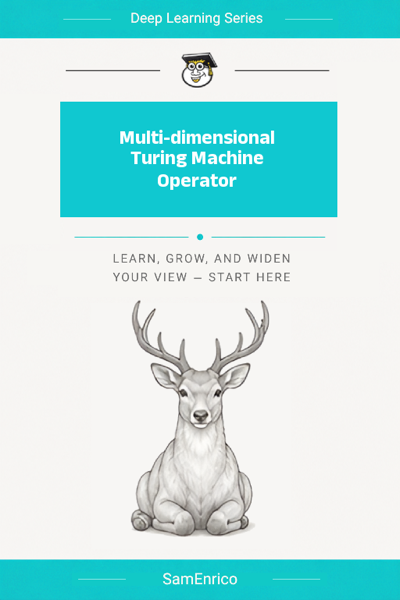
Non-FictionInformativeEducational
Multi-dimensional Turing Machine Operator eBook
A Coursebook on Multi-dimensional Turing Machine O
A Coursebook on Multi-dimensional Turing Machine Operator
Formats
Free sample
Chapter 1: The Tape That Grew…--– In the beginning, there was a line.Not a metaphor. Not a poetic flourish. A literal, infinite, one-dimensional line, segmented into discrete cells, each holding a single symbol from a finite alphabet. Above this line hovered a read-write head, no larger than a thought, connected to a finite state machine that could be in exactly one of a handful of internal configurations. At each tick of an imaginary clock, the head would read the symbol beneath it, consult a lookup table, write a new symbol, move left or right by exactly one cell, and transition to a new state.This was the Turing machine.
1936. Alan Turing, age twenty-four, had just killed something beautiful and terrifying: the dream of a universal decision procedure for all mathematical truths. In its place, he gave us computation itself. Every digital computer, every smartphone, every AI model that writes poetry or pretends to be your friend—all of them are just this lonely head crawling along a line, one cell at a time, following rules that a patient human with a pencil could execute given enough paper and centuries.But here is the secret that most computer science textbooks bury on page three hundred: the line is a lie.Not a falsehood, mind you. A constraint.
A historical accident. Turing chose one dimension because it was sufficient to prove his point about undecidability, not because it was optimal for all time. He needed the simplest possible model that could still compute everything computable. One dimension worked. Case closed.Except the case was never closed.Because while the classical 1D Turing machine can eventually compute anything, it does so with the grace of a man trying to paint the Sistine Chapel while crawling through a sewer pipe.
It can reach every cell, yes. But the cost in time and motion is staggering. Consider something as simple as finding a specific pattern in a two-dimensional grid—a chessboard, a photograph, a map. On a 1D Turing machine, you must flatten the grid into a line, row by row, then search linearly, then mentally reconstruct the spatial relationships you just destroyed. The head zigs left and right across vast distances, forgetting what it saw three rows ago, re-reading the same symbols like a distracted student cramming for an exam.Now imagine you could move up.
And down. And diagonally.Imagine the tape had width. And depth. And beyond.Welcome to the multi-dimensional Turing machine. And welcome to the reason you are no longer a programmer.
You are an operator.The Prisoner of the Line Let me tell you a story. It happened last year, though I will change the names to protect the stubborn.A friend of mine—let us call her Lena—is a computer vision engineer. She builds systems that identify tumors in medical scans. The scans are three-dimensional volumes: voxels arranged in a cube, each with a grayscale value representing tissue density. Lena's job is to write code that finds the boundaries of a tumor, a task that involves comparing each voxel to its twenty-six neighbors in 3D space.Her tools: Python, Py Torch, CUDA, and a cluster of GPUs.Her problem: none of those tools work the way she thinks they work.One night, over video call, she confessed, "I feel like I'm fighting the hardware.
Every algorithm I write wants to be two-dimensional. But the data is three-dimensional. So I spend all my time flattening and unflattening. I rewrite loops. I curse memory layouts.
I dream in row-major order."I asked her, "Have you ever used a 3D Turing machine?"She laughed. "That's a theoretical model. It doesn't exist.""Doesn't it?" I said. "What do you think your GPU's tensor cores are? They're not 1D.
They're not even 2D. They're a fabric of parallel processing elements arranged in a grid, moving data in multiple dimensions simultaneously. The only difference is that your GPU is finite—it has fixed memory and fixed geometry—while a Turing machine's tape is infinite. But the principle is the same: when your problem has structure in multiple dimensions, you want a machine that moves in multiple dimensions."Lena went quiet.Then she said, "So I've been a 1D operator trapped in a 3D world.""Worse," I said. "You didn't even know you were an operator."That is the purpose of this book.
Not to teach you one more programming language. Not to drill you on algorithms you will never implement by hand. But to retrain your intuition. To expand the shape of the tape in your mind until it matches the shape of the problems you actually face.By the end of this chapter, you will no longer see computation as a line. You will see a grid.
A volume. A hypercube. You will understand why the dimensionality of your machine is not a footnote in a theory textbook but the single most important design decision you never knew you were making.And you will begin your transformation from programmer to operator.The Classical Machine: One Line to Rule Them All Before we bend dimensions, we must respect the original.The classical 1D Turing machine consists of five components, though different authors count them differently. I will give you the version that will scale to multiple dimensions:A finite set of states, Q. One of these is the start state (q₀).
Some are halting states—accept (q_acc) and reject (q_rej).A finite input alphabet, Σ. These are the symbols that initially appear on the tape.A finite tape alphabet, Γ, which includes Σ and at least one special blank symbol (written as # or ⊔).A transition function, δ: Q × Γ → Q × Γ × {L, R}. Given a current state and the symbol being read, this function tells you: what state to enter, what symbol to write, and whether to move left or right.An infinite tape, divided into cells, each holding a symbol from Γ. The tape is infinite in both directions, though only finitely many cells are non-blank at any time.The head starts at cell 0. The machine runs until it enters a halting state.
If it never halts, it loops forever.That is the entire model. The Lambda Calculus of hardware. You can simulate any digital computer with this. You can simulate every algorithm ever written. You can simulate the universe, if the universe is discrete and you have infinite time.But you cannot simulate it quickly.The problem is locality.
On a 1D tape, the head can only see one cell at a time. To access a cell far away, the head must walk there, one step per cell, like a mail carrier without a bicycle. If you have a 2D grid of size n×n stored on a 1D tape in row-major order, moving from a cell in row i, column j to the cell directly below it (row i+1, column j) requires jumping forward by n cells. That jump takes n steps. To perform a 2D convolution—comparing each cell to its eight neighbors—the head must repeatedly walk great distances, forgetting intermediate results, recomputing coordinates from scratch.This is not a minor inefficiency.
This is a dimensional mismatch. Your algorithm thinks in two dimensions. Your machine thinks in one. The translation cost is…
This is the end of the free sample. Get the eBook to keep going. Buy now
About this book
Details
- Author
- Mccracken Earnestine
- Publisher
- SamEnrico
- Language
- English
- Genre
- Non-Fiction, Informative, Educational
- Released
- 2026-05-06
- Pages (approx.)
- 137
- Available as
- eBook, Audiobook

Read better in the ZLOADR app
Your eBooks on your phone or tablet. Sign in with your SamEnrico account and start reading.
More by Mccracken Earnestine
 Moon Phobia Selenophobia GuideMccracken Earnestine$11.99
 Call of Duty Addiction GuideMccracken Earnestine$11.99
 Doctor Suicide Attempt Survivor GuideMccracken Earnestine$11.99
 Depreciation for Retail EquipmentMccracken Earnestine$11.99
 The Stress Autoimmune Disease LinkMccracken Earnestine$11.99
 The Raven’s Lament: How the Trickster Brought the First DawnMccracken Earnestine$11.99
 Understanding Marie–unna Congenital HypotrichosisMccracken Earnestine$17.99
 Cybersecurity Services Export GuideMccracken Earnestine$12.99
 Manager Training For Remote ReviewsMccracken Earnestine$12.99
 How to Become a SelectorMccracken Earnestine$11.99
You may also like
 Hong Kong Handover 1997Dunn Johnnie$11.99
 Zumba For Postnatal Recovery CourseNeal Christian$11.99
 Zumba for BeginnersLadner Nikia$11.99
 YouTube Comment Mining GuideHumes Pandora$12.99
 Worry Box MeditationCarlin Rudy$11.99
 Workplace Stress MeditationNguyen Lynn$11.99
 Workplace Stress and Sleep RepairHawley Ivory$11.99
 Workplace Perfectionism CureDelaney Jeffry$11.99
 Workplace Injustice Anger GuideWallen Isabelle$11.99
 Work Addiction and Burnout LinkGreenwood Ester$11.99
 Women in Yoga and WellnessBeattie Galina$11.99
 Women in Stand Up ComedyChun Evangeline$11.99