
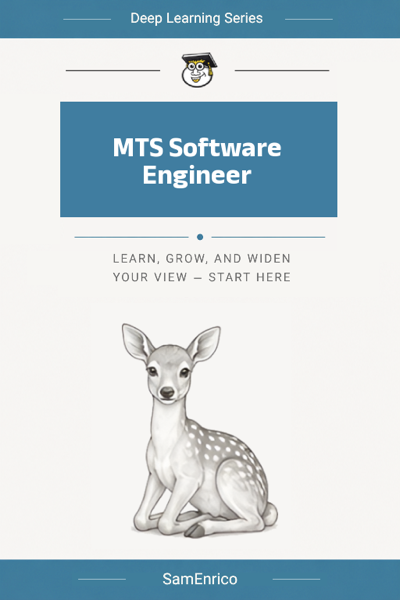
Non-FictionInformativeEducational
MTS Software Engineer eBook
A Coursebook on MTS Software Engineer
by Seward Loma
A Coursebook on MTS Software Engineer
Formats
Free sample
Chapter 1: The Ownership Paradox--A senior engineer named Maya had just delivered a flawless feature. Her code passed all tests, met every requirement, and deployed without incident. She expected a promotion to MTS. Instead, her manager said something that stopped her cold: "You're still thinking like a Senior. You shipped code, but you didn't own the problem."Maya had spent six years mastering algorithms, system design, and programming languages.
She could optimize a query, debug a memory leak, and lead a code review. But she had never been asked to define what "done" meant for an entire system. She had never been the last call before a billion-dollar outage. She had never signed off on a design that would outlive her tenure at the company.That conversation changed everything for Maya—and it is the exact moment this book aims to create for you.Welcome to the MTS journey.The Great Misunderstanding In the technology industry, few titles are as misunderstood as Member of Technical Staff. Ask ten engineers what MTS means, and you will get eleven answers.
Some believe it is simply a senior engineer with a different corporate label. Others think it signals a research-focused role, closer to a Ph D than to product development. Still others assume it is the natural next step after Senior, with no meaningful distinction except salary band.All of these views are wrong. And that misunderstanding costs engineers millions of dollars in lost compensation, years of stalled career progression, and the quiet frustration of doing Senior work while holding an MTS title.The truth is both simpler and harder: MTS is not Senior-plus. It is a fundamentally different role with different expectations, different failure modes, and a different definition of success.To understand why, we need to rewind.A Brief History: Where Did MTS Come From?The MTS title originated in research laboratories like Bell Labs, IBM Research, and Xerox PARC.
In those environments, a Member of Technical Staff was someone who contributed original technical work—often published—without managing people. The title signaled that you had earned a place among peers based on technical merit alone.When tech companies scaled beyond Silicon Valley startups, they borrowed the MTS title for a different purpose. They needed a way to recognize engineers whose impact exceeded Senior but who did not want to become managers. The industry settled on a dual-ladder system: Engineering Manager for people leaders, and MTS for technical leaders.But here is where confusion crept in. Most companies kept the Senior title as well.
They created a progression that looked like this:Software Engineer I → Software Engineer II → Senior Software Engineer → MTS → Senior MTS → Principal → Fellow The problem is that this ladder implies that MTS is just the next rung. It is not. The jump from Senior to MTS is the largest capability leap in the entire engineering career track—larger than from Junior to Senior, and arguably larger than from MTS to Principal.Why?Because Senior engineers solve problems that are given to them. MTS engineers discover which problems are worth solving.The Critical Distinction: Execution vs. Ownership Let me draw a distinction that will appear throughout this book.
It is the single most important concept in understanding the MTS role.A Software Engineer executes tasks. Someone gives them a ticket, a specification, or a user story. They implement it correctly, test it thoroughly, and deploy it safely. Success is measured in completed tickets and clean builds.A Senior Engineer designs features. They take a product requirement and break it into technical components.
They choose appropriate data structures, design APIs, and consider edge cases. Success is measured in features shipped and systems that function as specified.An MTS owns systems. They define what quality means for their component. They decide when to accept technical debt and when to refactor. They anticipate failure modes that no product manager could articulate.
They are the final escalation point when something breaks. Success is measured in system outcomes: reliability, scalability, operability, and long-term maintainability.Let me repeat that because it is easy to skim and miss:Senior: "I built what we asked for."MTS: "I built what we needed, even when we didn't know to ask for it."This is the Ownership Paradox that gives this chapter its name. To succeed as an MTS, you must take ownership that feels like overreach to a Senior engineer. You must make decisions without permission. You must act as if the system is yours—because eventually, it will be.Yet you will rarely have formal authority over the people whose work affects your system.
You cannot fire the colleague who introduces a breaking change. You cannot reassign the product manager who prioritizes the wrong features. You must influence without authority.That is the paradox: complete ownership over outcomes, zero authority over people.The Three Pillars of MTS Ownership What does ownership actually look like in daily work? It manifests in three distinct pillars. You will recognize an MTS by whether they consistently demonstrate all three.Pillar One: Quality Ownership A Senior engineer writes tests that pass.
An MTS defines what "passing" means.Quality ownership means you decide the testing strategy for your system. You choose between unit tests, integration tests, end-to-end tests, and chaos experiments based on risk analysis, not habit. You set the thresholds for code coverage, performance regression, and security scanning.More importantly, you own the definition of "done" for quality. When a product manager asks, "Can we ship this?," you are the person who answers—not because you have been given authority, but because your technical judgment is trusted.Practical example: A Senior engineer runs the test suite and reports that all 5,000 tests passed. An MTS asks, "Which tests are flaky?
Which scenarios aren't covered? What is the false negative rate?" The MTS knows that passing tests are necessary but not sufficient for quality.Pillar Two: Scalability Ownership A Senior engineer builds features that work for the current load. An MTS builds systems that work for the load three years from now.Scalability ownership does not mean premature optimization. It means you understand the growth trajectory of your system—not just in requests per second, but in data volume, team size, and feature complexity. You design for the constraints you know are coming, not the ones you fear might appear.Practical example: A Senior engineer adds a new database query that works fine at 100 queries per second.
An MTS notices that the query performs a full table scan and calculates that at 1,000 queries per second (projected for next quarter), the database will saturate. The MTS proposes an index or a denormalized table before the crisis occurs.Pillar Three: Long-Term Evolution Ownership A Senior engineer leaves behind code that works. An MTS leaves behind code that can change.Long-term evolution ownership is the most subtle but most important pillar. It means you design for the engineers who will maintain your system after you have moved to another team—or another company. You document not just what the code does, but why it does it.
You create abstractions that can be extended without being broken. You treat your system as a living artifact, not a one-time delivery.Practical…
This is the end of the free sample. Get the eBook to keep going. Buy now
About this book
Details
- Author
- Seward Loma
- Publisher
- SamEnrico
- Language
- English
- Genre
- Non-Fiction, Informative, Educational
- Released
- 2026-05-11
- Pages (approx.)
- 137
- Available as
- eBook, Audiobook

Read better in the ZLOADR app
Your eBooks on your phone or tablet. Sign in with your SamEnrico account and start reading.
More by Seward Loma
 LAPD Black Dahlia FilesSeward Loma$11.99
 Self Esteem for SinglesSeward Loma$11.99
 Carla Fracci GiselleSeward Loma$11.99
 Flirting Nonverbal Cues GuideSeward Loma$11.99
 The Iron Will of Zheng He: The Siege of Malacca and the Birth of a Naval EmpireSeward Loma$11.99
 Instagram Aesthetic HomeSeward Loma$12.99
 How to Produce BeetsSeward Loma$11.99
 10 Ways to Use Golden Syrup (Recipe Book)Seward Loma$11.99
You may also like
 Hong Kong Handover 1997Dunn Johnnie$11.99
 Zumba For Postnatal Recovery CourseNeal Christian$11.99
 Zumba for BeginnersLadner Nikia$11.99
 YouTube Comment Mining GuideHumes Pandora$12.99
 Worry Box MeditationCarlin Rudy$11.99
 Workplace Stress MeditationNguyen Lynn$11.99
 Workplace Stress and Sleep RepairHawley Ivory$11.99
 Workplace Perfectionism CureDelaney Jeffry$11.99
 Workplace Injustice Anger GuideWallen Isabelle$11.99
 Work Addiction and Burnout LinkGreenwood Ester$11.99
 Women in Yoga and WellnessBeattie Galina$11.99
 Women in Stand Up ComedyChun Evangeline$11.99