
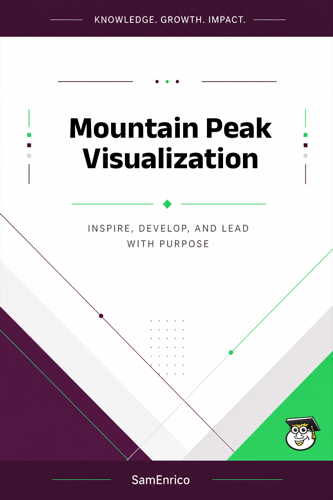
Non-FictionSelf-HelpVisualizationClarity
Mountain Peak Visualization eBook
Ascend a calm mountain path to achieve mental clar
Ascend a calm mountain path to achieve mental clarity and perspective.
Formats
Free sample
Chapter 1: The Vertical Lens--–- Every morning, before your feet touch the floor, you are already climbing. Not a mountain of rock and snow, but a mountain of obligations, notifications, memories, and unmet expectations. You climb it so automatically that you no longer notice the effort. The steepness feels normal. The thin air feels like life.
And somewhere along the way, you lost the ability to see your own terrain clearly.This book offers a different ascent. Not harder, not faster, not more heroic. Slower. Gentler. And from a radically different angle.The mountain you are about to visualize is not an escape from your life.
It is a lens. A lens made of elevation, silence, and deliberate perspective. When you learn to climb this inner mountain, you are not running away from your problems. You are stepping sideways, then upward, until the fog of daily urgency thins and you can finally see the shape of things as they really are.Why does upward movement create mental clarity? And why a mountain, specifically, rather than a tower, a hot air balloon, or a spaceship?
The answers lie at the intersection of evolutionary psychology, neuroscience, and a quiet truth that every culture has known for millennia: high places change how we think.The Ancient Compass Still Inside Your Skull Long before you had a smartphone, a mortgage, or an email inbox, your ancestors had a survival problem that shaped your brain’s architecture. They needed to know, instantly, whether a landscape offered safety or danger. And the fastest way to assess safety was elevation.From a height, predators could be spotted from a distance. Escape routes could be mapped. Resources—water, shelter, other humans—became visible across a wider field of view.
The human brain evolved to associate elevation with controlled perception: the higher you go, the more of the environment you can see, and the less likely you are to be surprised by a threat.That ancient calculation still runs beneath your conscious awareness. When you feel anxious, your peripheral vision narrows. When you feel safe, it expands. When you are overwhelmed, your brain’s threat-detection system (the amygdala) hijacks your attention and forces you to focus on the nearest, loudest problem. This is called attentional narrowing, and it is the neurological equivalent of being lost in a dark forest with a dying flashlight.Visualizing a mountain ascent reverses that narrowing.
Research in environmental psychology and cognitive neuroscience has shown that simply imagining a high vantage point—even with your eyes closed—activates the same spatial processing regions (the hippocampus and parahippocampal place area) as actually climbing. Your brain does not fully distinguish between a real view and a vividly imagined one. When you visualize standing on a mountain ridge, your brain releases a cascade of signals that reduce cortisol (the stress hormone) and increase perceived control.This is not mysticism. This is neurobiology. And it is the foundation of everything that follows.Competitive Climbing Versus the Calm Path Most books about visualization fall into a trap that this book will deliberately avoid.
They treat the mind like a muscle to be optimized, a problem to be solved, or a competitor to be trained. Their visualizations are athletic: imagine yourself winning the presentation, closing the deal, running the marathon, delivering the perfect speech. These are competitive climbs—summit-at-all-costs, often anxiety-provoking, and ultimately exhausting.There is nothing wrong with performance visualization. It works. But it is not designed for the person who wakes up foggy, exhausted, and unsure which end is up.
It is not designed for grief, for depression, for the slow accumulation of daily overwhelm. And it is certainly not designed for the quiet, persistent sense that you have lost perspective on your own life.Mountain Peak Visualization offers a different path: the calm path. On this path, there is no finish line. No leaderboard. No one watching.
The only metric is your own felt sense of clarity—and even that will fluctuate from day to day. The calm path is gentle, repeatable, and focused on process rather than outcome. You are not trying to achieve a peak experience. You are trying to visit a perspective, again and again, until the view becomes part of your baseline vision.Let me say this clearly, because it matters more than anything else in this chapter: you do not have to believe in mountains, visualization, or any of this for it to work. The brain responds to imagined environments whether or not you think they are “real.” Treat the mountain as a useful fiction.
A vivid metaphor. A dream you learn to steer. That is enough.What Vertical Clarity Actually Looks Like Before we go any further, let me describe the destination. Not because you will arrive there immediately—you won’t—but because knowing what clarity feels like helps you recognize it when it appears.Vertical clarity is not euphoria. It is not a sudden solution to all your problems.
It is not a voice from the sky announcing the meaning of life. Most people who try visualization for the first time expect fireworks. When they get something quieter, they assume they did something wrong.Here is what genuine mental clarity feels like:A softening of urgency. The deadline that felt like a heart attack ten minutes ago now feels like a manageable task.A reduction in self-talk. The endless inner narrator who comments on everything (“you’re doing this wrong,” “why did you say that,” “what if they’re angry”) grows quieter, not because you silenced him, but because you have moved to a place where his voice carries less weight.A sense of “oh, I see.” Not an answer, but a shape.
You suddenly understand the outline of a problem you’ve been wrestling with for weeks. The details may still be fuzzy, but the structure is visible.A widening of peripheral awareness. In your visualization, you notice more details—the distant lake, the bird circling below, the texture of the rock. In your real life, you start noticing more options, more exits, more possibilities.This is what the summit feels like. Not a scream.
A sigh.The Neuroscience of Looking Down Let me give you a little more science, because understanding the mechanism builds trust in the practice. When you are stuck in rumination—replaying the same argument, worrying about the same future disaster, criticizing yourself for the same past mistake—your brain’s default mode network (DMN) is overactive. The DMN is the collection of brain regions that light up when you are not focused on an external task. It is responsible for self-referential thought, autobiographical memory, and mental time travel (past and future). A little DMN activity is healthy.
Too much is depression, anxiety, and paralysis.Looking down from a height—even an imagined height—suppresses the DMN. Why? Because your brain evolved to prioritize spatial processing over self-processing when you are in a high place. From an elevation, your ancestors needed to scan the environment for threats and resources. That scanning requires attention to external space, not internal narrative.
The brain literally shifts resources from the DMN to the visuospatial network.In practical terms: when you visualize a mountain peak…
This is the end of the free sample. Get the eBook to keep going. Buy now
About this book
Details
- Author
- Brandon Danyelle
- Publisher
- SamEnrico
- Language
- English
- Genre
- Non-Fiction, Self-Help, Visualization, Clarity
- Released
- 2026-06-09
- Pages (approx.)
- 103
- Available as
- eBook, Audiobook

Read better in the ZLOADR app
Your eBooks on your phone or tablet. Sign in with your SamEnrico account and start reading.
More by Brandon Danyelle
 Blind Child Self Esteem GuideBrandon Danyelle$11.99
 The Second Trimester Loss WorkbookBrandon Danyelle$11.99
 Stretching for Tight CalvesBrandon Danyelle$11.99
 Metta for Parental EstrangementBrandon Danyelle$11.99
 The Opium Syndicate: How a Shanghai Drug Ring Poisoned an EmpireBrandon Danyelle$11.99
 How to Start a Truss Manufacturing BusinessBrandon Danyelle$11.99
 Extension Cord Inspection (for Damage)Brandon Danyelle$11.99
 Economics Formulas in ExcelBrandon Danyelle$12.99
 Creative Impact MeasurementBrandon Danyelle$12.99
 Understanding Necrotizing Encephalopathy, Infantile SubacuteBrandon Danyelle$17.99
You may also like
 Hong Kong Handover 1997Dunn Johnnie$11.99
 Zumba For Postnatal Recovery CourseNeal Christian$11.99
 Zumba for BeginnersLadner Nikia$11.99
 YouTube Comment Mining GuideHumes Pandora$12.99
 Worry Box MeditationCarlin Rudy$11.99
 Workplace Stress MeditationNguyen Lynn$11.99
 Workplace Stress and Sleep RepairHawley Ivory$11.99
 Workplace Perfectionism CureDelaney Jeffry$11.99
 Workplace Injustice Anger GuideWallen Isabelle$11.99
 Work Addiction and Burnout LinkGreenwood Ester$11.99
 Women in Yoga and WellnessBeattie Galina$11.99
 Women in Stand Up ComedyChun Evangeline$11.99