
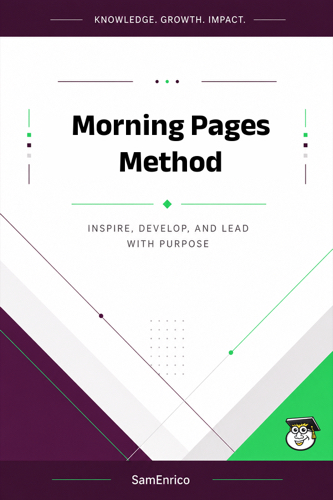
Non-FictionSelf-HelpMorning Pages
Morning Pages Method eBook
Three pages of stream of consciousness writing to
Three pages of stream of consciousness writing to clear mental blocks.
Formats
Free sample
Chapter 1: The Brain Drain...--–- You wake up. Before you check your phone, before you remember the email you didn’t send, before the to-do list descends like a flock of hungry birds—there is a space. A space of about thirty minutes where your brain is still stretching, still yawning, still not fully online. In that space lives a door. Behind that door is everything you actually think, feel, and want.
And most days, you close that door before you even know it exists.This book is about learning to open that door. Not with a key, not with a mantra, not with a complicated spiritual practice. With a pen and three pages of paper. Every morning. Before the Censor wakes up.Let me tell you something that sounds like a lie but is not: most of what you worry about, rehearse, regret, and plan before noon is not real.
It is mental static. It is the brain’s unfortunate habit of running the same anxious loops because it has nothing better to do. You wake up, and within sixty seconds, your brain has already replayed last night’s awkward conversation, anticipated today’s difficult meeting, and reminded you that you forgot to buy milk. This is not insight. This is noise.
And noise is not harmless—noise drowns out signal.The Morning Pages Method is not a writing technique. It is a clearing technique. Writing is the vehicle, but clarity is the destination. Three pages of longhand, stream-of-consciousness writing, done first thing in the morning, with no editing, no rereading, and no audience. That is the practice.
Simple enough to fit on a sticky note. Hard enough that most people quit before they see what it can do.I have watched this practice transform blocked painters into prolific creators, stalled executives into decisive leaders, and grieving humans into people who could finally breathe again. Not because the pages fix anything directly. Because they drain the swamp. And once the swamp is drained, you can see what has been living in the mud.This chapter is called The Brain Drain for a reason.
We are going to walk through the science, the psychology, and the lived experience of why three pages every morning changes everything. We are going to meet the two characters who live inside your head—the Censor and the Artist—and learn why the first thirty minutes of your day belong to you, not to them. And by the end of this chapter, you will understand why venting is not a waste of time. It is the most productive thing you can do before breakfast.The Cognitive Load of Being Human Let us start with a number: four.According to cognitive load theory, the human working memory can hold approximately four discrete chunks of information at any given moment. Some researchers say three to five.
The exact number is less important than the reality: your brain is a very small table. You can put four things on that table. Maybe five if you push. Then the table is full. Anything else you try to set down knocks something else onto the floor.Here is what most people keep on that table at 7:00 AM: the thing they are worried about from yesterday, the thing they are dreading today, the thing they forgot to do last week, and the vague sense that they are running late.
That is four. The table is full. There is no room for creative insight, strategic thinking, patience with your children, or the quiet joy of a morning coffee. Those things are on the floor.Morning Pages clear the table. You take every single item—the worry, the dread, the guilt, the vague anxiety—and you move it onto paper.
Not because the paper solves anything. Because the paper holds it. The brain does not have to hold it anymore. And once the table is empty, you get to choose what to put back.This is not metaphor. This is neurology.
The default mode network—the part of your brain that activates when you are not focused on an external task—is responsible for rumination, self-referential thought, and mind-wandering. It is also the part of your brain that loops anxious narratives. When you write stream-of-consciousness, you are essentially offloading the default mode network’s output onto an external medium. You are telling your brain: I see this. I have recorded this.
You can let it go now.And your brain, surprisingly, listens.I have worked with writers who described Morning Pages as “turning down the volume on a radio that had been playing static for decades.” One painter told me that after two weeks of pages, she realized she had been carrying the same argument with her mother in her head for eighteen years. Eighteen years of table space occupied by a conversation that never happened. She wrote the argument down. She cried. She moved on.
The table cleared.Venting feels unproductive because we have been taught that productivity means output: a finished painting, a signed contract, a clean house. But output is impossible when the input channels are clogged. You cannot pour clean water through a dirty pipe. Morning Pages are the cleaning of the pipe. And that cleaning takes time, and mess, and the willingness to write down things that are not elegant.The Censor and the Artist: A War You Did Not Know You Were Fighting Inside your head, there is a war.
Not a loud war with explosions and shouting. A quiet, cold war of attrition. On one side sits the Censor. On the other side sits the Artist. And for most of your waking life, the Censor wins.The Censor is not evil.
The Censor is trying to protect you. Its job is to keep you safe, socially acceptable, and free from embarrassment. The Censor is the voice that says “Don’t say that, they will think you are strange.” “That idea will never work.” “You are not a real writer.” “Who do you think you are?” The Censor is responsible for grammar, spelling, logic, and looking good in front of other people. It lives in the left hemisphere of your brain, which is the hemisphere associated with language, analysis, and linear thinking.The Artist is not virtuous. The Artist is simply the part of you that makes things.
It is intuitive, messy, playful, and utterly unconcerned with whether the thing it makes is good. The Artist draws stick figures and calls them masterpieces. The Artist writes bad poetry and does not care. The Artist lives in the right hemisphere, which is associated with holistic thinking, emotion, and creativity.Here is the problem. The Censor wakes up before the Artist.
The Censor is an early riser. But—and this is crucial—the Censor is groggy for the first thirty minutes after you wake. Your prefrontal cortex, which is the seat of executive function and self-control, does not fully activate until about thirty minutes after waking. That means the Censor is not fully online. It is there.
It is muttering. But it is not yet in charge.The Artist, by contrast, is also groggy. The difference is that the…
This is the end of the free sample. Get the eBook to keep going. Buy now
About this book
Details
- Author
- Batiste Florene
- Publisher
- SamEnrico
- Language
- English
- Genre
- Non-Fiction, Self-Help, Morning Pages
- Released
- 2026-06-11
- Pages (approx.)
- 143
- Available as
- eBook, Audiobook

Read better in the ZLOADR app
Your eBooks on your phone or tablet. Sign in with your SamEnrico account and start reading.
More by Batiste Florene
 Therapy Active Listening GuideBatiste Florene$11.99
 Immigrant Dry Cleaning Chain SuccessBatiste Florene$11.99
 Wholesaling SEO For SellersBatiste Florene$11.99
 Mobility Work for Injury PreventionBatiste Florene$11.99
 Huston Dynasty - John HustonBatiste Florene$11.99
 Birthmark Childhood ShameBatiste Florene$11.99
 The Inheritance of RageBatiste Florene$11.99
 Data Broker Registration FinesBatiste Florene$11.99
 The Philosopher-Kings of Industry: Black Entrepreneurs Who Built EmpiresBatiste Florene$11.99
 Silent Wings: The Unseen War Over Nagorno-KarabakhBatiste Florene$11.99
 Rosetta's Comet Chase: Europe's Quest to Unlock the Origins of the Solar SystemBatiste Florene$11.99
 How to Start a Artificial Limb Business (Beginners Guide)Batiste Florene$11.99
You may also like
 Hong Kong Handover 1997Dunn Johnnie$11.99
 Zumba For Postnatal Recovery CourseNeal Christian$11.99
 Zumba for BeginnersLadner Nikia$11.99
 YouTube Comment Mining GuideHumes Pandora$12.99
 Worry Box MeditationCarlin Rudy$11.99
 Workplace Stress MeditationNguyen Lynn$11.99
 Workplace Stress and Sleep RepairHawley Ivory$11.99
 Workplace Perfectionism CureDelaney Jeffry$11.99
 Workplace Injustice Anger GuideWallen Isabelle$11.99
 Work Addiction and Burnout LinkGreenwood Ester$11.99
 Women in Yoga and WellnessBeattie Galina$11.99
 Women in Stand Up ComedyChun Evangeline$11.99