
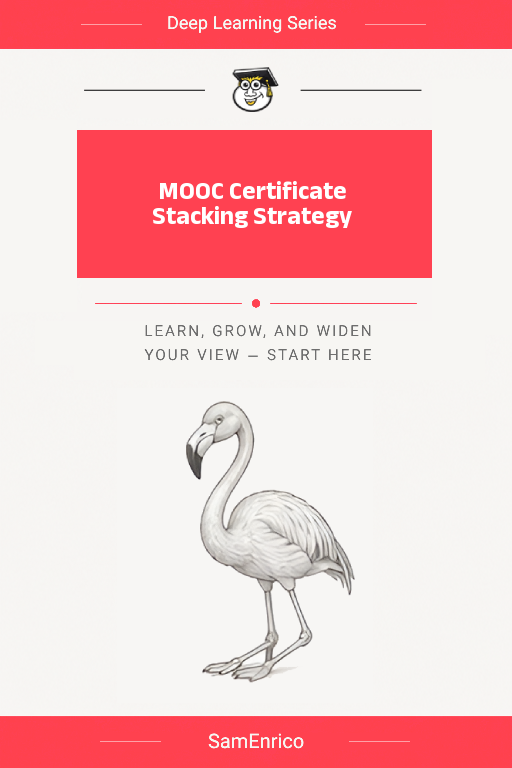
MOOC Certificate Stacking Strategy eBook
Combine multiple MOOC certificates into a career n
Combine multiple MOOC certificates into a career narrative that signals specialization and commitment to employers.
Formats
Free sample
Chapter 1: The Expiration Date--You don't have a credential problem. You have an obsolescence problem.Let that land for a moment. If you are reading this book, you have likely already accumulated a collection of credentials. Perhaps a bachelor's degree. Maybe a master's.
Certainly a handful of certificates from various online platforms that you collected during late-night browsing sessions or corporate training mandates. You have done everything society told you to do: you went to school, you got the paper, you stayed employed. And yet, something feels wrong. The promotions aren't coming. The interviews are drying up.
The job descriptions that once seemed accessible now appear to be written in a language you don't quite speak.Here is the truth that no university admissions office will tell you and no career coach wants to admit: your degree has an expiration date. And it is much closer than you think.This chapter is not an attack on higher education. It is not a manifesto declaring that degrees are worthless. That would be absurd and demonstrably false. Degrees still matter.
They signal persistence, social conformity, and baseline literacy. But the monopoly that degrees once held on the labor market has been broken. Quietly, systematically, and with surprisingly little media fanfare, employers have stopped believing that a diploma proves you can do the job. And once you understand why, you will also understand why stacking MOOC certificates into a coherent narrative is not just a clever career hack—it is the only rational response to the way hiring actually works in 2026.The Half-Life of a Technical Skill Let's start with a number: two point five.That is the number of years. According to research from the Massachusetts Institute of Technology, the half-life of a technical skill is approximately two and a half years.
For those who have forgotten their high school chemistry, the "half-life" of a substance is the time it takes for half of it to decay into something else. In the context of skills, this means that two and a half years after you learn something, half of what you learned is either obsolete, suboptimal, or has been replaced by a better method.Think about what you learned in your junior year of college. If you graduated five years ago, seventy-five percent of the technical content you paid tuition to absorb is now functionally outdated. If you graduated ten years ago, you are walking around with a skill set that is ninety-three percent decayed. This is not your fault.
It is not a sign of laziness or intellectual decline. It is simply the accelerating pace of technological change.Consider software development. A programmer who graduated in 2018 likely learned React version 16, which is now three major versions behind. They learned testing frameworks like Mocha and Chai, which have been largely replaced by Jest. They learned state management patterns like Redux, which is now considered heavy-handed for most applications.
They learned deployment workflows that involved FTP or manual server configuration, when the industry has moved to serverless architectures and continuous integration pipelines. None of this knowledge is useless. But much of it is no longer optimal. And in a competitive job market, "not optimal" is indistinguishable from "uncompetitive."This phenomenon is not limited to technology. Marketing professionals who learned Facebook Ads manager in 2020 are working with a platform that has fundamentally changed its targeting algorithms, its bidding strategies, and its privacy compliance requirements.
Financial analysts who learned Excel modeling a decade ago are now competing against candidates who can manipulate the same data in Python or R—languages that barely existed in the business school curriculum fifteen years ago. Human resources professionals who learned traditional recruiting methods are now expected to understand AI-powered applicant tracking systems, skills-based assessment platforms, and diversity sourcing tools that didn't exist when they earned their certifications.The degree, in other words, is a snapshot of what you knew at a specific moment in time. The problem is that employers don't need a snapshot. They need a live feed.The Great Credential Unbundling To understand why MOOC certificates are suddenly relevant, you need to understand what happened to the labor market between 2020 and 2026. The pandemic did not cause the shift toward skills-based hiring, but it massively accelerated it.Before 2020, most medium and large employers used a simple filtering mechanism: the four-year degree requirement.
If a job required a bachelor's degree—and tens of millions of jobs did—the applicant tracking system simply discarded anyone who could not check that box. This was inefficient, arbitrary, and often discriminatory, but it was easy. Employers did not have to think about what skills a job actually required. They just outsourced that thinking to universities.Then the pandemic created the Great Resignation, the labor shortages, and the sudden realization that millions of jobs were going unfilled because of arbitrary degree requirements. Companies like Google, IBM, Apple, and Bank of America announced that they would no longer require four-year degrees for many roles.
They were not being charitable. They were being desperate. They needed workers, and there were not enough degree-holders to fill the positions.What happened next was unexpected. The companies discovered that degree-holders were not actually better at the jobs. In many cases, candidates with certificates and demonstrated projects outperformed degree-holders in the first ninety days of employment.
The degree-holders had more theoretical knowledge. The certificate-holders had more practical, immediately applicable skills.By 2023, the movement had a name: skills-based hiring. By 2025, it had data. A report from Harvard Business School found that skills-based hiring increased the talent pool for middle-skill jobs by a factor of five to ten. Companies that dropped degree requirements saw higher retention, faster time-to-productivity, and more diverse workforces.
The shift was no longer experimental. It was strategic.Today, in 2026, more than sixty percent of employers report that they are actively de-emphasizing degrees in their hiring processes. That does not mean degrees are ignored. It means they are no longer the primary signal. They are one signal among many.
And they are often the least current signal.The Thirty-Nine Million There is a number that explains more about the future of work than any other statistic: thirty-nine million.That is the number of Americans who have completed some college but have not earned a degree. Thirty-nine million people who have student debt, who have spent years in classrooms, who have accumulated credits and transcripts and late nights studying for exams—and who have nothing to show for it in the eyes of traditional credentialing systems. They are the walking wounded of higher education. And their existence is a permanent indictment of the degree-for-everyone model.But here is the detail that most commentators miss: these thirty-nine million people are not failures. They are not less intelligent or less capable than degree-holders.
They are, in many cases, people who made rational decisions to leave school because the cost no longer justified the benefit. They looked at the rising tuition, the mounting debt, the uncertain job prospects, and they decided to stop gambling. That was not a failure of ambition. It was a failure of the system to provide a clear return on investment.The existence of this cohort creates political pressure on employers…
This is the end of the free sample. Get the eBook to keep going. Buy now
About this book
Details
- Author
- Leighton Tayna
- Publisher
- SamEnrico
- Language
- English
- Genre
- Non-Fiction, Student's Shortcut
- Released
- 2026-05-26
- Pages (approx.)
- 140
- Available as
- eBook, Audiobook

Read better in the ZLOADR app
Your eBooks on your phone or tablet. Sign in with your SamEnrico account and start reading.
More by Leighton Tayna
 Say No Without Guilt WorkbookLeighton Tayna$11.99
 Mindfulness for EntrepreneursLeighton Tayna$11.99
 The Daily Artist Habit WorkbookLeighton Tayna$11.99
 Remote Multitasking MythLeighton Tayna$11.99
 Loneliness After DivorceLeighton Tayna$11.99
 The Blood and Glory of the 1494 Derby: Florence vs. Milan in the Age of Renaissance RivalryLeighton Tayna$11.99
 AMA for Pre Launch CommunityLeighton Tayna$12.99
 Learn to Play the Alto HornLeighton Tayna$11.99
 Asset Protection AgentLeighton Tayna$11.99
 How to Start a Pharmaceutical Society Business (Beginners Guide)Leighton Tayna$11.99
You may also like
 Hong Kong Handover 1997Dunn Johnnie$11.99
 Zumba For Postnatal Recovery CourseNeal Christian$11.99
 Zumba for BeginnersLadner Nikia$11.99
 YouTube Comment Mining GuideHumes Pandora$12.99
 Worry Box MeditationCarlin Rudy$11.99
 Workplace Stress MeditationNguyen Lynn$11.99
 Workplace Stress and Sleep RepairHawley Ivory$11.99
 Workplace Perfectionism CureDelaney Jeffry$11.99
 Workplace Injustice Anger GuideWallen Isabelle$11.99
 Work Addiction and Burnout LinkGreenwood Ester$11.99
 Women in Yoga and WellnessBeattie Galina$11.99
 Women in Stand Up ComedyChun Evangeline$11.99