
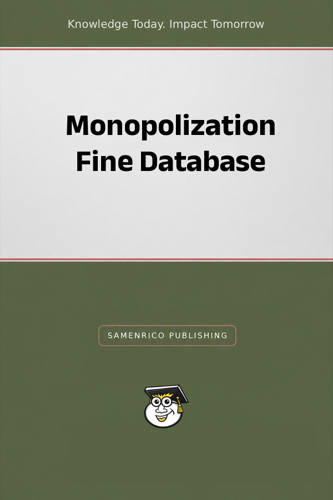
Monopolization Fine Database eBook
Documents Section 2 Sherman Act penalties and cond
by Bowie Marget
Documents Section 2 Sherman Act penalties and conduct-based monopolist fines.
Formats
Free sample
Chapter 1: The Forgotten Felonies---– In the spring of 2022, a little-noticed press release from the Antitrust Division of the U.S. Department of Justice landed on the desks of white-collar defense attorneys like a ghost from a forgotten era. The announcement was brief, almost routine in its bureaucratic language, but its implications were seismic: the Division would once again pursue criminal prosecutions under Section 2 of the Sherman Act, a provision that had lain dormant in criminal enforcement for forty-five years. For the handful of practitioners who understood the significance, the announcement raised an immediate, terrifying question—one for which no living lawyer had an answer. What happens when the government tries to put a monopolist in prison?This book answers that question.
But to understand the stakes—corporate fines up to $100 million, individual prison terms up to ten years, and the potential breakup of dominant firms as a criminal remedy—we must first understand the peculiar legal creature known as Section 2 of the Sherman Act. Unlike its more famous cousin, Section 1 (which prohibits agreements in restraint of trade), Section 2 stands alone. It criminalizes the conduct of a single firm. It punishes unilateral action. And for nearly half a century, it has been treated by prosecutors as a civil statute dressed in criminal clothing.This chapter establishes the foundational architecture of Section 2’s three distinct felonies: monopolization, attempted monopolization, and conspiracy to monopolize.
It explains why the distinction between Section 1 agreements and Section 2 unilateral conduct matters more for sentencing than for liability. And it introduces the central problem that animates this entire treatise: the Guidance Gap. The U.S. Sentencing Guidelines were created in 1984 and became effective in 1987, but the Department of Justice stopped bringing criminal monopolization cases in 1977. For a full decade—from 1977 to 1987—there were neither prosecutions nor Guidelines.
For the next thirty-five years, the Guidelines existed on paper but were never applied to a criminal Section 2 case because none were brought. When the DOJ revived criminal enforcement in 2022, no living practitioner had ever seen a Guidelines calculation for this offense. No precedent existed for how to sentence a monopolist.The stakes could not be higher. And the clock is already running.The Three Faces of Section 2The Sherman Act of 1890 was a remarkably short statute by modern standards—barely a page in length. Section 2, as originally enacted, provided simply that “every person who shall monopolize, or attempt to monopolize, or combine or conspire with any other person or persons to monopolize any part of the trade or commerce among the several States, or with foreign nations, shall be deemed guilty of a misdemeanor.” The original penalty was a fine not exceeding five thousand dollars, imprisonment not exceeding one year, or both.
The statute has been amended several times—most significantly in 1974, when violations were elevated from misdemeanors to felonies and penalties increased dramatically—but the core prohibition remains unchanged.Three distinct crimes are contained within these few words. Each has its own elements, its own evidentiary burdens, and—as we will see throughout this book—its own implications for sentencing.Monopolization: The Completed Offense The first and most serious crime under Section 2 is monopolization itself. This is the completed offense: a firm that has achieved monopoly power and maintains that power through exclusionary conduct rather than superior skill or historic accident has crossed the line from vigorous competition into criminal territory. The elements of monopolization, established by the Supreme Court in United States v. Grinnell Corp., 384 U.S.
563 (1966), are twofold: (1) the possession of monopoly power in a relevant market, and (2) the willful acquisition or maintenance of that power through exclusionary conduct, as distinguished from growth or development as a consequence of a superior product, business acumen, or historic accident.The first element—monopoly power—requires proof that the defendant firm controls prices or excludes competition in a properly defined market. This is typically demonstrated through market share evidence, with courts generally requiring shares above seventy percent to establish a prima facie case, though no bright-line rule exists. The second element—willful acquisition or maintenance—is where the criminal conduct lies. The Supreme Court has repeatedly emphasized that the Sherman Act does not punish a firm for acquiring monopoly power “passively” or “as a consequence of a superior product.” The crime is not having a monopoly; the crime is using a monopoly to crush rivals through exclusionary means.But what exactly counts as “exclusionary conduct”? The case law has identified several categories.
Predatory pricing—setting prices below cost with the specific intent to drive out competitors and recoup losses later—can constitute monopolization, though the Supreme Court has set a high bar for such claims. Exclusive dealing arrangements that foreclose substantial portions of the market from competitors may rise to the level of exclusionary conduct. Tying arrangements, where a monopolist conditions purchase of one product on purchase of another, have been prosecuted as monopolization when they serve to extend monopoly power from one market to another. Refusals to deal with competitors, particularly when a monopolist controls an essential facility that competitors cannot replicate, have also formed the basis of Section 2 liability.The criminal mental state required for monopolization is particularly important for sentencing purposes. Unlike civil liability, which can attach based on negligent or even inadvertent conduct, criminal monopolization requires proof of specific intent—a deliberate purpose to acquire or maintain monopoly power through exclusionary means.
The government must show that the defendant acted knowingly and willfully, not merely that the conduct had exclusionary effects. This heightened burden of proof will become critical when we analyze sentencing adjustments in later chapters, because conduct that lacks criminal intent may still support civil penalties but cannot sustain a criminal conviction.Attempted Monopolization: The Incomplete Crime The second crime under Section 2 is attempted monopolization. This is the crime that Nathan Zito pleaded guilty to in 2022—the first such plea in forty-five years. Attempted monopolization occupies a strange doctrinal space: it punishes conduct that falls short of actually achieving monopoly power, provided the defendant took substantial steps toward that goal with specific intent to monopolize.The elements of attempted monopolization, established by the Supreme Court in Spectrum Sports, Inc. v.
Mc Quillan, 506 U.S. 447 (1993), are threefold: (1) specific intent to monopolize, (2) dangerous probability of success, and (3) predatory or exclusionary conduct in furtherance of the attempt. The “dangerous probability of success” element is particularly significant because it requires the government to prove that the attempted monopolization was reasonably likely to succeed. This means that even if a firm never actually achieves monopoly power, it can still be convicted if its conduct brought it close to the threshold.The Zito case illustrates the application of these elements perfectly. Nathan Zito, an asphalt contractor in Connecticut, approached his only significant competitor and proposed a market-allocation scheme: Zito would take certain territories, his competitor would take others, and neither would bid on the other’s projects.
The competitor immediately became a government informant. Zito never actually achieved monopoly power—indeed, he never even entered into an agreement because the competitor was cooperating with law enforcement from the start. But by proposing the scheme, Zito demonstrated specific intent to monopolize; his conduct (the proposal itself) was exclusionary; and because he was…
This is the end of the free sample. Get the eBook to keep going. Buy now
About this book
Details
- Author
- Bowie Marget
- Publisher
- SamEnrico
- Language
- English
- Genre
- Non-Fiction, Compliance & Risk Archive, Monopolization
- Released
- 2026-06-06
- Pages (approx.)
- 157
- Available as
- eBook, Audiobook

Read better in the ZLOADR app
Your eBooks on your phone or tablet. Sign in with your SamEnrico account and start reading.
More by Bowie Marget
 Parkinson Circadian GuideBowie Marget$11.99
 The Three Second Rule InterventionBowie Marget$11.99
 Key Employee Sudden Departure Simulation KitBowie Marget$11.99
 Spouse Death and SleepBowie Marget$11.99
 Uber Destination Filter StrategyBowie Marget$11.99
 Flare First Aid MeditationBowie Marget$11.99
 Cannabis Use Disorder Chronic PainBowie Marget$11.99
 Hydration Anxiety FixBowie Marget$11.99
 The Torchbearer: How a Forgotten Hero Lit the 1948 London GamesBowie Marget$11.99
 Lysistrata’s Lament: The War That Women WonBowie Marget$11.99
 Growing ChamaeliriumBowie Marget$11.99
 How to Start a Compressor Engine Business (Beginners Guide)Bowie Marget$11.99