
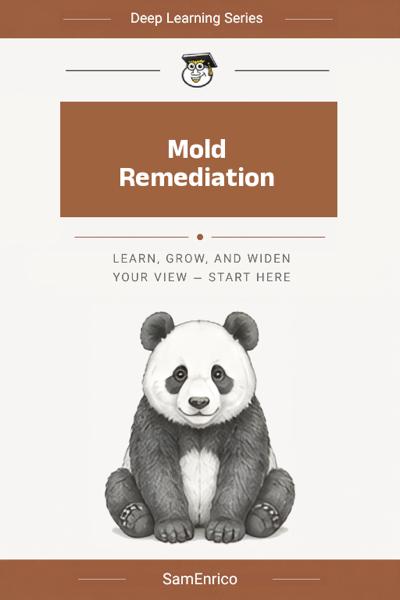
Non-FictionInformativeEducational
Mold Remediation eBook
A Coursebook on Mold Remediation
A Coursebook on Mold Remediation
Formats
Free sample
Chapter 1: The Thing Inside...--You cannot see it, but it has been there for months. Maybe years.Behind your bathroom vanity, where a slow drip from the supply line has turned the particle board into a dark, crumbly sponge. Inside your bedroom wall, where the roofer’s missed nail hole allowed a single teaspoon of rainwater to enter each storm—enough to keep the cavity perpetually damp. In the crawlspace beneath your living room, where the previous owner laid plastic sheeting but forgot to seal the seams, creating a humid microclimate where black colonies now bloom in geometric patterns.You have smelled it. That musty, earthy odor that no amount of scented candle can mask.
You have felt it. The congestion that clears when you go on vacation and returns the night you come home. You have wondered about it. And then, because the problem did not announce itself with a flood or a fire, you pushed the thought aside.This chapter is designed to stop you from pushing it aside again.We begin not with equipment lists or safety protocols—those come later. We begin with a single, transformative idea: mold is not the enemy.
Water is. Every remediation that fails does so because someone forgot this. Every family that moves out of a remediated home only to get sick again does so because someone treated the symptom instead of the disease.To understand why, you must first understand what mold actually is. Not as a monster from a headline, nor as a harmless nuisance, but as a living organism with a specific biology, a specific purpose in the natural world, and a specific set of conditions required for it to become a problem in yours.The Fungus Among Us: Biology Without the Panic Let us establish a foundational truth: mold is everywhere.Not in a metaphorical sense. Not in a “well, technically” sense.
In a literal, you-are-breathing-it-right-now sense. The air you are inhaling contains fungal spores. The dust on your bookshelf contains fungal fragments. The soil outside your window contains miles of microscopic fungal threads.This is not a failure of housekeeping. It is the default state of planet Earth.Mold belongs to the kingdom Fungi, a biological category distinct from plants (which photosynthesize), animals (which ingest food), and bacteria (which are single-celled prokaryotes).
Fungi are eukaryotic, meaning their cells contain a nucleus, and they reproduce via spores rather than seeds or eggs. There are hundreds of thousands of species of fungi, the vast majority of which are benign or even beneficial to humans. Penicillin comes from a fungus. Bread rises because of fungi. The decomposition that turns fallen logs into forest soil is performed primarily by fungi.Mold is simply the common name for multicellular fungi that grow in filamentous structures called hyphae.Here is where the biology becomes critical to your work as a remediator or to your understanding as a homeowner.
A single mold colony is not a uniform blob. It is a network of hyphae—thin, thread-like tubes that extend outward in search of food and moisture. These hyphae secrete enzymes that break down organic materials (wood, drywall paper, fabric, even the dust on your windowsill) into digestible nutrients. As the colony matures, it produces reproductive structures called spores.Spores are the reason mold is so difficult to control.A single colony can release millions of spores per minute. These spores are microscopic (typically 2–10 microns in diameter), designed by evolution to remain airborne for hours or even days, and remarkably resistant to environmental stress.
They can survive heat, cold, desiccation, and many common cleaning chemicals. Their job is simple: travel through air, land on a surface, detect moisture, germinate, and start a new colony.This is not malice. This is survival.The problem is not that mold exists. The problem is that our homes, as we build them today, provide an almost perfect environment for certain species of mold to proliferate. We wrap buildings in vapor barriers, seal them against drafts, stuff insulation into wall cavities, and then introduce moisture through leaks, condensation, and daily living (showering, cooking, breathing).
We create the biological equivalent of a five-star resort for fungi.The Great Misunderstanding: "Killing" Mold Before we go any further, we must eliminate one of the most persistent and dangerous myths in the entire remediation industry.You cannot solve a mold problem by killing the mold.Read that sentence again. Underline it. Tape it to your tool box.Here is why: dead mold is still mold.When a spore dies, its physical structure does not vanish. The cell wall, which contains the primary allergens that trigger human immune responses, remains intact. The fragments of hyphae, which can be just as inflammatory as whole spores, do not dissolve.
And the mycotoxins—secondary metabolites produced by some mold species that have been linked to more severe health effects—are often heat-stable and chemically resistant. They persist long after the organism that created them is dead.This means that spraying bleach on a patch of mold and watching it disappear (the dark color fades because the pigment is destroyed, not because the mold is gone) accomplishes nothing of value. Worse, it actively makes the problem harder to solve.Why? Because bleach is approximately 95% water. When you spray bleach on a porous surface like drywall or wood, the sodium hypochlorite (the active ingredient) evaporates or degrades within minutes.
The water soaks into the material, raising its moisture content. If there is any mold growing below the surface—and there almost always is, because hyphae penetrate porous materials—you have just fed it.The same logic applies to most biocides, fungicides, and "mold-killing" sprays. They may reduce the surface population of viable spores, but they do not remove the non-viable material. And they do not address the underlying moisture that allowed the mold to grow in the first place.The only reliable remedy is physical removal. The mold—viable spores, non-viable spores, hyphal fragments, mycotoxins, and the contaminated material they have colonized—must be removed from the building.
Not killed. Not encapsulated. Not bleached. Removed.This is the single most important technical concept in this entire book. Every subsequent chapter—every containment procedure, every cleaning method, every clearance test—exists to serve this principle.Viable vs.
Non-Viable: A Distinction That Matters To speak intelligently about mold remediation, you need two words: viable and non-viable.Viable spores are alive. Given sufficient moisture and a suitable food source, they can germinate and grow into new colonies. Non-viable spores are dead. They cannot germinate. But—and this is crucial—they can still trigger allergic reactions, asthma attacks, and other inflammatory responses.Why does this distinction matter?Because standard air spore trap testing (the kind most home inspectors perform) cannot reliably distinguish between viable and non-viable spores.
The sampler captures spores on a sticky slide, a laboratory technician counts them under a microscope, and you receive a report that says "Cladosporium: 1,200 spores per cubic meter" or "Stachybotrys: 250 spores per cubic meter."What that report does not tell you is how many of those spores are alive.This has profound implications for both assessment and remediation. A building with a high count of non-viable…
This is the end of the free sample. Get the eBook to keep going. Buy now
About this book
Details
- Author
- Julia Jessika
- Publisher
- SamEnrico
- Language
- English
- Genre
- Non-Fiction, Informative, Educational
- Released
- 2026-05-11
- Pages (approx.)
- 139
- Available as
- eBook, Audiobook

Read better in the ZLOADR app
Your eBooks on your phone or tablet. Sign in with your SamEnrico account and start reading.
More by Julia Jessika
 Sustainable Drive Career GuideJulia Jessika$11.99
 Resentment After TraumaJulia Jessika$11.99
 Availability Heuristic TradingJulia Jessika$11.99
 Caregiver Burnout for TBI CaregiversJulia Jessika$11.99
 Moltke the Strategist: The Mind Behind Prussia's Lightning WarJulia Jessika$11.99
 UN Political Affairs Officer GuideJulia Jessika$12.99
 How to Produce Babacos (Fruit)Julia Jessika$11.99
 Ultimate Handbook Guide to Chicago : (United States) Travel GuideJulia Jessika$11.99
You may also like
 Hong Kong Handover 1997Dunn Johnnie$11.99
 Zumba For Postnatal Recovery CourseNeal Christian$11.99
 Zumba for BeginnersLadner Nikia$11.99
 YouTube Comment Mining GuideHumes Pandora$12.99
 Worry Box MeditationCarlin Rudy$11.99
 Workplace Stress MeditationNguyen Lynn$11.99
 Workplace Stress and Sleep RepairHawley Ivory$11.99
 Workplace Perfectionism CureDelaney Jeffry$11.99
 Workplace Injustice Anger GuideWallen Isabelle$11.99
 Work Addiction and Burnout LinkGreenwood Ester$11.99
 Women in Yoga and WellnessBeattie Galina$11.99
 Women in Stand Up ComedyChun Evangeline$11.99