
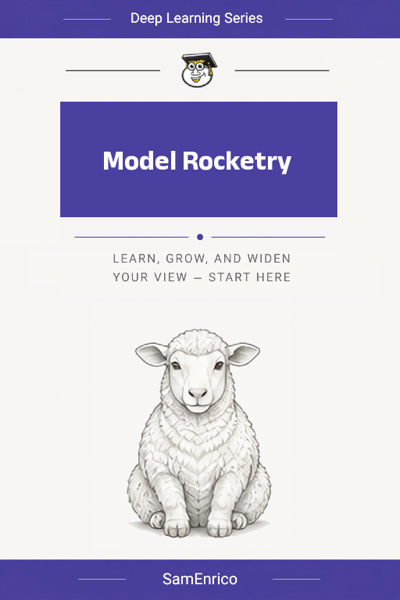
Non-FictionInformativeEducational
Model Rocketry eBook
A Coursebook on Model Rocketry
A Coursebook on Model Rocketry
Formats
Free sample
Chapter 1: The Accidental Rocket Scientist--–- The first time I watched a model rocket launch, I was nine years old, standing in a muddy soccer field on a Saturday morning in October. My father had bought a plastic Estes kit from a hobby shop that smelled of model airplane glue and ambition. He had no idea what he was doing. I had even less. But when we pressed that launch button—a cheap red button on a plastic box powered by a lantern battery—something happened that I have spent the rest of my life trying to understand.
The rocket did not simply go up. It vanished. One instant it was a cardboard tube with plastic fins resting on a steel rod. The next, it was a white needle piercing a grey sky, leaving behind a thread of smoke and a sound like tearing silk. We lost it, of course.
The parachute never deployed. The rocket came down somewhere in a cornfield a quarter-mile away, never to be seen again. But standing there with my finger still pressed on that button, staring at empty sky, I understood something profound: I had just touched the edge of physics. And I wanted to fall in.That is what this book is really about. It is not merely a technical manual, though it contains all the technical information you need.
It is not simply a safety guide, though safety is woven into every page. It is an invitation to feel what I felt in that muddy field: the thrill of building something with your own hands, watching it defy gravity for a few glorious seconds, and then bringing it back—if you are lucky and skilled—to do it all over again. Model rocketry is the only hobby I know where a twelve-year-old and a retired aerospace engineer can stand side by side, launch identical rockets, and both feel the same electric excitement when the motor ignites. It is a hobby of equalizers. The rocket does not care about your age, your income, or your education.
It only cares whether you followed the instructions, whether you understood the stability rules, and whether you respected the fire.Why This Book Exists There are already excellent books about model rocketry. G. Harry Stine’s Handbook of Model Rocketry has been the gold standard for decades, and it deserves every bit of its reputation. Bill Stine continues that legacy with updated editions that keep pace with new motors and materials. The Civil Air Patrol produces rigorous educational guides.
Estes Industries provides starter manuals with every kit. So why another book?Because most existing books fall into one of two camps. The first camp is the encyclopedia—comprehensive, authoritative, but dense. It tells you everything, sometimes before you are ready to hear it. The second camp is the quick-start guide—a pamphlet of thirty pages that gets you launched but leaves you stranded when something goes wrong.
This book sits in the middle. It is a coursebook: structured like a class, paced for a beginner, but deep enough to take you all the way to high-power certification if you choose to go that far.Think of this book as your flight instructor. You would not climb into a real airplane without ground school. You would not learn to fly by reading the entire maintenance manual for a Cessna. You need a guided path—someone who says, Start here.
Now try this. Now here is what probably went wrong. That is what these twelve chapters provide. By the time you finish, you will have built and launched multiple rockets, diagnosed failures, tracked altitudes, and decided whether you want to pursue high-power rocketry or join a competition club. And you will have done it safely, because safety is not an add-on in this book.
It is the foundation.The Birth of a Hobby Before we build anything, we need to understand where model rocketry came from. This history is not just trivia. It explains why model rockets are designed the way they are, why we use electric launch systems instead of fuses, and why a safety code exists at all.In the 1950s, if you were a kid who wanted to launch a rocket, your only option was essentially a firework. You would buy a metal tube, pack it with gunpowder, attach a fuse, light it, and run. These devices—often called "rocket motors" but really just modified fireworks—were unpredictable, dangerous, and frequently illegal.
They exploded on the launch pad. They flew sideways into crowds. They burned children. The fatality rate was low enough to avoid national headlines, but every hobby shop owner knew someone who had lost an eye or a finger.Enter G. Harry Stine.
Stine was a trained physicist who worked at the White Sands Missile Range in New Mexico, surrounded by the most advanced rocketry of the Cold War era. He watched the V-2 tests. He knew Wernher von Braun. And he also had a son who wanted to launch rockets. Stine looked at the dangerous fireworks on the market and said, essentially: There has to be a better way.The better way came from an unlikely partnership with Orville Carlisle, a model rocket enthusiast from Nebraska who had designed a safe, factory-made motor.
Carlisle’s motor used a slow-burning black powder pressed into a cardboard casing with a clay nozzle. It could not explode—it could only burn, producing thrust in a controlled way. And crucially, it had an ejection charge at the top that would pop out a parachute after the motor finished burning. This was revolutionary. For the first time, a rocket could be designed to come back down slowly.Stine recognized the genius immediately.
He wrote a safety code, designed standard motor classes (the A through G system we still use today), and partnered with a company called Model Missiles, Incorporated. In 1958, the first commercially available model rocket kit—the Astro-1—went on sale. The hobby was born.But Stine did not stop there. He founded the National Association of Rocketry (NAR) in 1957, creating a self-policing community that would enforce safety standards, certify motors, and advocate for the hobby with regulators. The NAR Safety Code, which you will find in full in Appendix A, is the direct descendant of Stine’s original rules.
It has been updated over the decades, but the core principles remain unchanged: use only certified motors, launch only with electrical ignition, never fire a rocket horizontally, and always maintain safe distances.Today, model rocketry is one of the safest outdoor hobbies in existence. According to NAR accident statistics, you are more likely to be injured by a bicycle than by a model rocket. That safety record is not an accident. It is the result of sixty years of engineers, hobbyists, and safety officers taking the rules seriously. And it is the culture you are joining when you open this book.What Makes a Model Rocket Different from a Firework?This distinction is so important that I am going to state it as plainly as possible: A model rocket is not a firework, and should never be treated like one.Fireworks are designed to explode.
They are entertainment devices that rely on disorientation, loud noises, and unpredictable movement. A model rocket, by contrast, is designed…
This is the end of the free sample. Get the eBook to keep going. Buy now
About this book
Details
- Author
- Mclendon Latrice
- Publisher
- SamEnrico
- Language
- English
- Genre
- Non-Fiction, Informative, Educational
- Released
- 2026-06-02
- Pages (approx.)
- 147
- Available as
- eBook, Audiobook

Read better in the ZLOADR app
Your eBooks on your phone or tablet. Sign in with your SamEnrico account and start reading.
More by Mclendon Latrice
 Gynecomastia Body AcceptanceMclendon Latrice$11.99
 Breaking Yelling Cycles HandbookMclendon Latrice$11.99
 Sexual Addiction for ClergyMclendon Latrice$11.99
 Jungle Explorer Spider BiteMclendon Latrice$11.99
 The Day the Sky Split: The Tunguska Event That Shook the WorldMclendon Latrice$11.99
 Nefertiti's Last Breath: The Queen Who Vanished from HistoryMclendon Latrice$11.99
 Understanding Holoprosencephaly Radial Heart Renal AnomaliesMclendon Latrice$17.99
 Wave Free Accounting HandbookMclendon Latrice$12.99
 Cybersecurity Consolidation OutlookMclendon Latrice$12.99
 How to Become a Childrens AttendantMclendon Latrice$11.99
You may also like
 Hong Kong Handover 1997Dunn Johnnie$11.99
 Zumba For Postnatal Recovery CourseNeal Christian$11.99
 Zumba for BeginnersLadner Nikia$11.99
 YouTube Comment Mining GuideHumes Pandora$12.99
 Worry Box MeditationCarlin Rudy$11.99
 Workplace Stress MeditationNguyen Lynn$11.99
 Workplace Stress and Sleep RepairHawley Ivory$11.99
 Workplace Perfectionism CureDelaney Jeffry$11.99
 Workplace Injustice Anger GuideWallen Isabelle$11.99
 Work Addiction and Burnout LinkGreenwood Ester$11.99
 Women in Yoga and WellnessBeattie Galina$11.99
 Women in Stand Up ComedyChun Evangeline$11.99