
Non-FictionInformativeEducational
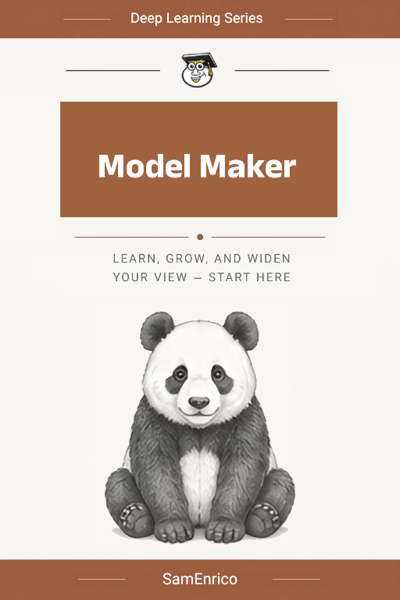
Model Maker eBook
A Coursebook on Model Maker
A Coursebook on Model Maker
Formats
Free sample
Chapter 1: Thinking Through Sawdust...--– In the winter of 2017, a young industrial designer named Mira had spent eleven weeks perfecting a digital model of a surgical instrument handle. The CAD renderings were gorgeous. The curves were mathematically elegant. The client had signed off on the screen images with enthusiasm. Then Mira 3D-printed a single physical prototype, held it in her hand for the first time, and realized something that no monitor could have shown her: the grip was two millimeters too narrow for an average adult hand.
That tiny discrepancy, invisible in perspective view and lost in the smoothness of digital rendering, would have caused surgeon hand fatigue after twenty minutes of use. In the physical world, it was a deal-breaker. In the digital world, it had never existed.This book exists because of moments like Mira's. It exists because screens lie—not maliciously, but inevitably. A rendering can simulate gravity, but it cannot make you feel the balance of an object in your palm.
A CAD model can measure angles to ten thousandths of a millimeter, but it cannot tell you whether a snap-fit joint will click into place with satisfying certainty or crack under its own stress. The physical model is a truth-teller. It is the difference between a design that works in theory and a design that works in the world.This is not a book about how to use software. It is not a book about rendering, ray tracing, or virtual reality. This is a book about making things you can hold, drop, break, fix, sand, paint, and hand to another human being who will turn it over in their fingers and say, "Oh, I see how this works." It is a book for architects who need to show a client how light will move through a lobby at 4:00 PM in December.
It is a book for product designers who need to verify that a button is reachable by a thumb. It is a book for hobbyists who want to build something real from a digital file. It is a book for prop makers who need a sword that looks like metal but weighs like foam. It is a book for anyone who has ever looked at a screen and thought, "I wonder what this actually feels like."The Model Maker is built on a simple premise: physical models are not lesser versions of digital designs. They are different tools for different jobs.
A hammer is not a failed screwdriver, and a physical prototype is not a failed rendering. The chapters that follow will teach you how to select materials, wield tools—both hand and digital—finish surfaces, document your work, and turn your skill into a career. But before any of that, before you cut your first piece of foam or level your first 3D printer bed, you need to understand what a model is, why we make them, and how to choose the right type of model for the question you are trying to answer.That is what this first chapter provides. It is the philosophical foundation upon which every subsequent technique is built. Read it carefully, because every time you feel lost in later chapters—every time you wonder whether you should sand or print or cast or mold—you will find your answer by returning to the question this chapter asks you to master: What am I trying to learn?What a Model Actually Is (And What It Is Not)Let us begin with a definition that will serve as the backbone of this entire book.
A model is a physical representation of an idea, created for a specific purpose, that omits irrelevant details to highlight relevant ones. That last clause is the most important part. A model is not a miniature copy of reality. It is a deliberate distortion of reality. It lies—but it lies usefully.Consider a simple architectural model of a house.
It is made of white foam board. There are no windows, no doors, no shingles, no siding. The owner's car is not parked in the driveway. The trees are simple green blobs on wire stems. By any objective measure, this model is a terrible representation of the actual house.
And that is exactly why it is a good model. The architect does not want the client to judge the color of the siding or the style of the windows. Those decisions come later. The architect wants the client to understand the massing—how the building sits on the site, how tall it feels from the street, how the roof line relates to neighboring structures. All the irrelevant details (color, texture, hardware, landscaping) have been stripped away so the relevant ones (volume, proportion, site relationship) can be seen clearly.This is the secret that separates great model makers from beginners.
Beginners try to make everything perfect. They attempt to replicate reality at a smaller scale, including every brick pattern and every grain of wood. Great model makers ask, "What question is this model supposed to answer?" and ruthlessly eliminate anything that does not contribute to that answer.In the chapters that follow, you will learn dozens of techniques. But technique without intention is just fiddling. Before you cut, ask yourself: "What am I trying to learn from this model?" The answer will tell you how detailed to be, what materials to use, and how long to spend.The Three Model Types: A Taxonomy for Decision-Making Throughout this book, we will refer to three distinct model types.
Understanding the differences between them is the single most important framework you will learn in Chapter 1. Every later chapter—from materials selection to finishing techniques—assumes you know which type you are building.Study Models (Quick, Ugly, Iterative)A study model is not meant to be beautiful. It is meant to be fast. It asks questions like: Does this shape feel right? Does this mechanism move the way I expect?
Does this part fit into that part? Study models are often made from cheap materials—foam core, cardboard, hot glue, clay, scrap wood. They are built in minutes or hours, not days. They are meant to be thrown away. In fact, if you have not destroyed at least three study models during a project, you are probably spending too much time on each one.The key characteristic of a study model is that it tests one thing at a time.
A study model of a chair might be a block of foam carved to test the seat height. A separate study model might be a wire armature to test the backrest angle. A third might be a paper template to test the footprint. Do not try to test everything in one model. That is how study models become representation models (next category) before they are ready.Study models are for your eyes only.
They are ugly. They are covered in pencil marks and glue residue. They have pieces of tape holding them together. That is not failure. That is the entire point.
Cheap, fast, and disposable—those are the virtues of a study model.Representation Models (Aesthetic, For Clients)A representation model is the opposite of a study model in almost every way. It…
This is the end of the free sample. Get the eBook to keep going. Buy now
About this book
Details
- Author
- Guillory Crissy
- Publisher
- SamEnrico
- Language
- English
- Genre
- Non-Fiction, Informative, Educational
- Released
- 2026-05-09
- Pages (approx.)
- 157
- Available as
- eBook, Audiobook

Read better in the ZLOADR app
Your eBooks on your phone or tablet. Sign in with your SamEnrico account and start reading.
More by Guillory Crissy
 ABCDE for Pet CareGuillory Crissy$11.99
 Senior Blue Zone AdoptionGuillory Crissy$11.99
 The Emotional Life Review GuideGuillory Crissy$11.99
 Team Sport NutritionGuillory Crissy$11.99
 ABCDE For Sleep HygieneGuillory Crissy$11.99
 The Iron Masters of Meroë: Forging an Empire in Fire and StoneGuillory Crissy$11.99
 How to Start a Draw Knife Business (Beginners Guide)Guillory Crissy$11.99
 Rwanda Student Packing GuideGuillory Crissy$12.99
 VAT for Transportation GuideGuillory Crissy$12.99
 Understanding Robinow–sorauf SyndromeGuillory Crissy$17.99
You may also like
 Hong Kong Handover 1997Dunn Johnnie$11.99
 Zumba For Postnatal Recovery CourseNeal Christian$11.99
 Zumba for BeginnersLadner Nikia$11.99
 YouTube Comment Mining GuideHumes Pandora$12.99
 Worry Box MeditationCarlin Rudy$11.99
 Workplace Stress MeditationNguyen Lynn$11.99
 Workplace Stress and Sleep RepairHawley Ivory$11.99
 Workplace Perfectionism CureDelaney Jeffry$11.99
 Workplace Injustice Anger GuideWallen Isabelle$11.99
 Work Addiction and Burnout LinkGreenwood Ester$11.99
 Women in Yoga and WellnessBeattie Galina$11.99
 Women in Stand Up ComedyChun Evangeline$11.99