
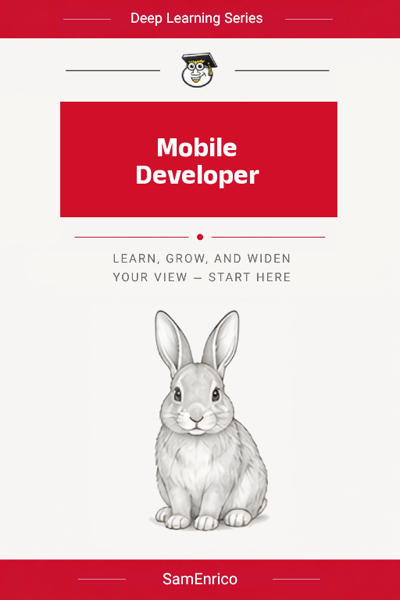
Non-FictionInformativeEducational
Mobile Developer eBook
A Coursebook on Mobile Developer
by Minnick Neda
A Coursebook on Mobile Developer
Formats
Free sample
Chapter 1: The Unspoken Economics--–- Every time you tap a screen, money moves. Not metaphorically—actual currency, denominated in dollars, euros, yen, or yuan, changes hands. The app you just opened to check the weather? Somewhere, a database query cost fractions of a cent. The social media scroll you performed while waiting for coffee?
Ad impressions generated real-time bids. The game your child plays on your phone while you cook dinner? A virtual item purchase funded someone's rent. Mobile development, at its core, is not primarily about code. It is about value exchange.
And until you understand what moves that money—what makes users open, stay, and pay—you will write technically flawless applications that nobody uses.This is the first and most painful lesson that the best-selling mobile development books rarely state outright. They begin with “Hello World” and Xcode installation screenshots. They assume that the reader's goal is to ship code. But the market does not reward code. It rewards outcomes.
The developer who understands why a billion people downloaded Tik Tok but only twelve thousand downloaded a beautifully architected meditation timer will build a career. The developer who only understands MVVM and Retrofit will build a portfolio of ghost apps.So let us begin with economics.The Two Gardens and the Walls Between Them In 2008, Apple opened the App Store with five hundred applications. Google followed suit later that year with the Android Market (later rebranded Google Play). As of 2025, the two stores collectively host nearly nine million apps. Nine million.
That number is so large it becomes meaningless until you reframe it: if you installed one new app every minute of every day without sleeping, it would take you over seventeen years to try them all.But the distribution is not equal. The Pareto principle—the 80/20 rule—applies brutally. Approximately 80 percent of all consumer time spent in mobile apps goes to just three or four apps per user: typically a messaging app, a social network, a video platform, and perhaps a map. The remaining 20 percent of time is fought over by the other eight million, nine hundred ninety-nine thousand, nine hundred ninety-six apps.This is the economic reality that every mobile developer must internalize before writing a single line of Swift, Kotlin, or Dart. You are not competing against similar apps.
You are competing against everything that demands your user's attention: their group chat, their news feed, their streaming queue, their email inbox, and, increasingly, the gravitational pull of algorithmic content designed by thousands of engineers to maximize minutes.Yet the mobile economy is not a tragedy. It is a $150 billion annual market, with Apple's App Store generating approximately $102 billion in 2024 and Google Play contributing roughly $48 billion. Those numbers represent developer revenue, in-app purchases, subscriptions, and paid downloads before store commissions. After Apple's 15-30 percent and Google's 15-30 percent (reduced for small businesses and subscriptions after one year), developers collectively take home north of $100 billion annually.Somebody is getting paid.The Platform Personality: Why i OS and Android Are Not Interchangeable If you ask a non-technical person to describe the difference between an i Phone and an Android phone, they will likely mention price, camera quality, or the color of text bubbles. These are surface differences.
The deeper difference—the one that shapes every career and business decision—is platform personality.i OS users, as a population, spend more money. This is not speculation; it is audited financial data. The average revenue per paying user (ARPPU) on i OS is roughly two to three times higher than on Android in Western markets. For every dollar spent on Google Play, approximately two to three dollars are spent on the App Store, despite Android having a larger global install base. Why?
The economics of hardware. Apple's cheapest new i Phone in 2025 still costs several hundred dollars. The average Android device includes many models that cost under two hundred dollars. Users who can afford premium hardware are statistically more likely to spend money on software, subscriptions, and virtual goods.This creates a strategic reality: if you are building a paid app, a subscription service, or an application with in-app purchases targeting North America, Western Europe, or affluent parts of Asia, you prioritize i OS first. The return on investment for i OS development hours is higher because each user is worth more.Android, conversely, dominates global scale.
Approximately 70 percent of the world's smartphones run Android. If your goal is user count—if you are building an ad-supported social network, a communication tool, or a service for emerging markets—Android is not optional. India alone has hundreds of millions of Android users. Brazil, Indonesia, Nigeria—Android is the entry point to the mobile internet for the majority of humanity.The smartest mobile developers do not choose one platform out of ideology. They choose based on the answer to two questions: “Where is my target audience?” and “How does my app make money?”The Spectrum of Development: Beyond the Native vs.
Cross-Platform Holy War Every mobile developer eventually encounters the question: “Should I build native apps for each platform, or use a cross-platform framework?” The question, as usually framed, is a trap. It assumes there are only two options and that the answer is permanent. Neither assumption is correct.At one end of the spectrum sits native development. On i OS, this means Swift with Swift UI. On Android, this means Kotlin with Jetpack Compose.
Native development gives you complete control over the platform's capabilities, the best performance, the smallest binary size, and immediate access to new OS features the day they are announced. The cost is maintaining two separate codebases, two separate teams (or developers with dual expertise), and two separate release schedules. A simple feature—adding a button that does something—must be implemented twice, tested twice, and debugged twice.At the other end of the spectrum sits Progressive Web Apps (PWAs). These are websites that behave like apps: they can be installed to the home screen, send push notifications, and work offline. For certain use cases—news readers, simple utilities, internal business tools—a PWA is perfectly adequate and dramatically cheaper to build and maintain.
You write HTML, CSS, and Java Script once, and it works everywhere with a browser. The trade-off is limited access to device hardware (no advanced Bluetooth, no NFC, no background sync beyond basic functionality) and a discoverability problem: most users do not know they can “install” a website.In the middle sit the cross-platform frameworks. Flutter, from Google, uses the Dart language and compiles to native ARM code. React Native, from Meta (formerly Facebook), uses Java Script or Type Script and bridges to native components. Kotlin Multiplatform (KMP) allows sharing business logic while keeping platform-specific UIs.
Each has passionate advocates, and each has real trade-offs.Flutter (versions 3.24 and beyond as of this writing) offers pixel-perfect consistency across platforms because it draws every pixel itself, bypassing the underlying platform's UI toolkit entirely. A Flutter button looks the same on i OS and Android because it is a Flutter button, not an i OS button or an Android button. This is a feature if your design system demands consistency. It is a drawback if your…
This is the end of the free sample. Get the eBook to keep going. Buy now
About this book
Details
- Author
- Minnick Neda
- Publisher
- SamEnrico
- Language
- English
- Genre
- Non-Fiction, Informative, Educational
- Released
- 2026-06-02
- Pages (approx.)
- 154
- Available as
- eBook, Audiobook

Read better in the ZLOADR app
Your eBooks on your phone or tablet. Sign in with your SamEnrico account and start reading.
More by Minnick Neda
 Success Redefinition WorkbookMinnick Neda$11.99
 Citation Rules for ACS Chemistry CourseMinnick Neda$11.99
 Parent Disappointment HealingMinnick Neda$11.99
 A10 Warthog PilotMinnick Neda$11.99
 Negative Assertion Technique GuideMinnick Neda$11.99
 80s Brat Pack Young StarsMinnick Neda$11.99
 UK VAT Registration for Landlords and Property Investors CourseMinnick Neda$11.99
 Fiverr Keyword Research GuideMinnick Neda$11.99
 Concrete Anchor DiscoveryMinnick Neda$11.99
 The Iron Throne of Meroë: The Metallurgical Kings of KushMinnick Neda$11.99
 Frostbite Prophecy: The Last Transmission of Station OmegaMinnick Neda$11.99
 Echoes of the Lost Colony: Roanoke’s Time RippleMinnick Neda$11.99
You may also like
 Hong Kong Handover 1997Dunn Johnnie$11.99
 Zumba For Postnatal Recovery CourseNeal Christian$11.99
 Zumba for BeginnersLadner Nikia$11.99
 YouTube Comment Mining GuideHumes Pandora$12.99
 Worry Box MeditationCarlin Rudy$11.99
 Workplace Stress MeditationNguyen Lynn$11.99
 Workplace Stress and Sleep RepairHawley Ivory$11.99
 Workplace Perfectionism CureDelaney Jeffry$11.99
 Workplace Injustice Anger GuideWallen Isabelle$11.99
 Work Addiction and Burnout LinkGreenwood Ester$11.99
 Women in Yoga and WellnessBeattie Galina$11.99
 Women in Stand Up ComedyChun Evangeline$11.99