
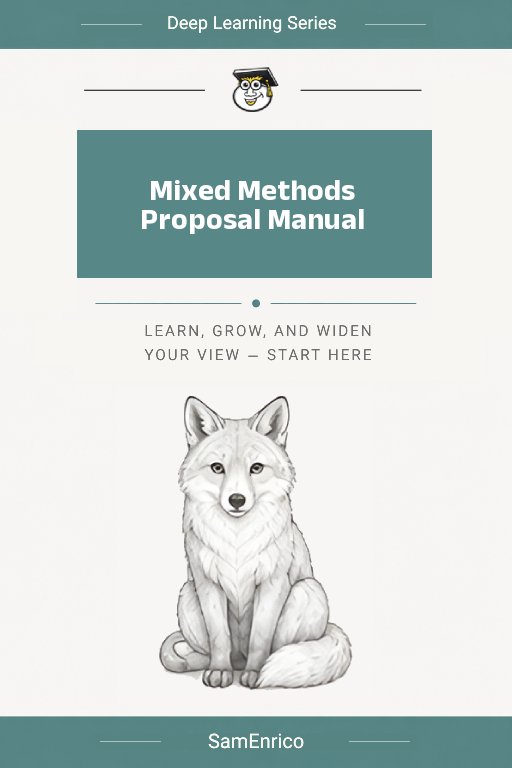
Non-FictionStudent's ShortcutMixed Methods
Mixed Methods Proposal Manual Audiobook
Integrate qualitative and quantitative approaches
by Kirk Jeneva
Integrate qualitative and quantitative approaches in grad school proposals. Explain sequential, concurrent, or transformative designs with clear justifications.
Formats
Free sample
Chapter 1: The Deficiencies Argument...--–- Most graduate students begin their mixed methods journey by asking the wrong question. They sit down with their dissertation chair or proposal committee and ask, “Which design should I use? Explanatory sequential? Exploratory sequential? Concurrent?” This question, while well-intentioned, is methodologically backward.
It is the equivalent of walking into a hardware store and asking, “Which tool should I buy?” before you have diagnosed whether you need to cut a board, drive a nail, or measure a distance. The tool without the problem is meaningless. The design without the rationale is indefensible.This chapter exists to force you to answer the question that must come before any discussion of design, sampling, analysis, or diagrams: Why can’t you answer your research question with a single method? If you cannot answer that question with clarity, specificity, and conviction, your proposal will be rejected. Not because your committee is cruel, but because mixed methods without a genuine rationale is not rigorous research—it is methodological busywork.
Committees see this every semester: a student who claims to be doing mixed methods because it “sounds sophisticated” or because they “want to cover all bases” or because they “think both types of data would be nice to have.” These are not rationales. They are confessions of methodological confusion.The central argument of this chapter—and indeed of this entire book—is that mixed methods is not a default choice. It is a response to a specific kind of problem. That problem has a particular structure: it contains elements that require generalization and elements that require context; it involves variables that can be measured and experiences that must be interpreted; it demands statistical relationships and lived narratives. When your problem has this dual structure, mixed methods becomes not just acceptable but necessary.
When it does not, you should be doing mono-method research, and this book will tell you so.This chapter introduces the single most important concept in mixed methods proposal writing: the deficiencies argument. Popularized by Creswell and Plano Clark in their foundational texts, the deficiencies argument is the logical backbone of every successful mixed methods proposal. It works like this: you first state what a purely quantitative study would miss. Then you state what a purely qualitative study would miss. Then you argue that because each method alone is deficient in answering your specific research question, mixing them is not…
This is the end of the free sample. Get the Audiobook to keep going. Buy now
About this book
Details
- Author
- Kirk Jeneva
- Publisher
- SamEnrico
- Language
- English
- Genre
- Non-Fiction, Student's Shortcut, Mixed Methods
- Released
- 2026-05-30
- Pages (approx.)
- 156
- Available as
- eBook, Audiobook

Listen in the VoxFlicks app
Audiobooks and audio dramas wherever you go. Sign in with your SamEnrico account and press play.
More by Kirk Jeneva
 The Food Packaging GuideKirk Jeneva$11.99
 Dahlia Death Mask StudyKirk Jeneva$11.99
 African Nonverbal GuideKirk Jeneva$11.99
 Burnout and Social SupportKirk Jeneva$11.99
 The Celestial Architects of Great Zimbabwe: How African Astronomers Built a Kingdom by the StarsKirk Jeneva$11.99
 Principal Systems EngineerKirk Jeneva$11.99
 How to Produce Bicycle CagesKirk Jeneva$11.99
You may also like
 Hong Kong Handover 1997Dunn Johnnie$11.99
 Zumba For Postnatal Recovery CourseNeal Christian$11.99
 Zumba for BeginnersLadner Nikia$11.99
 YouTube Comment Mining GuideHumes Pandora$12.99
 Worry Box MeditationCarlin Rudy$11.99
 Workplace Stress MeditationNguyen Lynn$11.99
 Workplace Stress and Sleep RepairHawley Ivory$11.99
 Workplace Perfectionism CureDelaney Jeffry$11.99
 Workplace Injustice Anger GuideWallen Isabelle$11.99
 Work Addiction and Burnout LinkGreenwood Ester$11.99
 Women in Yoga and WellnessBeattie Galina$11.99
 Women in Stand Up ComedyChun Evangeline$11.99