
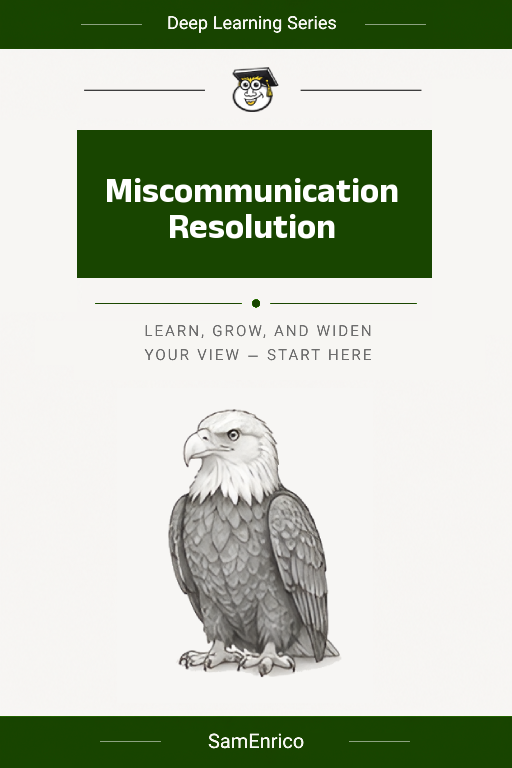
Non-FictionProfessional's Cheat SheetMiscommunication
Miscommunication Resolution eBook
Address remote team misunderstandings caused by la
Address remote team misunderstandings caused by lack of non-verbal cues.
Formats
Free sample
Chapter 1: The 93% Lie...--The email arrived at 2:17 PM on a Tuesday. It contained four words: "OK, let's go with that." The sender was a senior vice president at a mid-sized fintech company. The recipient was a product manager who had spent three weeks preparing a detailed proposal. Neither of them knew it yet, but those four words would cost the company $400,000.Here is what the product manager saw: a dismissive, one-word acknowledgment that felt like a shrug. Here is what the VP intended: enthusiastic approval delivered quickly because he trusted the product manager's judgment completely.
The gap between intent and impact lasted seventy-two hours. In that time, the product manager assumed his proposal had been rejected with passive aggression. He stopped working on it. He started updating his resume. The VP assumed the project was moving forward.
No one asked. No one clarified. The silence was loud enough to bankrupt a quarter-million-dollar initiative.This is not an outlier. This is the daily reality of remote work.In the absence of physical presence, something strange and terrifying happens to human communication. The cues we have relied upon for tens of thousands of years—the raised eyebrow that signals curiosity, the forward lean that signals engagement, the softening of the voice that signals care—all of them vanish.
What remains is text. And text, as we are learning at great cost, is a terrible container for emotion.The problem has a name in the research community. It is called the "empathy vacuum," and it is the single greatest threat to distributed teams today. When you cannot see a colleague's face or hear the warmth in their voice, your brain does something predictable and destructive: it fills the void with anxiety. It assumes the worst.
It tells a story in which you are the victim and the person on the other end of the Slack message is the villain.This book is about closing that vacuum. It is not a collection of platitudes about "better communication" or "active listening." Those concepts were designed for rooms where people could see each other. They fail in the digital space. What works instead is something far more deliberate: the systematic engineering of cues to replace the 65 to 90 percent of communication that disappears when you take humans out of physical proximity.But before we can build the bridge, we have to understand the full scope of what we have lost. And that means confronting a piece of research that has been widely misunderstood, frequently misapplied, and almost never translated correctly to the remote work context.The Research Everyone Quotes and No One Understands In 1971, psychologist Albert Mehrabian published a study on the relative importance of verbal and non-verbal messages.
His finding was simple: in situations where emotional content is being communicated and where the verbal message contradicts the non-verbal message, 7 percent of the meaning comes from words, 38 percent from tone of voice, and 55 percent from body language.That is the origin of the 7-38-55 rule. It is also the origin of a massive misunderstanding that has caused more confusion than it has resolved.Here is what Mehrabian's research does NOT say: that 93 percent of all communication is non-verbal. That was never the claim. The study only applied to situations of emotional incongruence—when someone says "I'm fine" but their voice is shaking and their arms are crossed. In those specific moments, words carry only 7 percent of the weight.Here is what the research DOES suggest, when translated to the remote work context: we are constantly operating in conditions of emotional incongruence because we have lost access to the calibrating cues.
When a manager types "OK" in Slack, there is no tone of voice to tell us whether that "OK" is warm or cold. There is no body language to tell us whether the manager is nodding or frowning. We are forced to guess. And we are terrible at guessing.The real loss in remote communication is not a fixed percentage of all meaning. It is access to specific channels of information that have evolved over millions of years to help us cooperate, coordinate, and trust one another.
When those channels disappear, the machinery of human collaboration breaks down in predictable ways.The Four Channels We Lose To understand what breaks, we have to understand what was there before. In a physical room with another human being, you have access to four distinct channels of information that simply do not exist in digital text and are only partially preserved in video or audio.The first channel is proxemics—the use of physical space to communicate relationship status. When you stand close to someone, you signal trust and intimacy. When you step back, you signal discomfort or formality. When you lean in during a conversation, you signal engagement and interest.
When you lean away, you signal disengagement or disagreement. These signals happen constantly, automatically, and below the level of conscious awareness. They are the background music of human interaction, and we do not notice them until they are gone.The second channel is kinesics—the study of body movement. This includes gestures, posture, facial expressions, and eye gaze. A raised eyebrow can signal surprise, skepticism, or invitation, depending on context.
A crossed arm can signal defensiveness or simply cold temperature. A downward gaze can signal submission, shame, or deep thinking. Humans process these signals in milliseconds, long before the conscious mind has caught up. We are wired to read bodies because bodies tell the truth when words lie.The third channel is paralanguage—the vocal elements that accompany speech but are not words themselves. Pitch, pace, volume, rhythm, and intonation all carry meaning.
A rising intonation at the end of a sentence turns a statement into a question. A dropped pitch signals finality and authority. A faster pace signals excitement or anxiety. A slower pace signals thoughtfulness or condescension. In text, all of this disappears.
The words remain, but the music is gone.The fourth channel is chronemics—the use of time to communicate meaning. In person, we interpret response time instinctively. A quick reply signals engagement and enthusiasm. A delayed reply signals disinterest or distraction. But in person, we have context for the delay.
We can see if someone is typing an email, talking to another person, or deep in thought. Remotely, we see only the absence of response. The silence becomes a story.When you add these four channels together, you begin to understand what remote work has taken from us. It is not 93 percent of all meaning. It is access to the calibration tools that prevent us from catastrophizing, assuming negative intent, and turning small disagreements into relationship-destroying conflicts.The Empathy Vacuum in Action Consider a scenario that plays out thousands of times every day in distributed teams around the world.A project manager named Priya sends a Slack message to a designer named Carlos at 10:00 AM: "Hey Carlos, any update on the homepage mockups?" She is not in a hurry.
She is just checking in. She adds a smile emoji to signal warmth.Carlos sees the message at 10:03 AM. He is in the middle of a complex Figma file and does not want to…
This is the end of the free sample. Get the eBook to keep going. Buy now
About this book
Details
- Author
- Floyd Jennifer
- Publisher
- SamEnrico
- Language
- English
- Genre
- Non-Fiction, Professional's Cheat Sheet, Miscommunication
- Released
- 2026-05-29
- Pages (approx.)
- 133
- Available as
- eBook, Audiobook

Read better in the ZLOADR app
Your eBooks on your phone or tablet. Sign in with your SamEnrico account and start reading.
More by Floyd Jennifer
 Antwerp Heist Magnetic Lock HackFloyd Jennifer$11.99
 The Paraben And Sulfate Avoidance PlanFloyd Jennifer$11.99
 Colombian Cartel San AndresFloyd Jennifer$11.99
 College Stress Resilience WorkbookFloyd Jennifer$11.99
 Stress and Thyroid DisordersFloyd Jennifer$11.99
 The Thunderbird's Last Flight: A Haida Legend of Sky and StormFloyd Jennifer$11.99
 Shifting Continents: How Soviet Geologists Proved the Earth Moves (1950s-1960s)Floyd Jennifer$11.99
 Seasonal Tread AssistantFloyd Jennifer$11.99
 How to Start a Hobby in KnifemakingFloyd Jennifer$11.99
 Strategy Meeting Cheat Sheet for ConsultantsFloyd Jennifer$12.99
 Understanding Female PseudohermaphroditismFloyd Jennifer$17.99
You may also like
 Hong Kong Handover 1997Dunn Johnnie$11.99
 Zumba For Postnatal Recovery CourseNeal Christian$11.99
 Zumba for BeginnersLadner Nikia$11.99
 YouTube Comment Mining GuideHumes Pandora$12.99
 Worry Box MeditationCarlin Rudy$11.99
 Workplace Stress MeditationNguyen Lynn$11.99
 Workplace Stress and Sleep RepairHawley Ivory$11.99
 Workplace Perfectionism CureDelaney Jeffry$11.99
 Workplace Injustice Anger GuideWallen Isabelle$11.99
 Work Addiction and Burnout LinkGreenwood Ester$11.99
 Women in Yoga and WellnessBeattie Galina$11.99
 Women in Stand Up ComedyChun Evangeline$11.99