
Non-FictionSelf-HelpRapport Building
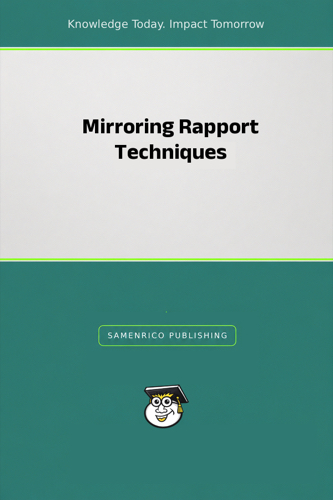
Mirroring Rapport Techniques eBook
Shows how matching body language builds subconscio
Shows how matching body language builds subconscious trust and connection.
Formats
Free sample
Chapter 1: The Reptilian Override...--–- You are driving home from work. You have three routes to choose from. The fastest route saves you eleven minutes. The scenic route saves you nothing but offers a nice view. The third route passes by a coffee shop where a barista once remembered your name and your order after a single visit six months ago.–- You take the third route.
You tell yourself it’s because you want coffee. But you don’t buy coffee. You just drive past, glance at the shop, and feel a small, warm pulse of something you cannot name. That something is not logic. That something is your limbic system overriding your prefrontal cortex.
And that something is the entire subject of this book.–- This chapter will dismantle the most dangerous myth in human communication: the belief that trust is built through rational argument, factual accuracy, and logical consistency. It will introduce you to the neuroscience of subconscious connection, the hormone that acts as nature’s social glue, and the concept of Neuronal Echoing—the reason why two strangers who cross their legs at the same moment feel an inexplicable sense of kinship. By the end of this chapter, you will understand why your most carefully constructed pitch failed while a simple shrug from someone else succeeded. You will never trust logic alone again.The $10 Million Mistake–- In 2016, a software executive named Daniel had ninety days to acquire a mid-sized data analytics firm. His offer was $10 million.
His competitor’s offer was $9.2 million. Daniel had better terms, a stronger balance sheet, and a detailed integration plan that had taken his team six weeks to build. He presented his case in a conference room with forty-two slides, three financial models, and a five-page risk mitigation appendix. The CEO of the target company nodded throughout, asked seven intelligent questions, and then sold to the competitor.–- After the deal closed, Daniel asked for a debrief meeting. The CEO hesitated, then agreed.
“Your numbers were better,” the CEO said. “Your team was more prepared. But every time you talked, you stood behind the podium with your arms crossed. The other guy sat next to me, leaned in when I leaned in, and matched my breathing without knowing it. I don’t know why I trusted him more.
I just did.”–- Daniel had lost $10 million not because his argument was weaker, but because his posture was mismatched. The competitor had never read a single book on negotiation. He was simply a natural mirrorer. And nature, it turns out, is a better negotiator than logic.The Three Brains Within You–- To understand why mirroring works, you must first understand that you do not have one brain. You have three.
Neuroscientist Paul Mac Lean’s Triune Brain model, while simplified, remains the most useful map for anyone trying to build trust.–- The Reptilian Brain (Brainstem and Cerebellum): This is the oldest part, dating back over 500 million years. It controls breathing, heart rate, body temperature, and the fight-flight-freeze response. It does not think. It detects threats. When someone stands too close, your reptilian brain fires before you consciously notice.
When someone’s posture mismatches yours, this brain registers “potential danger” in 0.3 seconds.–- The Limbic System (Mammalian Brain): This evolved with early mammals around 150 million years ago. It processes emotion, memory, and social bonding. The amygdala (fear and threat detection), hippocampus (memory formation), and hypothalamus (hormone regulation) all live here. This is where trust is actually built—not in the thinking brain. When you feel “safe” with someone, your limbic system has decided so, often without a single word exchanged.–- The Neocortex (Thinking Brain): This is the newest addition, just 2-3 million years old.
It handles language, abstract reasoning, planning, and conscious decision-making. Here is the catch: the neocortex is slow. It processes about 60 bits of information per second. The limbic system processes 11 million bits per second. By the time your neocortex has finished analyzing someone’s argument, your limbic system has already decided whether to trust them.–- Most communication training focuses exclusively on the neocortex—better slides, clearer language, more persuasive arguments.
This is like trying to win a car race by polishing the windshield while ignoring the engine. The engine of trust is limbic. And the language of the limbic system is not English, not Mandarin, not any spoken tongue. The language of the limbic system is physical synchrony.Neuronal Echoing: The Science of Invisible Connection–- In the late 1990s, a team of neuroscientists at the University of Parma made an accidental discovery that would change our understanding of human connection forever. They had implanted electrodes into the brains of macaque monkeys to study motor planning.
When a monkey reached for a peanut, specific neurons fired. Then one day, a researcher reached for a peanut in front of the monkey. The monkey’s brain fired the same neurons—even though the monkey had not moved.–- These were named mirror neurons. Subsequent human research using f MRI confirmed that we possess a more sophisticated version of this system. When you watch someone smile, the same neural circuits activate as when you smile yourself.
When you see someone cross their arms in defensiveness, your brain simulates that posture unconsciously. You feel what they feel, not through empathy as a concept, but through empathy as a neurological event.–- This is Neuronal Echoing: the phenomenon where observing another person’s posture, gesture, or facial expression activates the same motor and emotional circuits in your own brain as if you were performing that action yourself. It is the biological basis for every “good vibe” and “bad feeling” you have ever experienced about another person.–- Neuronal Echoing happens continuously, below the threshold of awareness. When you sit across from someone who is leaning forward with open palms, your brain subtly prepares your body to do the same. When you encounter someone whose posture is closed and rigid, your brain registers tension before you consciously notice it.
The more two people’s postures, gestures, and facial expressions align over time, the stronger the neuronal echoing becomes—and the more oxytocin releases into both bloodstreams.The Oxytocin Bridge–- Oxytocin is a neuropeptide produced in the hypothalamus and released by the pituitary gland. Popularly (and inaccurately) called the “love hormone,” it is better understood as the “social safety signal.” Oxytocin does not cause love. It reduces the brain’s fear response in the presence of others, making social connection feel safe rather than threatening.–- In a landmark study at Claremont Graduate University, economist Paul Zak found that a single dose of oxytocin (administered via nasal spray) increased people’s willingness to entrust strangers with their money by 44 percent. More relevant to this book, Zak also discovered that simple behavioral synchrony—two people walking in step, sitting in matched postures, or nodding in rhythm—increased endogenous (self-produced) oxytocin by an average of 23 percent within fifteen minutes.–- Here is the kicker: the fifteen-minute window is for casual observation. In face-to-face conversation with active mirroring, oxytocin release begins within the first 10 seconds of synchrony.
That is not a typo. Ten seconds. By the time you have exchanged “Hello, how are you?” and “Fine, thanks,”…
This is the end of the free sample. Get the eBook to keep going. Buy now
About this book
Details
- Author
- Applegate Gabriela
- Publisher
- SamEnrico
- Language
- English
- Genre
- Non-Fiction, Self-Help, Rapport Building
- Released
- 2026-06-06
- Pages (approx.)
- 146
- Available as
- eBook, Audiobook

Read better in the ZLOADR app
Your eBooks on your phone or tablet. Sign in with your SamEnrico account and start reading.
More by Applegate Gabriela
 Migraine and Nausea ManagementApplegate Gabriela$11.99
 Vitamin A Vision Health GuideApplegate Gabriela$11.99
 Senior Cancer SurvivorApplegate Gabriela$11.99
 NVC for TherapistsApplegate Gabriela$11.99
 The Stress and Lupus ConnectionApplegate Gabriela$11.99
 Neil Patrick Harris DoogieApplegate Gabriela$11.99
 Task Parking LotApplegate Gabriela$11.99
 Great Mother Dream SymbolApplegate Gabriela$11.99
 Silent Codebreakers: The AI Whisperers of Cold War EspionageApplegate Gabriela$11.99
 Echoes of the Red Code: How a Soviet AI Nearly Started World War IIIApplegate Gabriela$11.99
 The Alpine Innovators: How Swiss Cuisine Conquered the WorldApplegate Gabriela$11.99
 Derivatives and Hedging FundamentalsApplegate Gabriela$11.99
You may also like
 Hong Kong Handover 1997Dunn Johnnie$11.99
 Zumba For Postnatal Recovery CourseNeal Christian$11.99
 Zumba for BeginnersLadner Nikia$11.99
 YouTube Comment Mining GuideHumes Pandora$12.99
 Worry Box MeditationCarlin Rudy$11.99
 Workplace Stress MeditationNguyen Lynn$11.99
 Workplace Stress and Sleep RepairHawley Ivory$11.99
 Workplace Perfectionism CureDelaney Jeffry$11.99
 Workplace Injustice Anger GuideWallen Isabelle$11.99
 Work Addiction and Burnout LinkGreenwood Ester$11.99
 Women in Yoga and WellnessBeattie Galina$11.99
 Women in Stand Up ComedyChun Evangeline$11.99