
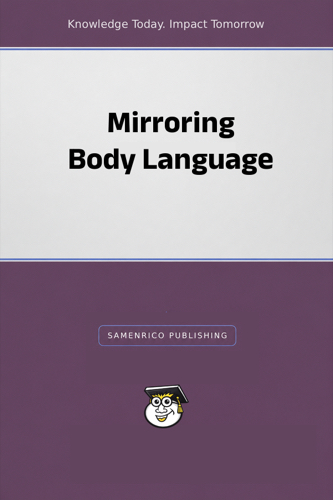
Non-FictionSelf-HelpBody Language
Mirroring Body Language eBook
Subtly copy posture and gestures to build rapport.
Subtly copy posture and gestures to build rapport.
Formats
Free sample
Chapter 1: The Biology of Belonging--–- You are standing in a crowded elevator. The doors close. For a moment, no one speaks. Then, without thinking, you shift your weight. Two seconds later, the person next to you shifts theirs.
You cross your arms. They cross theirs. You glance at the floor numbers. They glance too. Neither of you is aware of this dance.
Neither of you planned it. And yet, by the time the doors open on the seventh floor, something has happened. You don’t know this person’s name, their politics, or their profession. But you feel a faint, inexplicable sense of ease with them. You would be slightly more likely to hold the door for them.
Slightly more likely to smile if you passed them in the hallway later.That feeling has a name. It is called rapport. And it is not magic. It is biology.For decades, body language books have treated mirroring as a parlor trick—something slick salespeople do to close deals or pickup artists use to manipulate strangers. That framing is not only cynical; it is scientifically backward.
Mirroring is not a weapon of influence invented by car salesmen. It is a ancient, hardwired survival mechanism that evolved long before humans had language, commerce, or even consciousness as we know it. You do not learn to mirror. You are born ready to mirror. The only question is whether you learn to do it deliberately, or whether you leave it to chance.This chapter dismantles the myth that mirroring is manipulation.
It roots the practice in evolutionary biology and neuroscience, revealing why your brain is built to trust people who move like you. You will learn about mirror neurons—the neural substrate of empathy—and why they fire identically whether you throw a ball or watch someone else throw one. You will discover Albert Mehrabian’s 55/38/7 rule, which explains why your posture and tone matter more than your words. And you will explore limbic synchrony, the physiological merging of two nervous systems into one rhythmic dance.By the end of this chapter, you will understand that mirroring is not something you do to people. It is something you offer them.
It is the biological signal that says: You are safe. You belong. I am like you.The Mirror Neuron Revolution In the early 1990s, a team of Italian neuroscientists at the University of Parma made a discovery that would reshape our understanding of human connection. Dr. Giacomo Rizzolatti and his colleagues had implanted electrodes in the brains of macaque monkeys to study how neurons fired when the monkeys performed specific actions—grasping a peanut, pulling a lever, tearing a piece of paper.
The experiment was routine. The discovery was not.One day, a graduate student entered the lab with an ice cream cone. As he raised the cone to his mouth, one of the monkeys—sitting still, doing nothing—suddenly fired the exact same set of neurons that would have fired if it had grasped the cone itself. The monkey’s brain was mirroring the action it was merely watching. The researchers had stumbled upon what we now call mirror neurons.Here is what makes this discovery extraordinary: mirror neurons fire identically whether you perform an action or watch someone else perform it.
The same neural circuit activates when you smile and when you see a smile. The same circuit hums when you feel pain and when you watch someone stub their toe. Your brain does not sharply distinguish between self and other at the level of basic actions and emotions. It simulates the other’s experience inside your own body.This simulation is automatic, unconscious, and relentless. You cannot turn it off.
When you watch a tightrope walker, your own calves tense. When you see someone cry, your throat tightens. When you observe a speaker gesture wildly, your own motor cortex prepares to gesture—even if your hands remain still. Your brain is a rehearsal space for the lives of everyone around you.Mirror neurons explain why flinching is contagious. They explain why yawns spread through conference rooms.
And they explain, at the deepest level, why mirroring body language builds rapport. When you subtly copy someone’s posture, you are not performing a social trick. You are offering their mirror neurons a reflection of themselves. Their brain sees your posture and thinks, unconsciously: That person is like me. That person is safe.But mirror neurons are only half the story.
They fire in response to what you see. The other half of the equation involves what you communicate—and how little your actual words matter.The 55/38/7 Rule: Why Words Are the Weakest Signal In 1967, psychologist Albert Mehrabian conducted a series of studies at UCLA that would become legendary in communication research—and routinely misunderstood. Mehrabian was investigating how people judge whether someone likes them. Participants listened to audio recordings of a single word—“maybe”—spoken in different tones (warm, neutral, cold) while seeing photos of different facial expressions (happy, neutral, angry). The results were striking.When the tone of voice contradicted the facial expression, people believed the face.
When the words contradicted the tone, people believed the tone. Mehrabian distilled these findings into a now-famous formula: in communication of feelings and attitudes, 55 percent of meaning comes from body language (posture, gestures, eye contact, facial expression), 38 percent from tone of voice (pitch, tempo, volume, rhythm), and only 7 percent from the actual words spoken.Let that sink in. Ninety-three percent of emotional meaning is nonverbal. The words you choose—your careful arguments, your clever phrasing, your logical points—account for less than one-tenth of the message someone receives about how you feel toward them.This does not mean words are useless. In purely informational communication—explaining how to assemble a bookshelf or reporting quarterly earnings—the 55/38/7 ratio compresses.
Words carry more weight when the goal is clarity rather than connection. But whenever the subtext is “Do you like me?” “Do you trust me?” “Am I safe with you?”—which is to say, in virtually every human interaction that matters—the body and voice dominate.Mirroring is uniquely powerful because it targets the two largest channels simultaneously. When you match someone’s posture (55 percent) and their vocal tone (38 percent), you are communicating on 93 percent of the bandwidth. The remaining 7 percent—your actual words—can be almost irrelevant. This is why two people can discuss the weather and feel deeply connected, while two others can agree on politics and feel hostile.
The words are the same. The mirroring is not.Consider a simple experiment you can run today. Have a conversation with a friend while deliberately mismatching their posture. If they lean forward, lean back. If they cross their legs, uncross yours.
Speak at a different tempo—faster if they are slow, slower if they are fast. Notice how the conversation feels. Notice how quickly they look away, check their phone, or find an excuse to leave. Now try the opposite. Subtly match their posture and voice.
Do not mimic—just echo with a two-to-three second delay. Notice how the conversation lengthens. Notice how they smile more. Notice how they seem to relax.You have not changed your words.…
This is the end of the free sample. Get the eBook to keep going. Buy now
About this book
Details
- Author
- Cassidy Blair
- Publisher
- SamEnrico
- Language
- English
- Genre
- Non-Fiction, Self-Help, Body Language
- Released
- 2026-06-06
- Pages (approx.)
- 134
- Available as
- eBook, Audiobook

Read better in the ZLOADR app
Your eBooks on your phone or tablet. Sign in with your SamEnrico account and start reading.
More by Cassidy Blair
 Somme Hawthorn Ridge MineCassidy Blair$11.99
 Self Talk for Lawyers GuideCassidy Blair$11.99
 Virtual Reality AgoraphobiaCassidy Blair$11.99
 Overcoming Food Addiction in CollegeCassidy Blair$11.99
 International Franchise Employment LawCassidy Blair$12.99
 The Au Pair NightmareCassidy Blair$11.99
 Spouse Financial BetrayalCassidy Blair$11.99
 Bushcraft Improv MindsetCassidy Blair$11.99
 The Sound of the Outback: How Indigenous Hip-Hop Took Over AustraliaCassidy Blair$11.99
 The Secret Summit: The Alpinists Who Charted the Alps' Deadly HeightsCassidy Blair$11.99
 Service Providers Guide to Chimney CapsCassidy Blair$11.99
 How to Produce Tennis Ball Hoppers and CartsCassidy Blair$11.99
You may also like
 Hong Kong Handover 1997Dunn Johnnie$11.99
 Zumba For Postnatal Recovery CourseNeal Christian$11.99
 Zumba for BeginnersLadner Nikia$11.99
 YouTube Comment Mining GuideHumes Pandora$12.99
 Worry Box MeditationCarlin Rudy$11.99
 Workplace Stress MeditationNguyen Lynn$11.99
 Workplace Stress and Sleep RepairHawley Ivory$11.99
 Workplace Perfectionism CureDelaney Jeffry$11.99
 Workplace Injustice Anger GuideWallen Isabelle$11.99
 Work Addiction and Burnout LinkGreenwood Ester$11.99
 Women in Yoga and WellnessBeattie Galina$11.99
 Women in Stand Up ComedyChun Evangeline$11.99