
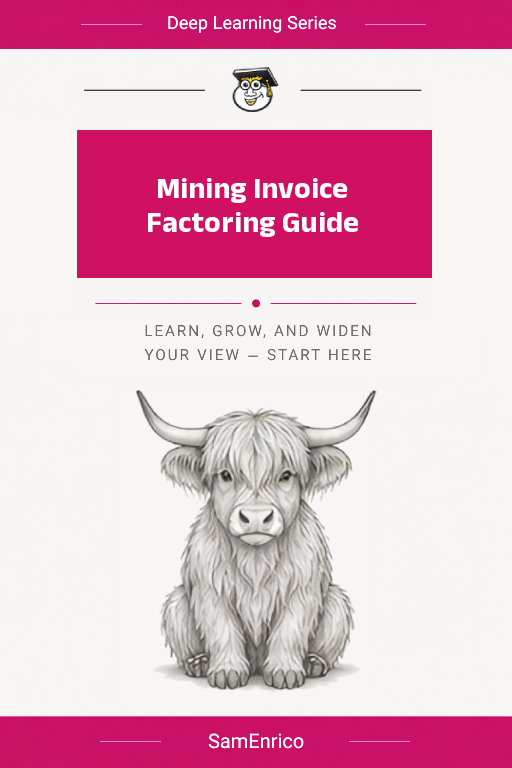
Non-FictionBusiness BriefMining
Mining Invoice Factoring Guide eBook
Factors mining contractor invoices in emerging mar
Factors mining contractor invoices in emerging markets including remote site logistics, equipment suppliers, and royalty payments.
Formats
Free sample
Chapter 1: The Liquidity Trap--–- The voicemail crackled through cheap speakers in a Lubumbashi office trailer. “Paul, it’s Margaret at the bank. Your credit line is frozen until you clear the overdue interest. We need a meeting.” Paul Mwamba, who ran a haulage fleet of seventeen trucks moving copper concentrate from the Democratic Republic of Congo’s Katanga province to Zambia, stared at his fuel report. He had $1.4 million in unpaid invoices from a mine owned by a Glencore subsidiary.
The mine’s accounts payable department was in Johannesburg. Payment approval required signatures in London. Meanwhile, his trucks were idle because he could not afford diesel. His payroll for fifty-three drivers was due in four days. His children’s school fees were overdue.
And the bank that had happily lent him money to purchase trucks two years earlier had just pulled the plug because of a single missed interest payment—caused, ironically, by the mine’s own delayed payment.Paul’s story is not an anomaly. It is the daily reality for tens of thousands of mining contractors across emerging markets. They sit on millions of dollars in legitimate, collectible invoices. They have performed the work. The mine has accepted the service.
The ore has been weighed, shipped, or processed. Yet they cannot access the cash trapped in those invoices. Traditional financing—bank overdrafts, asset-backed loans, even conventional factoring—fails them at every turn. This chapter explains why. It dissects the structural mismatch between mining payment cycles and operational expenses, reviews what the standard factoring textbooks get wrong, and introduces the key terminology that will frame the rest of this book.
By the end, you will understand why a contractor with $2 million in invoices can be flat broke—and why that paradox is the exact opportunity this book exists to solve.The Structural Mismatch: Why Mining Contractors Starve in a River of Receivables Mining is a cash-flow inverted industry. The contractor pays first, delivers second, and waits third. A typical earthmoving contractor must purchase or lease heavy equipment costing between 500,000and500,000 and 500,000and5 million per machine. They must hire skilled operators at 3,000to3,000 to 3,000to8,000 per month each. They must stock spare parts for breakdowns, maintaining 50,000to50,000 to 50,000to200,000 in inventory.
They must front the cost of fuel, lubricants, and tires—all before the first invoice is even submitted. Then, after the work is completed and signed off, the contractor submits an invoice. That invoice enters the mining company’s accounts payable system, where it sits for anywhere from thirty to one hundred twenty days, sometimes longer.The industry standard payment term in mining is net ninety days from invoice receipt, but that is the optimistic number. In emerging markets, actual payment often stretches to one hundred twenty or even one hundred fifty days. Delays compound at every link.
The mine’s own finance team waits for payment from the smelter. The smelter waits for settlement from the commodity buyer. The commodity buyer waits for the London Metal Exchange to clear funds. Each link in the chain adds two to four weeks. Meanwhile, the contractor’s expenses are weekly.
Payroll is due every Friday. Fuel suppliers demand cash on delivery or seven-day terms at most. Parts distributors in Johannesburg, Dubai, or Singapore will not release a $40,000 hydraulic pump without a wire transfer. The contractor is caught in a classic working capital trap: assets that are valuable but illiquid, and liabilities that are urgent and cash-only.This mismatch creates a specific type of distress that standard finance does not recognize. A bank looks at Paul Mwamba’s balance sheet and sees $1.4 million in accounts receivable.
The bank says, “You have assets. Why do you need money?” The contractor says, “Those assets are on someone else’s payment schedule. I need cash today.” The bank’s models assume that accounts receivable are near-cash. In mining, they are near-cash only if the counterparty is a tier-one mining major with perfect credit and a centralized payment system—and even then, the waiting period is brutal. When the counterparty is a mid-tier miner in a frontier market, those receivables might as well be locked in a vault for six months.What the Top Ten Factoring Books Get Right (And Wrong)The existing literature on invoice factoring is extensive.
Dozens of books cover the mechanics, the legal frameworks, and the sales strategies. Most of them are useful—within their narrow domain. Before we build the mining-specific solution, it is worth understanding what these books teach and where they fall silent.What they get right. Standard factoring books explain the core transaction clearly. A factor purchases a contractor’s accounts receivable at a discount.
The contractor receives an advance—typically seventy to ninety percent of the invoice face value—within twenty-four to forty-eight hours. The factor then collects the full invoice amount from the mining company when due. Once collected, the factor releases the remaining balance, called the reserve, minus a discount fee. The books also distinguish between recourse factoring, where the contractor must buy back unpaid invoices, and non-recourse factoring, where the factor absorbs the loss if the mining company defaults. They explain notification factoring, where the mining company knows the invoice has been sold, versus confidential factoring, where the mining company continues to pay the contractor, who forwards payment to the factor.
These concepts are foundational, and we will use them throughout this book.What they get wrong—or omit entirely. The standard textbooks assume a clean, predictable environment. They assume the debtor has a verifiable credit history. They assume invoices are generated from standard purchase orders. They assume delivery can be confirmed with a signature or an electronic approval.
They assume currency is stable and freely convertible. They assume the legal system will enforce a factoring agreement predictably. In emerging market mining, none of these assumptions hold.The standard books do not discuss what happens when the mine is in the DRC, the contractor’s office is in Zambia, the mining company’s headquarters is in South Africa, and payment is processed in London. They do not address currency controls that trap cash in Nigerian Naira or Egyptian Pounds. They have no framework for verifying an invoice from a site with no internet, no phone signal, and a dirt airstrip.
They do not mention anti-assignment clauses buried in mining master service agreements that explicitly prohibit factoring. They have never heard of ZATCA, the Saudi e-invoicing system, or the United Arab Emirates’ blockchain invoice registry. They certainly do not discuss Shariah-compliant structures for contractors in the Gulf Cooperation Council countries or Pakistan.This book exists to fill those gaps. Chapter 1 is the diagnosis. The rest of the book is the treatment.The Case Example: Lubumbashi to London Let us walk through Paul Mwamba’s situation in detail because it contains every element of the mining factoring problem.
Paul’s company, Katanga Haulage SARL, has a contract with Kamoto Copper Company, a mine in the DRC’s Lualaba province. Kamoto Copper is majority-owned by Glencore, a Swiss mining giant. The contract is straightforward: Katanga Haulage moves copper concentrate from Kamoto Copper’s stockpile to the Zambian border, where it is transferred to rail for shipment to the port…
This is the end of the free sample. Get the eBook to keep going. Buy now
About this book
Details
- Author
- Gallegos Delmy
- Publisher
- SamEnrico
- Language
- English
- Genre
- Non-Fiction, Business Brief, Mining
- Released
- 2026-06-01
- Pages (approx.)
- 141
- Available as
- eBook, Audiobook

Read better in the ZLOADR app
Your eBooks on your phone or tablet. Sign in with your SamEnrico account and start reading.
More by Gallegos Delmy
 Envy Coping SkillsGallegos Delmy$11.99
 TM for Sugar Addiction GuideGallegos Delmy$11.99
 Active Listening For BeginnersGallegos Delmy$11.99
 The Self Talk for CriticismGallegos Delmy$11.99
 The Corporate Psychopath ProfileGallegos Delmy$11.99
 The Shattered Tides: The Battle of Saldanha Bay and the Rise of the IroncladsGallegos Delmy$11.99
 Understanding TinnitusGallegos Delmy$17.99
 Free Softr Validation GuideGallegos Delmy$12.99
 How to Become a Plastics FabricatorGallegos Delmy$11.99
 Skincare SpecialistGallegos Delmy$11.99
You may also like
 Hong Kong Handover 1997Dunn Johnnie$11.99
 Zumba For Postnatal Recovery CourseNeal Christian$11.99
 Zumba for BeginnersLadner Nikia$11.99
 YouTube Comment Mining GuideHumes Pandora$12.99
 Worry Box MeditationCarlin Rudy$11.99
 Workplace Stress MeditationNguyen Lynn$11.99
 Workplace Stress and Sleep RepairHawley Ivory$11.99
 Workplace Perfectionism CureDelaney Jeffry$11.99
 Workplace Injustice Anger GuideWallen Isabelle$11.99
 Work Addiction and Burnout LinkGreenwood Ester$11.99
 Women in Yoga and WellnessBeattie Galina$11.99
 Women in Stand Up ComedyChun Evangeline$11.99