
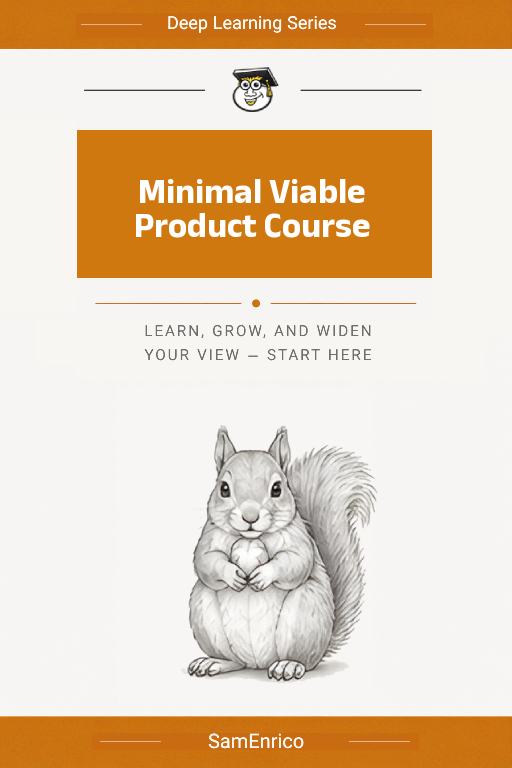
Minimal Viable Product Course eBook
Build only essential features of your digital prod
Build only essential features of your digital product to launch fast and iterate based on feedback.
Formats
Free sample
Chapter 1: The Three Ghosts--–- Every failed product starts as a good idea. This is the cruelest truth in building software. You wake up at 3:00 AM with a vision. You see the solution clearly. You believe—truly, deeply believe—that if you just build this feature, launch this app, or ship this update, customers will flock to you.
The logic feels airtight. The opportunity feels urgent. So you gather your team. You write specifications. You hire developers.
You spend weeks, sometimes months, breathing life into your vision. And then you release it into the world.And nothing happens.No spike in retention. No flood of praise. Not even angry emails—because anger at least means someone cared enough to be disappointed. Just silence.
Your feature exists. It works exactly as designed. But it might as well be invisible. A ghost.I have built more ghost features than I care to admit. The most painful one cost me six months and half a million dollars.
We were an e-commerce startup with a decent product but flat growth. Someone on the team—I think it was me—had a brilliant idea: a recommendation engine that would show customers products they actually wanted. We called it "The Muse." The name alone made us feel smart. We built sophisticated algorithms. We designed beautiful interface cards.
We integrated with every part of the customer journey. The Muse would pop up after a purchase, on the home page, in email digests. We were convinced this was the secret weapon. Our competitors didn't have it. Investors would drool.
Customers would thank us.We launched with a company-wide countdown. The CEO pressed a button. Confetti fell in the Slack channel. And then we watched the analytics.Zero point five percent click-through rate. Not five percent.
Half of one percent. Ninety-eight percent of users never touched The Muse at all. The remaining two percent clicked once and never returned. We had built a ghost feature. We had spent half a million dollars to create something that, from the customer's perspective, might as well have never existed.That night, I sat alone in my apartment and asked myself a question that would change the entire trajectory of my career: Why did I build this?
Not why did we build this particular feature, but why did I—a reasonably intelligent, experienced product person—invest serious resources into something that nobody asked for, nobody wanted, and nobody used?The answer was uncomfortable. I built The Muse because building felt like progress. I built it because I was afraid of standing still. I built it because I had confused activity with achievement. I built it because I had never learned to distinguish between legitimate uncertainty and simple anxiety.
I built it because I was haunted.This chapter is about the three ghosts that haunt every product builder. They are invisible. They are persuasive. And if you do not learn to recognize them, they will lead you to build feature after feature that nobody uses. The three ghosts are the Assumption Ghost, the Solution Ghost, and the Scalability Ghost.
Each one kills products in a different way. Each one requires a different exorcism. And before you write a single line of code for your next project, you need to identify which ghost is haunting you.Let me be clear about what this chapter is not. It is not a feel-good pep talk about believing in yourself. It is not a collection of war stories designed to make you feel better about your own failures.
It is a diagnostic tool. By the end of this chapter, you will take a five-minute quiz that will tell you exactly which ghost is draining your product's potential. You will know where to focus your limited time and attention. And you will never again build a feature simply because you are anxious about doing nothing.The Problem with Product Anxiety Before we meet the three ghosts, we need to understand the psychological terrain they inhabit. Most product failures are not caused by bad code, limited budgets, or aggressive competitors.
They are caused by a specific emotional state called product anxiety.Product anxiety is the fear that if you are not actively building something, you are falling behind. It manifests in predictable ways. You see a competitor launch a new feature, and you feel a knot in your stomach. You attend a conference and hear about a hot new technology, and you worry that your stack is obsolete. You go two weeks without shipping something visible, and your stakeholders start asking questions.
So you build. You ship. You announce. The anxiety subsides temporarily. But because you built without learning, the anxiety returns even stronger.
You are on a treadmill that leads only to more ghost features.Product anxiety is different from product uncertainty. Product uncertainty is the honest admission that you do not know something about your customers, your solution, or your market. Product uncertainty is healthy. It leads to questions, experiments, and learning. Product anxiety feels urgent but reveals nothing.
It demands action without direction. It is the enemy of the minimal viable product.The bestselling authors who form the foundation of this book—Eric Ries, Marty Cagan, Dan Olsen, Ash Maurya, Melissa Perri, Rob Fitzpatrick, Teresa Torres, Nir Eyal, Alistair Croll, Benjamin Yoskovitz, and John Doerr—all agree on one thing: most product failures begin as solutions in search of problems. You do not start with a ghost feature. You start with a guess. And because you have not distinguished between anxiety and uncertainty, you treat your guess as fact.
You build before you learn. That is how ghosts are born.Over the next several pages, we will meet each ghost in detail. We will learn how to spot them. We will learn how to test whether they are haunting us. And we will learn the single most important question you can ask before building anything.Ghost Number One: The Assumption Ghost The Assumption Ghost is the most common and the most dangerous.
It haunts you when you believe you already know what problem your customers need solved. You have not asked them. You have not observed them. You have simply assumed.The Assumption Ghost speaks in seductive phrases: "Everyone knows that..." "It's obvious that..." "Any reasonable person would want..." "Our competitors are doing it, so..." "The data suggests..." (when you have no data). This ghost makes you feel certain.
Certainty is comfortable. Certainty allows you to skip the messy, awkward, time-consuming work of talking to actual human beings. Certainty lets you stay in your chair, write specifications, and feel productive.But certainty without evidence is just arrogance in disguise.I once worked with a founder named Sarah who was building a productivity app for lawyers. She had been a lawyer for ten years before switching to tech. She knew the problem intimately.
She had lived it. She told me, with absolute confidence, that the biggest pain point for lawyers was organizing case notes across different matters. She had already sketched the solution: a tagging system with automatic cross-referencing. She was ready to hire developers.I asked her a simple question: "When is the last time you talked to…
This is the end of the free sample. Get the eBook to keep going. Buy now
About this book
Details
- Author
- Pearson Oscar
- Publisher
- SamEnrico
- Language
- English
- Genre
- Non-Fiction, First 30 Days, MVP
- Released
- 2026-06-01
- Pages (approx.)
- 147
- Available as
- eBook, Audiobook

Read better in the ZLOADR app
Your eBooks on your phone or tablet. Sign in with your SamEnrico account and start reading.
More by Pearson Oscar
 Mitigation Planning GuidePearson Oscar$11.99
 Burnout Recovery Acupuncture GuidePearson Oscar$11.99
 Cocaine Bowel Ischemia GuidePearson Oscar$11.99
 The Five Second Interruption RulePearson Oscar$11.99
 HGH and Acromegaly RisksPearson Oscar$11.99
 The Nonprofit Job Search TimelinePearson Oscar$11.99
 Learning Goal SettingPearson Oscar$11.99
 Grief and Writing After Child LossPearson Oscar$11.99
 The Blood of the Shirakawa: The Genpei War's Last Stand at Ichi-no-TaniPearson Oscar$11.99
 Voltaire’s Lightning: Sparks of the EnlightenmentPearson Oscar$11.99
 How to Produce Wire SpringsPearson Oscar$11.99
 GCC After Sales Service ImportancePearson Oscar$12.99
You may also like
 Hong Kong Handover 1997Dunn Johnnie$11.99
 Zumba For Postnatal Recovery CourseNeal Christian$11.99
 Zumba for BeginnersLadner Nikia$11.99
 YouTube Comment Mining GuideHumes Pandora$12.99
 Worry Box MeditationCarlin Rudy$11.99
 Workplace Stress MeditationNguyen Lynn$11.99
 Workplace Stress and Sleep RepairHawley Ivory$11.99
 Workplace Perfectionism CureDelaney Jeffry$11.99
 Workplace Injustice Anger GuideWallen Isabelle$11.99
 Work Addiction and Burnout LinkGreenwood Ester$11.99
 Women in Yoga and WellnessBeattie Galina$11.99
 Women in Stand Up ComedyChun Evangeline$11.99