
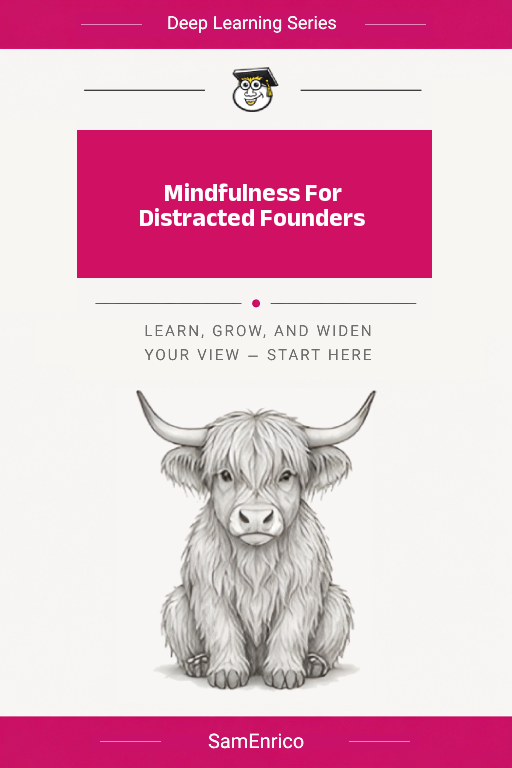
Mindfulness For Distracted Founders eBook
Practice 2 minute resets between meetings to ancho
by Alonzo Rea
Practice 2 minute resets between meetings to anchor attention when depression scatters focus.
Formats
Free sample
Chapter 1: The Fog Machine--You are not lazy. You are not broken. You are not a bad founder.If you are reading this book, you have likely spent the past several months—or years—waking up before dawn to answer investor emails, sitting through back-to-back Zoom calls until your vision blurs, and making decisions that affect the livelihoods of your employees, the savings of your investors, and the future of a company you built from nothing. You have done all of this while carrying a weight that no one else can see. A weight that feels less like sadness and more like concrete poured into your bones.
A weight that makes the simple act of clicking "accept" on a calendar invitation feel like climbing a mountain in boots filled with wet sand.And then you sat down to meditate. Because someone told you that mindfulness would fix it. A blog post said ten minutes a day would change your life. A fellow founder mentioned Headspace. Your therapist suggested "just noticing your breath." So you tried.
You closed your laptop, sat on the edge of your office chair, and attempted to follow the instructions. And within forty-five seconds, your brain was already rehearsing the argument you had with your CTO yesterday, then calculating your monthly burn rate, then imagining your mother's disappointed face if you told her you were thinking of selling. You opened your eyes. You felt worse than before. And you concluded, quietly, shamefully, that mindfulness is not for you.That conclusion is wrong.
But your experience is accurate.The problem is not that mindfulness does not work. The problem is that almost every book, app, and course on the subject was designed for a different human being—someone with leisurely mornings, predictable schedules, and a nervous system that has not been marinated in sixteen-hour workdays for three consecutive years. Traditional mindfulness asks you to sit still for twenty minutes. Traditional mindfulness asks you to watch your thoughts like clouds. Traditional mindfulness asks you to accept things as they are.
These are beautiful and worthy practices. They are also, for the distracted and depressed founder who has exactly ninety seconds between a board meeting and a product review, functionally impossible.This book exists because of that gap. And this chapter exists because, before we can teach you a single breathing technique or grounding protocol, we have to name the thing that is actually happening inside your brain. Because you have probably been calling it by the wrong name.The Name of the Fog Let us begin with a definition that will appear throughout this book. When you feel scattered, heavy, unable to focus, and strangely exhausted despite having done nothing physically demanding, you are likely experiencing what psychologists call high-functioning depression—specifically, its cognitive symptom cluster.
This is not a diagnosis. This book does not replace a psychiatrist or a therapist. But it is a name for the fog that has no name in startup culture.High-functioning depression is the state of achieving external milestones while feeling internally hollow. You closed the round. You shipped the feature.
You hired the VP. And yet, in the quiet between meetings, you feel nothing—or worse, you feel a low, humming dread that you cannot trace to any specific cause. Unlike major depressive episodes that immobilize completely, high-functioning depression allows you to perform. You can smile in the pitch. You can lead the all-hands.
But the cost of that performance is enormous, and it shows up in the gaps: the ten minutes between Zoom calls when you find yourself staring at the wall, the thirty seconds after a difficult conversation when your brain plays the argument on repeat, the two hours at the end of the day when you cannot remember a single thing you accomplished.Here is what you need to understand, and understand deeply: the fog is not a moral failure.You have likely internalized a story that says otherwise. The story sounds something like this: If I were stronger, I would not feel this way. If I were a better founder, I would be more present. If I had more grit, I could just push through it. That story is not only unkind—it is neurologically backwards.
What you are calling weakness is actually your brain's ancient, evolutionarily conserved attempt to protect you from further harm.The Energy Conservation Lie Your brain has a default setting that served your ancestors exceptionally well. When resources were scarce, when predators lurked in the tall grass, when winter threatened starvation, the brain developed a survival mechanism: it learned to conserve energy. This mechanism manifests as lowered motivation, reduced physical activity, narrowed attention, and a tendency to focus on potential threats rather than potential rewards. In a survival context, this keeps you alive. You do not waste energy chasing a deer you will not catch.
You do not ignore the rustle in the bushes. You hunker down. You conserve. You survive.In a startup context, that same mechanism becomes catastrophic.Your brain cannot tell the difference between a saber-toothed tiger and a Series A pitch deck. It cannot distinguish between a food shortage and a cash flow projection.
When you are chronically stressed—and if you are a founder, you are chronically stressed—your brain's threat-detection system (the amygdala) remains constantly activated. This constant activation triggers the energy-conservation response. Your brain believes, on a level below conscious thought, that resources are scarce and danger is imminent. So it does what it evolved to do: it lowers your energy, scatters your attention, and fixates on worst-case scenarios.You experience this as depression. Your brain experiences this as good strategy.This is the central reframe of this book.
When you feel the fog descending—when your attention scatters, when your limbs feel heavy, when the thought "we are failing" loops for the hundredth time—you are not witnessing a character flaw. You are witnessing a mismatch between your ancient nervous system and your modern environment. The fog is not a sign that you are broken. The fog is a sign that your brain is trying to protect you from a threat that does not actually exist. And the way out is not more willpower.
The way out is teaching your nervous system that you are, in fact, safe.Distraction Versus Depressive Scatter Before we go further, we must distinguish between two very different states that look identical from the outside but require completely different responses.Ordinary distraction feels like novelty-seeking. You are working on the budget, and suddenly you are checking Twitter. You are writing the investor update, and suddenly you are reorganizing your desk. Your attention drifts because your brain is bored, or tired, or curious. Ordinary distraction is a pull toward something else.
It has a quality of lightness, even if it is frustrating.Depressive scatter feels like wading through mud. You are not pulled away by something more interesting. You are simply unable to hold onto anything at all. The thought slips through your fingers before you can complete it. The sentence on the screen blurs.
You read the same email four times and still do not know what it says. This is not a pull…
This is the end of the free sample. Get the eBook to keep going. Buy now
About this book
Details
- Author
- Alonzo Rea
- Publisher
- SamEnrico
- Language
- English
- Genre
- Non-Fiction, Mental Wealth
- Released
- 2026-06-01
- Pages (approx.)
- 127
- Available as
- eBook, Audiobook

Read better in the ZLOADR app
Your eBooks on your phone or tablet. Sign in with your SamEnrico account and start reading.
More by Alonzo Rea
 Caretaking From ChildhoodAlonzo Rea$11.99
 Professor Communication GuideAlonzo Rea$11.99
 Mindfulness Meditation Body Scan TutorialAlonzo Rea$11.99
 Meditation for Perfectionism AnxietyAlonzo Rea$11.99
 Number Shape Peg WorkbookAlonzo Rea$11.99
 Body Scan for Somatic ExperiencingAlonzo Rea$11.99
 Parent Caregiver AnxietyAlonzo Rea$11.99
 Metta For People PleasersAlonzo Rea$11.99
 Dual Career Couple MigrationAlonzo Rea$11.99
 The Silk Road Escape: How a Convict Outsmarted the SystemAlonzo Rea$11.99
 The Quantum Whisperer: How a Teen Genius Cracked the Code of the CosmosAlonzo Rea$11.99
 Growing DracaenaAlonzo Rea$11.99
You may also like
 Hong Kong Handover 1997Dunn Johnnie$11.99
 Zumba For Postnatal Recovery CourseNeal Christian$11.99
 Zumba for BeginnersLadner Nikia$11.99
 YouTube Comment Mining GuideHumes Pandora$12.99
 Worry Box MeditationCarlin Rudy$11.99
 Workplace Stress MeditationNguyen Lynn$11.99
 Workplace Stress and Sleep RepairHawley Ivory$11.99
 Workplace Perfectionism CureDelaney Jeffry$11.99
 Workplace Injustice Anger GuideWallen Isabelle$11.99
 Work Addiction and Burnout LinkGreenwood Ester$11.99
 Women in Yoga and WellnessBeattie Galina$11.99
 Women in Stand Up ComedyChun Evangeline$11.99