
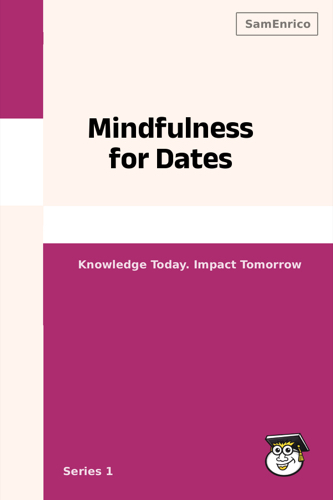
Mindfulness for Dates eBook
Be fully present with conversation partner.
Be fully present with conversation partner.
Formats
Free sample
Chapter 1: The Resume Funeral--You have already ruined your next date, and you haven't even left the house.Let me say that again, more slowly, so it lands: The date you are about to go on—the one you are nervously preparing for, the one for which you have already picked out an outfit and rehearsed three funny anecdotes and checked their Instagram stories twice—that date is already damaged. Not beyond repair, but damaged. Because you walked in with a resume, and you handed it to them before you said hello.The resume is not a physical document. You did not print out your CV and slide it across the table (I hope). The resume is the collection of assumptions, judgments, and expectations you have assembled about this person based on digital scraps and social media breadcrumbs.
You scanned their Linked In. You judged their vacation photos. You noted their job title and calculated their approximate income. You decided they were "probably boring" because they like hiking and you hate hiking. Or you decided they were "out of your league" because their teeth are very white and their friends are very attractive.
Or you decided they were "a bad bet" because they follow three political accounts you disagree with.You did all of this before they said a single word to you.This is not preparation. This is the opposite of mindfulness. This is the ego's desperate attempt to control the uncontrollable by reducing a living, breathing, changing human being into a static set of data points. And it is killing your dates before they begin.The Anatomy of the Resume Let me show you what the resume looks like in practice. I want you to be honest with yourself here.
No one is watching.You match with someone on an app. You spend exactly four to seven seconds looking at their first photo—studies show this is the average time before a swipe decision—and then you scroll through the rest. While you scroll, your brain is running a silent calculation in the background, something like this:Attractive? Yes. No.
Maybe. Check the second photo. Okay, attractive. Job? Oh, they're a graphic designer.
That's creative, but do they make money? Don't think about that. Hobbies? They like running. I hate running.
But they also like tacos. Everyone likes tacos. That's not a personality. Their bio says "looking for someone who doesn't take themselves too seriously." Everyone says that. That means nothing.
But their third photo has a dog. Good sign. Dog people are trustworthy. Unless the dog is borrowed. Is that a borrowed dog?
Who borrows a dog for a photo? Paranoid. Stop. Swipe right.That entire calculation happens in less time than it takes to microwave a bag of popcorn. And you have just created a resume.
You have assigned them traits—creative, possibly broke, fit (threatening), average sense of humor, dog-adjacent. You have decided what matters (job, dog, teeth) and what does not matter (everything else). You have built a story about who they are, and you have not exchanged a single word.Now comes the real damage. You take that resume into the date. You sit down, and instead of meeting a person, you meet your expectations.
You test them against the resume. Are they as attractive as their photos? Are they as funny as their bio? Is the dog real? Every word they say is filtered through the grid you built in advance.
They say they had a long week at work, and you think, Graphic design can't be that stressful. They say they went for a run that morning, and you think, Of course they did, the resume said runner.You are not listening to them. You are listening to your assumptions about them. And those two things are not the same.Why We Build Resumes (The Illusion of Safety)You might be reading this and thinking, But isn't that just normal? Doesn't everyone do this?
Isn't this just... preparation?Yes, everyone does this. And yes, it is normal. But "normal" is not the same as "effective." Normal dating behavior is precisely what produces the widespread experience of lonely, anxious, performative dates that go nowhere. Normal is the problem.
Normal is the thing this book exists to undo.So why do we build resumes? Three reasons.First: The illusion of control. Dating is terrifying because the outcome is entirely outside your control. You cannot make someone like you. You cannot force chemistry.
You cannot predict whether they will text back. The human brain hates this uncertainty. It would rather be wrong with confidence than uncertain with openness. So the brain builds a resume—a set of predictions—to create the feeling of knowing what will happen. If they like hiking, they are probably outdoorsy.
If they are outdoorsy, they are probably active. If they are active, they are probably healthy. If they are healthy, they might live a long time. That is good. I like this person.
The chain of assumptions is absurd, but it feels like knowledge. And the brain prefers the comfort of false knowledge to the discomfort of true uncertainty.Second: Social comparison. The resume is also a tool for ranking. You are not just evaluating them; you are comparing them to everyone else. To your ex.
To the other three people you are currently messaging. To the idealized version of a partner that lives in your head. The resume turns a human being into a scorecard. They are a 7 on looks, an 8 on job, a 6 on humor, a 9 on dog ownership. Average score 7.5.
That is acceptable. This is grotesque, and we all do it. The resume allows you to treat a person like a product review because it is less vulnerable than treating them like a mystery.Third: Self-protection. The resume is a shield. If you have already decided they are "probably boring" or "probably not your type," then you do not have to be disappointed when the date goes badly.
You were right all along. The resume protects you from hope, because hope is dangerous. Hope means you care. Caring means you can get hurt. So you pre-judge them as a way of pre-rejecting them, just in case they reject you first.All of this is understandable.
All of this is human. And all of this is the enemy of presence.The Beginner's Mind: A Radical Alternative There is another way. It is older than dating apps, older than psychotherapy, older than almost everything in this book. It comes from Zen Buddhism, and it is called Shoshin, or "Beginner's Mind."Beginner's Mind is the practice of looking at something as if you have never seen it before. Not as if you are pretending to be ignorant.
Actually opening yourself to the possibility that everything you think you know might be wrong, or incomplete, or irrelevant.A master potter, when asked to teach a beginner, is supposed to approach the clay with Beginner's Mind—forgetting the thousand pots they have already made, seeing this lump of wet earth as if it is the first one. A scientist making a discovery is supposed to set aside their hypotheses and look at the data…
This is the end of the free sample. Get the eBook to keep going. Buy now
About this book
Details
- Author
- Elizondo Cruz
- Publisher
- SamEnrico
- Language
- English
- Genre
- Non-Fiction, Self-Help, Dating
- Released
- 2026-06-07
- Pages (approx.)
- 130
- Available as
- eBook, Audiobook

Read better in the ZLOADR app
Your eBooks on your phone or tablet. Sign in with your SamEnrico account and start reading.
More by Elizondo Cruz
 Pandemic Freight Cost SurgeElizondo Cruz$11.99
 Holiday Grief Without ChildElizondo Cruz$11.99
 Dividend Cut Survival HandbookElizondo Cruz$11.99
 The Hypnotic Voice ProtocolElizondo Cruz$11.99
 Social Support Burnout ShieldElizondo Cruz$11.99
 Norway Nazi Collaborator ReckoningElizondo Cruz$11.99
 Gig Platform Expense TrackerElizondo Cruz$11.99
 The Pharaoh's Pitch: Ancient Egypt's Forgotten Baseball PioneersElizondo Cruz$11.99
 Quetzalcoatl’s Serpent Flight: The Feathered Serpent’s Cosmic JourneyElizondo Cruz$11.99
 How to Produce Windsurfing Board PartsElizondo Cruz$11.99
 Growing AchimenesElizondo Cruz$11.99
 Swedish Institute Scholarship GuideElizondo Cruz$12.99
You may also like
 Hong Kong Handover 1997Dunn Johnnie$11.99
 Zumba For Postnatal Recovery CourseNeal Christian$11.99
 Zumba for BeginnersLadner Nikia$11.99
 YouTube Comment Mining GuideHumes Pandora$12.99
 Worry Box MeditationCarlin Rudy$11.99
 Workplace Stress MeditationNguyen Lynn$11.99
 Workplace Stress and Sleep RepairHawley Ivory$11.99
 Workplace Perfectionism CureDelaney Jeffry$11.99
 Workplace Injustice Anger GuideWallen Isabelle$11.99
 Work Addiction and Burnout LinkGreenwood Ester$11.99
 Women in Yoga and WellnessBeattie Galina$11.99
 Women in Stand Up ComedyChun Evangeline$11.99