
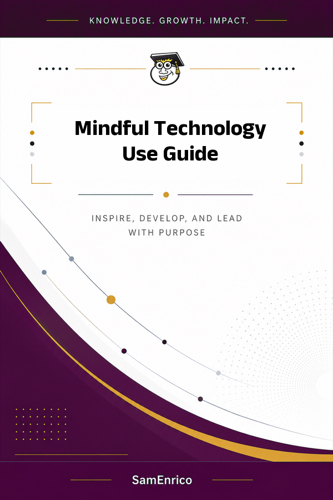
Non-FictionSelf-HelpDigital WellnessScreen Time
Mindful Technology Use Guide eBook
Notice the urge to check devices and choose intent
Notice the urge to check devices and choose intentional engagement.
Formats
Free sample
Chapter 1: The Phantom Buzz...--–- Your hand is moving before you know it. Mid-sentence in a conversation with your partner, your right hand drifts toward your pocket. You are not bored. You are not expecting an important call. Your phone did not vibrate.
And yet, here is your hand, halfway to the device, like a trained dog responding to a whistle only you can hear.This is the phantom buzz. It is not a hallucination. It is a conditioned nervous twitch, etched into your muscle memory by thousands of repetitions. And it is the single most honest indicator of your relationship with technology. Because the phantom buzz reveals what you have stopped noticing: that you are no longer choosing to check your phone.
Your phone is choosing for you.Let me pause here and tell you something that will either relieve you or terrify you. The phantom buzz is not a sign of weakness. It is not a character flaw. It is not evidence that you lack discipline. The phantom buzz is evidence that you have been trained.
And what has been trained can be retrained.Over the next twelve chapters, this book will teach you to notice the urge, pause before acting, and choose intentional engagement over automatic reaction. But before we can build the pause, we have to see the pattern. Before we can choose differently, we have to see what we are actually doing right now. And that is what this first chapter is for: raw, unfiltered awareness.The Scene You Have Lived a Thousand Times You are sitting at a red light. Three seconds pass.
Your hand reaches for your phone. You check notifications. Nothing new. You put the phone down. The light turns green.
You drive ten seconds. Another red light. Your hand reaches again.You are watching a movie with your family. A slow scene begins. Your hand finds your phone.
You scroll Instagram for thirty seconds. You look up. You missed nothing important in the movie. But you also missed nothing important online. You just missed thirty seconds of your life.You are lying in bed at 11:15 PM.
You are tired. You know you should sleep. Your hand reaches for your phone. You tell yourself you will check "just one thing." Forty-five minutes later, you are still scrolling. You are not enjoying it.
You are not learning anything. You are not connecting with anyone. You are simply doing it, because the alternative—closing your eyes and being alone with your thoughts—has become unbearable.These scenes share a common structure. An urge arises. You act on it without deliberation.
The action produces a small reward (a novel piece of information, a moment of relief from boredom). And the loop repeats. Psychologists call this the habit loop: trigger, routine, reward. In the digital age, this loop runs dozens or even hundreds of times per day, largely beneath the level of conscious awareness.The first step toward mindful technology use is simply to see the loop. Not to fix it.
Not to judge it. Just to see it.External Triggers: The Visible Invitations Let us distinguish between two kinds of triggers, because they require different responses. The first kind is the external trigger: a signal from the world outside your body that invites you to check your device.External triggers are the most obvious and the easiest to address. They include:A notification banner sliding down from the top of your screen A vibration in your pocket A ringtone or alert sound A blinking LED light on your phone A badge icon showing a red number on an app The sound of someone else's phone (which makes you check yours, just in case)Each of these external triggers is carefully designed by teams of behavioral psychologists, user experience designers, and neuroscientists working for the largest technology companies in the world. They are not accidental.
They are not neutral. They are engineered to capture your attention with maximum efficiency.Here is how it works. Your brain has an ancient survival mechanism called the orienting response. When something new, bright, loud, or moving appears in your environment, your brain automatically shifts attention toward it. This kept your ancestors alive.
A rustle in the bushes might be a predator. Better to look than to be eaten.In the modern world, your phone exploits this ancient reflex. Every notification triggers the orienting response. Your brain releases a small pulse of norepinephrine, a neurotransmitter associated with alertness and urgency. You feel a tiny spike of something that feels like importance.
You look. Most of the time, there is nothing important. But your brain cannot distinguish between a genuine emergency and a like on Instagram. The same chemical response happens either way.Over time, this conditioning becomes automatic. You do not need to see a notification to reach for your phone.
The absence of a notification becomes a trigger in itself. Is something happening? Let me check. This is why you look at your phone when it is silent. This is why your hand moves before your conscious mind has decided anything.
The external trigger has become internalized.Internal Triggers: The Hidden Drivers The second kind of trigger is more powerful and more difficult to see. Internal triggers arise from within your body and mind: boredom, loneliness, anxiety, fatigue, uncertainty, hunger, restlessness, and even anticipation.You check your phone when you are bored in line at the grocery store. You check your phone when you feel lonely at a party. You check your phone when you are anxious before a difficult conversation. You check your phone when you are tired at work and need a "break" that somehow makes you more tired.
You check your phone when you are uncertain about what to do next, because your phone always has a next thing ready to do.Internal triggers are not created by technology companies. They are part of being human. But technology companies have become extraordinarily skilled at exploiting them. Every time you feel a moment of discomfort—a gap in conversation, a pause in activity, a flicker of uncertainty—your phone offers itself as the solution. Why sit with boredom when you can scroll?
Why feel loneliness when you can see what other people are doing? Why tolerate anxiety when you can distract yourself into numbness?The problem is that checking your phone does not resolve the internal trigger. It postpones it. You feel bored, so you scroll. You stop scrolling.
The boredom is still there. You feel lonely, so you check Instagram. You see other people having fun without you. Now you feel lonely and inadequate. The internal trigger has not been resolved.
It has been amplified.Most of this book is about managing internal triggers. Chapters three, four, and six will teach you specific techniques for sitting with discomfort, labeling emotions, and choosing a response instead of reacting automatically. But for this first chapter, we are only trying to see the triggers. We are not trying to fix them yet.The Dopamine Trap: Why Apps Feel So Compelling You have heard of dopamine. You have heard that your phone is a "dopamine machine." But what does that actually mean?Dopamine…
This is the end of the free sample. Get the eBook to keep going. Buy now
About this book
Details
- Author
- Fluker Arletha
- Publisher
- SamEnrico
- Language
- English
- Genre
- Non-Fiction, Self-Help, Digital Wellness, Screen Time
- Released
- 2026-06-10
- Pages (approx.)
- 134
- Available as
- eBook, Audiobook

Read better in the ZLOADR app
Your eBooks on your phone or tablet. Sign in with your SamEnrico account and start reading.
More by Fluker Arletha
 Pet Loss During DivorceFluker Arletha$11.99
 Complicated Grief After Friendship LossFluker Arletha$11.99
 Environmental Engineer CreativityFluker Arletha$11.99
 The Cesar Chavez Farmworker LeaderFluker Arletha$11.99
 Shadows of the Yamato: The Hidden War of the WajinFluker Arletha$11.99
 Strategic Sourcing EfficiencyFluker Arletha$12.99
 AI Accounting Comparison GuideFluker Arletha$12.99
 CoachFluker Arletha$11.99
 Understanding Stoll–kieny–dott SyndromeFluker Arletha$17.99
 Ultimate Handbook Guide to Agra : (India) Travel GuideFluker Arletha$11.99
You may also like
 Hong Kong Handover 1997Dunn Johnnie$11.99
 Zumba For Postnatal Recovery CourseNeal Christian$11.99
 Zumba for BeginnersLadner Nikia$11.99
 YouTube Comment Mining GuideHumes Pandora$12.99
 Worry Box MeditationCarlin Rudy$11.99
 Workplace Stress MeditationNguyen Lynn$11.99
 Workplace Stress and Sleep RepairHawley Ivory$11.99
 Workplace Perfectionism CureDelaney Jeffry$11.99
 Workplace Injustice Anger GuideWallen Isabelle$11.99
 Work Addiction and Burnout LinkGreenwood Ester$11.99
 Women in Yoga and WellnessBeattie Galina$11.99
 Women in Stand Up ComedyChun Evangeline$11.99