
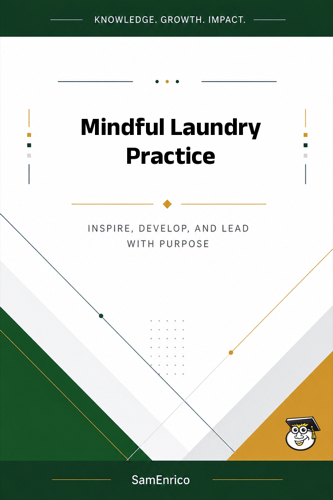
Non-FictionSelf-HelpHouseholdDaily Practice
Mindful Laundry Practice eBook
Feel fabric textures and folding rhythms as medita
Feel fabric textures and folding rhythms as meditation.
Formats
Free sample
Chapter 1: The Washing Machine Whispers--–- The first time I heard it, I was standing barefoot on a cold concrete floor at 11:47 on a Tuesday night. My third load of laundry that day. The machine was mid-spin, rattling like a freight train, and I was crying over a missing sock. Not because the sock mattered—it was gray, unremarkable, one of a dozen identical pairs—but because the missing sock had become everything. It was the missed deadline.
The argument I couldn't take back. The phone call I kept meaning to return. The weight I had been carrying for months, compressed into a single piece of missing cotton.The washing machine did not stop. It did not care. It thumped and whirred and drained and spun, completing its cycle with the indifferent dignity of a thing that knew exactly what it was supposed to do.
I, on the other hand, did not know what I was supposed to do. I only knew I was exhausted, and the laundry was never finished, and somehow that felt like a personal failure.That night, I sat on the floor and watched the machine finish its work. The spin cycle slowed. The drum settled. A final click.
And then—silence. In that silence, something shifted. I realized I had been treating my mind the way I treated my laundry: as a problem to be solved, a mess to be managed, a cycle to be endured. But the machine didn't endure its cycles. It trusted them.
It had been designed to move through agitation, rest, and release without once asking, "Am I doing this right?"I had never trusted my own cycles. I had spent years trying to skip the agitation, rush the rest, and force the release. And I was exhausted.This book is the record of what happened when I stopped fighting and started listening. When I realized that the washing machine—humming, rattling, spinning in my basement—was not just an appliance. It was a teacher.
And the laundry was not just a chore. It was a practice.The Radical Premise: Your Laundry Machine Is an Oracle Let me say this clearly, because it sounds absurd: your washing machine knows something you don't. Not in a mystical, crystals-and-incense way. In a mechanical, biological, absolutely practical way. It knows how to move through a cycle without interfering with itself.
It knows that agitation is not a malfunction. It knows that rest is not laziness. It knows that draining is not loss—it is preparation for the next fill.Your mind, for all its complexity, does not know these things. Your mind confuses agitation with danger. It interprets rest as stagnation.
It experiences release as grief. And then it tries to solve these "problems" by thinking harder, worrying more, and controlling every variable within reach. This is like trying to speed up a washing machine by hitting it with a hammer. It doesn't work. It only breaks things.The premise of this book is simple and radical: the state of your laundry reflects the state of your mind.
Not metaphorically. Literally. When your laundry is piled in chaos, when the machine is overloaded, when you are shoving wet clothes into a corner because you ran out of time—that is not a housekeeping problem. That is a diagnostic. Your external disorder is an echo of your internal disorder.And the reverse is also true.
When you learn to move through the laundry cycle with presence, trust, and breath, you are not just cleaning clothes. You are retraining your nervous system. You are teaching your mind that agitation passes, rest arrives, and release is safe.This is not self-help fluff. This is neurobiology dressed in fabric softener.Cycle Mapping: Listening to What You Already Know Before we go any further, I want you to do something that will feel strange. I want you to pause mid-laundry—right now, if you have a load going, or the next time you start one—and simply listen.Stand in front of your washing machine.
Do not scroll your phone. Do not start another task. Do not mentally rehearse tomorrow's meeting. Just stand there. Listen.What do you hear?A low, steady hum?
That is the fill cycle. Water entering. Expectation building. Your mind in the moment before a task begins.A thumping, rattling, violent churn? That is agitation.
The machine doing exactly what it was designed to do. Your mind in the grip of anxiety, conflict, or obsessive thought.A pause? A moment of near-silence between bursts? That is rest. The machine resetting.
Your mind's natural capacity for calm, briefly revealed.A swooshing drain? That is release. Water leaving. Your mind letting go of what it no longer needs.A high-speed whir? That is the spin cycle.
Centrifugal force flinging out residual moisture. Your mind integrating the lesson, preparing for what comes next.Now turn your attention inward. Not with judgment. Not with analysis. Just with curiosity.
Does your mind sound like this machine right now?If the machine is rattling and you are rattled—that is not a coincidence. You are not broken. You are in cycle.If the machine is humming steadily and you are scattered—that is also information. You are out of sync with your environment. That is not a crisis.
It is a signal.The practice of Cycle Mapping is not about fixing anything. It is about seeing clearly. And seeing clearly is the first step toward trusting the process.The Agitation Cycle: Why Anxiety Is Not a Malfunction Let me tell you something that might change your life: agitation is not a mistake.When your washing machine thumps and vibrates and rattles the pipes, you do not call a repair person. You do not panic. You do not stand there saying, "Why can't you just be calm?" You understand, on a fundamental level, that the machine is doing its job.
The agitation cycle is what loosens dirt. Without it, nothing gets clean.Your mind has an agitation cycle too. It is called anxiety, rumination, worry, and internal conflict. And for your entire life, you have probably been told that these states are problems to be eliminated. Take a pill.
Think positive. Meditate it away. Distract yourself.But what if anxiety is not a malfunction? What if it is your mind's way of loosening dirt—the accumulated residue of old hurts, unprocessed fears, and unexamined beliefs—so that it can be drained away?I am not romanticizing suffering. Clinical anxiety is real and serious, and if you are in crisis, please seek professional help.
But for the everyday agitation that most of us experience—the racing heart before a difficult conversation, the clenched jaw during rush hour, the scattered thoughts at 3 AM—what if the solution was not elimination but trust?The anatomy of agitation: When your mind enters its agitation cycle, you will notice physical signs. A racing heart. Shallow breathing. Clenched jaw or shoulders. A sense of urgency without a clear target.
These are not signs that something is wrong. They are signs that something is being processed.The instinct, when agitation arises, is to "open the lid." To interrupt the cycle…
This is the end of the free sample. Get the eBook to keep going. Buy now
About this book
Details
- Author
- Orosco Leisha
- Publisher
- SamEnrico
- Language
- English
- Genre
- Non-Fiction, Self-Help, Household, Daily Practice
- Released
- 2026-06-07
- Pages (approx.)
- 126
- Available as
- eBook, Audiobook

Read better in the ZLOADR app
Your eBooks on your phone or tablet. Sign in with your SamEnrico account and start reading.
More by Orosco Leisha
 Jonathan Edwards Revival FireOrosco Leisha$11.99
 Remote Hiring PlaybookOrosco Leisha$11.99
 The Complicated Grief First YearOrosco Leisha$11.99
 The Digital Body Language BookOrosco Leisha$11.99
 The Medici Conspiracy: How a Lost Leonardo da Vinci Masterpiece Resurfaced in the Shadow of WarOrosco Leisha$11.99
 Delivery Professional ParcelOrosco Leisha$11.99
 Fairtrade Cocoa ExportOrosco Leisha$12.99
 Trademark Valuation for M AOrosco Leisha$12.99
 Understanding Subcortical Laminar HeterotopiaOrosco Leisha$17.99
 How to Become a Shear-grinder OperatorOrosco Leisha$11.99
You may also like
 Hong Kong Handover 1997Dunn Johnnie$11.99
 Zumba For Postnatal Recovery CourseNeal Christian$11.99
 Zumba for BeginnersLadner Nikia$11.99
 YouTube Comment Mining GuideHumes Pandora$12.99
 Worry Box MeditationCarlin Rudy$11.99
 Workplace Stress MeditationNguyen Lynn$11.99
 Workplace Stress and Sleep RepairHawley Ivory$11.99
 Workplace Perfectionism CureDelaney Jeffry$11.99
 Workplace Injustice Anger GuideWallen Isabelle$11.99
 Work Addiction and Burnout LinkGreenwood Ester$11.99
 Women in Yoga and WellnessBeattie Galina$11.99
 Women in Stand Up ComedyChun Evangeline$11.99