
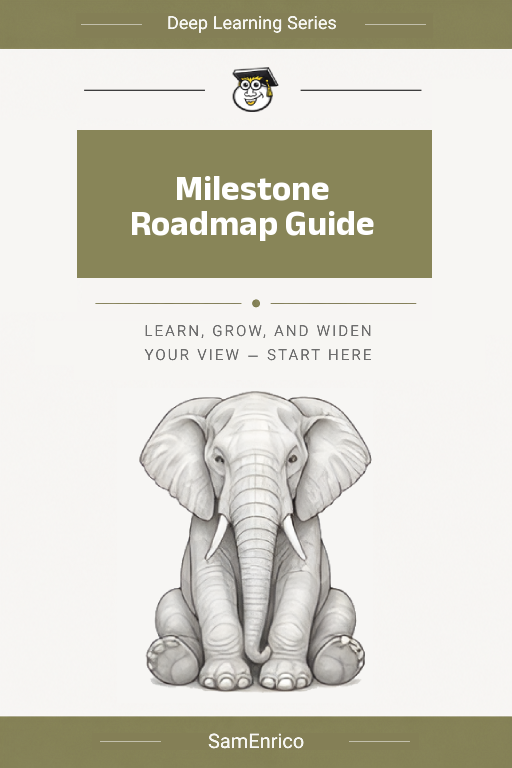
Milestone Roadmap Guide eBook
Set quarterly goals and key achievements.
Set quarterly goals and key achievements.
Formats
Free sample
Chapter 1: The Annual Illusionist--–- Every January, millions of people sit down with fresh notebooks, clean spreadsheets, and genuine hope. They write down their annual goals with the kind of optimism that only a new year can bring. They imagine December, looking back on a transformed life, a thriving business, a body reshaped, a bank account doubled. And then April arrives. And nothing has changed.This is not a failure of willpower.
This is not a character flaw. This is the work of the Annual Illusionist – a seductive, invisible force that has convinced you that more time equals better results. The Illusionist whispers that a year is a gift, that you need room to breathe, that rushing is for amateurs. And every single year, the Illusionist steals eleven months of your life and hands you back one month of frantic, desperate scrambling.The evidence is everywhere, but we have been trained not to see it. Ask yourself honestly: In your last annual goal, during which month did most of the actual progress occur?
Not the planning. Not the talking. Not the meetings about the planning. The actual, measurable movement toward the finish line. For the vast majority of people, the answer is months ten, eleven, or twelve.
Sometimes month nine, if they are unusually disciplined. Everything before that was noise.This is Annual Paralysis, and it is the most expensive productivity disease in the modern world. It costs companies billions in wasted salaries. It costs individuals years of their lives spent in the purgatory of "working on it." And it is completely, utterly preventable – not by working harder, not by installing another productivity app, not by waking up at 4am to journal, but by doing one simple thing: abandoning the year as your unit of measurement and adopting the quarter.The Myth of the Annual Plan Let us examine the anatomy of a typical annual goal. On January 15th, you feel like a god.
The year stretches before you like an empty highway. You have twelve months. Anything is possible. You write down ambitious targets – lose thirty pounds, launch a new product line, write a book, double your revenue. The very act of writing them down releases dopamine.
You have done the hard part, or so you believe.February arrives. Life intervenes. A project at work runs long. A child gets sick. A client demands attention.
You tell yourself it is fine. You have eleven months left. The Illusionist smiles.By April, the goal has migrated to a secondary list. By June, it lives in a folder labeled "Q3 Planning." By September, you feel a vague sense of anxiety when you think about it, so you stop thinking about it. Then November arrives, and panic sets in.
You have sixty days to achieve what you promised yourself in three hundred days of inaction. You cram. You stress. You might succeed, barely, but you will not enjoy it. And you will learn nothing except that you work well under pressure – which is not a strategy, it is an excuse.This pattern is so common that entire industries have been built to exploit it.
Gym memberships spike in January and attendance normalizes by March. Online course enrollment peaks in the first week of the year and completion rates crater by week six. Business planning retreats produce beautiful documents that no one looks at after February. The Illusionist feeds on hope and delivers shame.The Science of the Wrong Time Horizon Why does the annual plan fail so consistently? The answer lies in cognitive psychology and behavioral economics.
Three distinct mechanisms work together to sabotage year-long goals.First, hyperbolic discounting. Humans are wired to prefer smaller, immediate rewards over larger, delayed ones. A donut today is more appealing than a flat stomach in December. An extra hour of sleep this morning is more tangible than a promotion eleven months from now. The further away a reward is, the less our brains care about it.
An annual goal is so distant that our brains treat it as essentially fictional. We know it intellectually, but we do not feel it emotionally.Second, the planning fallacy. First identified by Daniel Kahneman and Amos Tversky, the planning fallacy describes our consistent tendency to underestimate the time, cost, and risk of future tasks while overestimating our own capabilities. When you set an annual goal, you imagine the best-case scenario – no emergencies, no interruptions, no fatigue, no friction. You plan for the perfect path and then reality introduces speed bumps.
By March, you are already behind the imaginary schedule you created in January, and shame replaces motivation.Third, the absence of feedback loops. An annual goal provides a single data point: success or failure, measured once, after 365 days. That is like driving across the country with a blindfold on and checking your GPS only when you arrive. You have no way to course-correct. You have no way to know if you are veering off track in February, because February is still "early." By the time you realize you are lost, it is November and you have no time left.The quarter solves all three problems simultaneously.
Ninety days is close enough to feel real – your brain can imagine 90 days. Ninety days is short enough that the planning fallacy has less room to operate – you cannot hide eleven months of delay in a 90-day window. And ninety days provides a regular feedback loop – four times per year, you get a clear signal: win or learn.The Rhythm Method: Why Beats Per Minute Matter More Than Repetition There is a difference between rhythm and routine, and that difference is the secret to sustained execution.Routine is doing the same thing at the same time every day. Routine is valuable for habits like brushing your teeth or making coffee. But routine has a dark side: it becomes invisible.
When something is routine, you stop thinking about it. You stop improving it. You stop feeling it. Routine is the enemy of urgency.Rhythm is different. Rhythm is a pattern of peaks and valleys, of sprints and recoveries, of intensity and rest.
Think of music. A metronome produces routine – tick, tick, tick, identical and endless. A drumbeat produces rhythm – boom, pause, ba-boom, pause. The pause is not empty; it is anticipation. The variation is not inefficiency; it is energy.The quarterly system creates rhythm.
You begin with a planning week – intense, focused, strategic. Then you execute in weekly sprints, with Friday afternoons reserved for review and reflection. Then you rest. Then you sprint again. Then you close the quarter with a retrospective – celebration and learning.
Then you pause. Then you plan the next quarter. This rhythm is predictable but not monotonous. It has a heartbeat. And hearts, when they stop beating, are not resting – they are dead.Most people alternate between two dysfunctional states: frantic activity followed by exhausted collapse.
That is not rhythm; that is burnout cycling. True rhythm is sustainable because it builds in recovery before you need it. You review every Friday, not because you are behind, but because the review is the beat. You retrospect every 90 days, not because the quarter failed, but because the retrospective is the downbeat…
This is the end of the free sample. Get the eBook to keep going. Buy now
About this book
Details
- Author
- Holder Delmer
- Publisher
- SamEnrico
- Language
- English
- Genre
- Non-Fiction, First 30 Days, Roadmapping, First 30 Days, Milestone Planning
- Released
- 2026-06-07
- Pages (approx.)
- 127
- Available as
- eBook, Audiobook

Read better in the ZLOADR app
Your eBooks on your phone or tablet. Sign in with your SamEnrico account and start reading.
More by Holder Delmer
 Stress Bladder UrgencyHolder Delmer$11.99
 Menopause Exercise PrescriptionHolder Delmer$11.99
 Moving Stress Relationship GuideHolder Delmer$11.99
 ABCDE for Wedding PlannersHolder Delmer$11.99
 Welcome Email Automation SeriesHolder Delmer$11.99
 Niels Bohr Quantum PioneerHolder Delmer$11.99
 Venus Cloud Top GuideHolder Delmer$11.99
 Cricket Player's Self HypnosisHolder Delmer$11.99
 Tsushima: The Storm That Forged a NavyHolder Delmer$11.99
 The Alchemists of Timbuktu: A Love Story in Numbers and ElementsHolder Delmer$11.99
 How to Produce Disc Golf BagsHolder Delmer$11.99
 Zonkeys: Zebra-donkey HybridHolder Delmer$11.99