
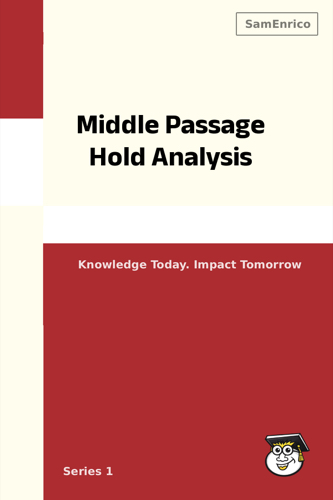
Non-FictionHistoryMaritime History
Middle Passage Hold Analysis
Details the brutal packing methods used to maximiz
Details the brutal packing methods used to maximize profit by cramming enslaved Africans below deck.
Formats
About this book
Free sample
Chapter 1: The Spreadsheet of Brutality--–- In the counting houses of Liverpool, Bristol, and Nantes, men in powdered wigs and gold-buckled shoes did not speak of kidnapping, torture, or murder. They spoke of “adventure,” “investment,” and “return on capital.” They sat before enormous leather-bound ledgers, dipping quills into iron-gall ink, and calculated the optimal number of human beings who could be crammed into a wooden hold such that the profit from the survivors exceeded the cost of the dead. These were not sadists, though some were certainly cruel. They were businessmen. And business, in the eighteenth-century Atlantic world, had discovered a terrible truth: the human body could be treated as a depreciating asset, and the mathematics of suffering could be optimized.The Slave Trade as a Financial System To understand the Middle Passage—the brutal, six-to-eleven-week voyage that transported enslaved Africans across the Atlantic to the Americas—one must first abandon the comfortable fiction that the trade was an irrational or chaotic enterprise.
It was not. From approximately 1526 to 1867, the transatlantic slave trade operated as a highly sophisticated global financial system, complete with insurance markets, futures contracts, credit instruments, and actuarial tables. The slave ship was not merely a vessel of transport; it was a floating factory designed to transform living human beings into negotiable commodities. And at the heart of this transformation lay a simple, horrifying calculation: how many bodies could be packed below deck such that the number that arrived alive—and thus saleable—exceeded the number that died in transit, and by a margin wide enough to satisfy investors.The chapter title, “The Spreadsheet of Brutality,” is not metaphorical. Historians who have examined the archives of slave-trading firms—the Liverpool-based firms of Baker and Dawson, the London-based Camden and Amboy Company, the French house of Raby and Desfarges—have uncovered detailed ledgers that list enslaved Africans as line items alongside barrels of gunpowder, rolls of iron bars, and bolts of cotton cloth.
Each captive received a purchase price (recorded in pounds sterling, livres tournois, or Dutch guilders), a projected survival probability (often expressed as a fraction, e.g.…
This is the end of the free sample. Get the eBook to keep going. Buy now
Contents
- Chapter 1
- Chapter 2
- Chapter 3
- Chapter 4
- Chapter 5
- Chapter 6
- Chapter 7
- Chapter 8
- Chapter 9
- Chapter 10
- Chapter 11
- Chapter 12
Details
- Author
- Archibald Ezequiel
- Publisher
- SamEnrico
- Language
- English
- Genre
- Non-Fiction, History, Maritime History
- Released
- 2026-06-08
- Pages (approx.)
- 125
- Available as
- eBook, Audiobook

Read better in the ZLOADR app
Your eBooks on your phone or tablet. Sign in with your SamEnrico account and start reading.
More by Archibald Ezequiel
 Long Term Regulation for SeniorsArchibald Ezequiel$11.99
 Brokerage Automated Investing GuideArchibald Ezequiel$11.99
 Stress and Vulnerability PracticeArchibald Ezequiel$11.99
 The Lantern and the Lens: The Birth of Latin American CinemaArchibald Ezequiel$11.99
 PII Redaction TranslationArchibald Ezequiel$12.99
 How to Produce Book Stands and RestsArchibald Ezequiel$11.99
 10 Ways to Use Aframomum Melegueta (Recipe Book)Archibald Ezequiel$11.99
 Chief Human Resources OfficerArchibald Ezequiel$11.99
You may also like
 Hong Kong Handover 1997Dunn Johnnie$11.99
 Zumba For Postnatal Recovery CourseNeal Christian$11.99
 Zumba for BeginnersLadner Nikia$11.99
 YouTube Comment Mining GuideHumes Pandora$12.99
 Worry Box MeditationCarlin Rudy$11.99
 Workplace Stress MeditationNguyen Lynn$11.99
 Workplace Stress and Sleep RepairHawley Ivory$11.99
 Workplace Perfectionism CureDelaney Jeffry$11.99
 Workplace Injustice Anger GuideWallen Isabelle$11.99
 Work Addiction and Burnout LinkGreenwood Ester$11.99
 Women in Yoga and WellnessBeattie Galina$11.99
 Women in Stand Up ComedyChun Evangeline$11.99