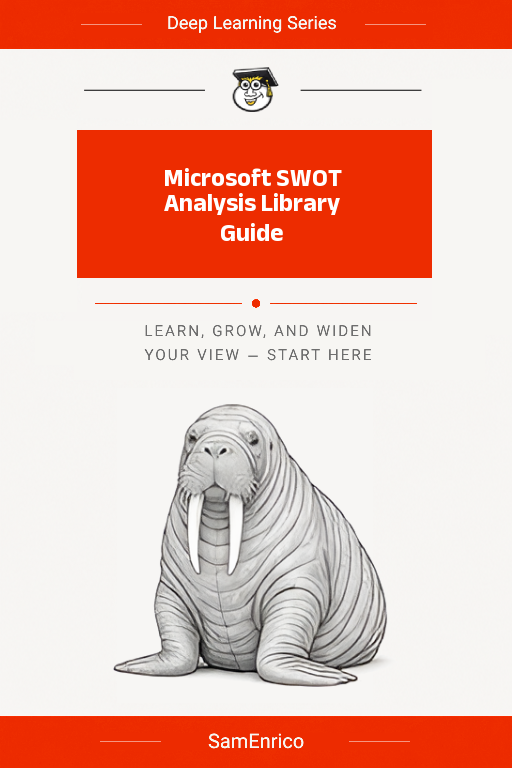
Microsoft SWOT Analysis Guide
Assess Azure cloud strength, Office dominance, AI
Assess Azure cloud strength, Office dominance, AI integration, and regulatory scrutiny across markets.
Formats
About this book
Free sample
Chapter 1: The Lock-In Paradox--–- In the spring of 2024, a Fortune 50 chief information officer we will call Sarah received a routine renewal notice from Microsoft. The price had increased 18 percent year over year. Her internal teams had not requested any new services. No major usage spikes had occurred. When her procurement lead called their Microsoft account executive to ask for an explanation, the answer was chilling in its simplicity: "Your organization is now classified as an AI-intensive enterprise.
The increase reflects your Copilot readiness allocation."Sarah had not asked for Copilot. Her team had not piloted it. She had not signed anything approving an AI deployment. Yet Microsoft had unilaterally reclassified her entire organization and added a line item to her invoice that would cost her company nearly $4 million annually. When she escalated to her Microsoft regional vice president, the response was even more revealing: "We can discuss adjustments, but you should know that your discounted rate is contingent on enterprise-wide adoption of our AI suite.
This is the new bundling model."Sarah had just discovered the Lock-In Paradox firsthand: the very integration that makes Microsoft indispensable also makes it inescapable, and the very AI features positioned as value-adds are being weaponized as pricing leverage. She was trapped, but she did not yet understand the mechanics of her own captivity.This chapter reveals those mechanics. It redefines how we assess Microsoft's strength not through market share statistics or revenue figures, but through the structural lock-in mechanisms that create what we term the Fortress of Integration. More importantly, it introduces a critical distinction that will echo throughout this book: lock-in is not uniform. For hybrid workloads that straddle on-premise and cloud environments, Microsoft's integration creates nearly insurmountable switching costs.
For pure-cloud workloads that run entirely on Kubernetes with open data formats, that same integration becomes an exit ramp. Understanding this distinction is the difference between negotiating from a position of strength and signing whatever renewal lands on your desk.The Full Stack Fallacy Most analysts evaluate Microsoft's strength by looking at individual market shares: Azure at roughly 23 percent of cloud infrastructure…
This is the end of the free sample. Get the eBook to keep going. Buy now
Contents
- Chapter 1
- Chapter 2
- Chapter 3
- Chapter 4
- Chapter 5
- Chapter 6
- Chapter 7
- Chapter 8
- Chapter 9
- Chapter 10
- Chapter 11
- Chapter 12
Details
- Author
- Cockrell Selina
- Publisher
- SamEnrico
- Language
- English
- Genre
- Non-Fiction, Strategic Atlas, Cloud Analysis
- Released
- 2026-06-01
- Pages (approx.)
- 141
- Available as
- eBook, Audiobook

Read better in the ZLOADR app
Your eBooks on your phone or tablet. Sign in with your SamEnrico account and start reading.
More by Cockrell Selina
 Bookstore PeaceCockrell Selina$11.99
 Senior Fashion Confidence GuideCockrell Selina$11.99
 The Codependency Self Esteem GuideCockrell Selina$11.99
 Emotional Intelligence for SalesCockrell Selina$11.99
 Catch Up Vaccination ScheduleCockrell Selina$11.99
 The Arctic Conquest: Canada's Race Against the PlagueCockrell Selina$11.99
 Understanding Multiple Subcutaneous AngiolipomasCockrell Selina$17.99
 Tenant Services CoordinatorCockrell Selina$11.99
 AI Financial Reconciliation GuideCockrell Selina$12.99
 How to Start a Building Societies Business (Beginners Guide)Cockrell Selina$11.99