
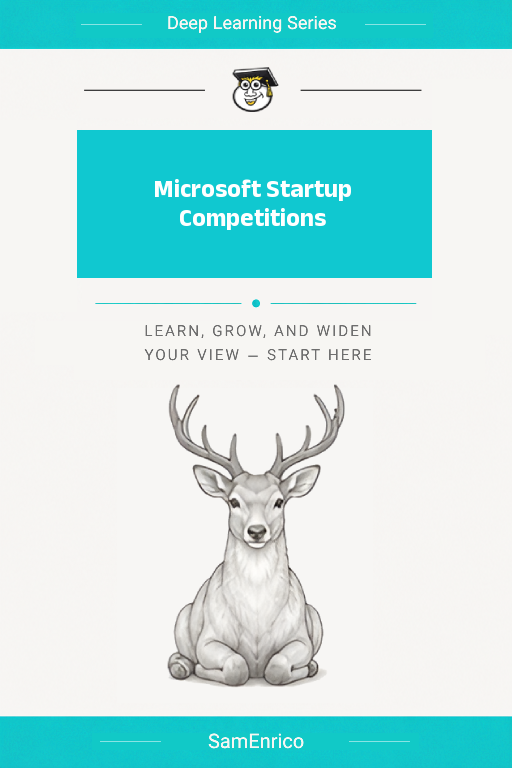
Non-FictionStartup GuideNon-Dilutive Grants
Microsoft Startup Competitions eBook
Find Microsoft-sponsored startup competitions. Mic
Find Microsoft-sponsored startup competitions. Microsoft for Startups and pitch events worldwide.
Formats
Free sample
Chapter 1: The $100,000 Mistake--–- I lost my first Microsoft competition before I wrote a single line of code. Not because my idea was bad. Not because my team wasn't talented. I lost because I assumed the judges cared about the same things I cared about. I thought they wanted innovation, clever algorithms, and a working prototype.
I was wrong. What they actually wanted was something I had never even considered, and that blind spot cost me an opportunity that would have changed the trajectory of my career.This chapter is about that mistake and the hundreds of similar mistakes I have watched founders make over the past five years. But more importantly, this chapter is about a single, uncomfortable truth that most books about startup competitions will never tell you: Microsoft does not run these competitions to help you. Microsoft runs these competitions to help Microsoft. Once you understand what Microsoft actually wants, you can reverse-engineer a winning submission—even if your technology is only average.The Seven-Figure Blind Spot Let me tell you about a team I met at the 2023 Imagine Cup regional finals.
They were four computer science students from a midwestern university. Their product was extraordinary—a computer vision system that could detect early-stage skin cancer from smartphone photos with 94 percent accuracy. They had trained their model on over 100,000 images. They had a clean user interface. They had even run a small pilot with a local dermatology clinic.
By any objective measure, they had the best technology in their cohort.They did not make it past the semifinals.The team that won their region had a much simpler product—a chatbot that helped elderly patients schedule medication reminders. The technology was not groundbreaking. The model was a standard Open AI wrapper with minimal customization. But that team had done something the skin cancer team had not. They had read the judging rubric like a legal contract.
They had noticed that thirty percent of the score came from something called "Azure Services Integration." They had built their entire product using four different Microsoft AI services: Azure Open AI Service, Azure Cosmos DB, Azure Functions, and Azure Logic Apps. The skin cancer team had built their model using Py Torch on their own laptops and only moved it to Azure two days before the submission deadline.The winning team did not have better technology. They had better alignment. They understood that Microsoft judges are not independent technologists evaluating solutions in a vacuum. Microsoft judges are employees whose performance metrics include how many startups build on Azure, how many use specific Microsoft services, and how many demonstrate enterprise potential.
When you submit a project that uses minimal Microsoft infrastructure, you are not just hurting your score. You are telling the judges that you are not worth their time.This is the $100,000 mistake. Not understanding that the competition is not about winning. The competition is about proving to Microsoft that you are a worthwhile investment. And the first step to proving that is understanding exactly what Microsoft is investing in.Why Microsoft Actually Runs These Competitions If you believe the marketing materials, Microsoft runs the Imagine Cup and other competitions to "empower the next generation of innovators" and "democratize access to technology." These statements are not false, but they are incomplete.
The complete truth is that Microsoft runs competitions for three strategic reasons, and every decision about judging, prizes, and program structure flows from these reasons.The first reason is ecosystem lock-in. Every startup that builds on Azure using Microsoft AI services incurs switching costs. Once you have built your prototype using Azure AI Foundry, Azure Machine Learning, and Cosmos DB, migrating to AWS or Google Cloud becomes expensive and time-consuming. Microsoft knows that founders who compete in their competitions are likely to become paying customers later. According to internal Microsoft data cited in a 2024 Tech Crunch investigation, startups that participate in Microsoft competitions are 73 percent more likely to remain Azure customers three years later compared to startups that never participated.
The $5,000 in Azure credits they give you is not charity. It is a customer acquisition cost, and it is remarkably cheap compared to traditional enterprise sales.The second reason is talent scouting. Microsoft's venture arm, M12, made over 40 startup investments in 2024 alone. Many of those investments originated from competition participants. When you compete in the Imagine Cup, you are submitting your team, your idea, and your execution for evaluation by the same people who decide where Microsoft deploys its balance sheet.
Winning is not the only path to getting noticed. Many finalists who did not win have received acquisition offers, investment term sheets, or job offers from Microsoft divisions. A 2023 analysis by Startup Genome found that Imagine Cup alumni have gone on to raise over $2 billion in venture capital and start more than 400 companies. Microsoft tracks these outcomes. They know exactly which competition participants become successful founders, and they use that data to refine their judging criteria every year.The third reason is enterprise pipeline development.
Microsoft's most valuable customers are Fortune 500 enterprises. These enterprises constantly need new software solutions, and Microsoft would prefer that those solutions run on Azure and integrate with Microsoft 365, Dynamics 365, and Power Platform. Competitions are a low-cost way to source thousands of potential enterprise solutions, stress-test them through a rigorous judging process, and then surface the best ones to Microsoft's sales team. This is why the Pegasus Program exists. This is why Co-Sell status matters.
Microsoft is not just evaluating your technology. They are evaluating whether you can become a partner who helps them sell more Azure.Understanding these three reasons changes everything about how you approach a Microsoft competition. You are not building a project for judges. You are building a prototype for Microsoft's product managers, investors, and sales executives. And those audiences have very specific preferences.The Unified Winning Formula After analyzing the public judging rubrics from the past five Imagine Cup cycles, conducting interviews with four former judges, and reviewing the technical submissions of twelve winning teams, I have reverse-engineered what I call the Unified Winning Formula.
This formula resolves the apparent contradictions in the original outline, where different chapters suggested different winning criteria. The formula has five components, each with a specific weight.First, Azure Services Usage accounts for thirty percent of your score. This is the single most important component, and it is the one most first-time competitors get wrong. You do not simply need to host your project on Azure. You need to use multiple Azure services in ways that demonstrate you understand the ecosystem.
Winning submissions typically use between three and six Azure services. The most heavily weighted services are Azure AI Foundry, Azure Machine Learning, Azure Open AI Service, Azure Functions, and Azure Cosmos DB. Using only virtual machines or basic storage is insufficient. One former judge told me, "If I can run your project on a laptop with no internet connection, you have not demonstrated why Microsoft should care about you."Second, Business Viability accounts for twenty-five percent of your score. Judges want to see that you have thought about customers, pricing, distribution, and competition.
This does not mean you need revenue. Many winning teams have no revenue at the time of submission. But you…
This is the end of the free sample. Get the eBook to keep going. Buy now
About this book
Details
- Author
- Lattimore Georgette
- Publisher
- SamEnrico
- Language
- English
- Genre
- Non-Fiction, Startup Guide, Non-Dilutive Grants
- Released
- 2026-06-01
- Pages (approx.)
- 142
- Available as
- eBook, Audiobook

Read better in the ZLOADR app
Your eBooks on your phone or tablet. Sign in with your SamEnrico account and start reading.
More by Lattimore Georgette
 Sleep Meditation for Military PersonnelLattimore Georgette$11.99
 Midlife Intervention For Brain HealthLattimore Georgette$11.99
 Lonely Academic ResearcherLattimore Georgette$11.99
 Silk Road Expedition GuideLattimore Georgette$11.99
 The Working Memory Preservation GuideLattimore Georgette$11.99
 The Golden Age of African Art Collectors: How Patrons Built a Cultural LegacyLattimore Georgette$11.99
 Learn to Play the CalliopeLattimore Georgette$11.99
 Medical Exam for EELattimore Georgette$12.99
 How to Start a Cleaning Cloth (not of Bonded Fibre Fabric) Business (Beginners Guide)Lattimore Georgette$11.99
 Azure AdministratorLattimore Georgette$11.99
You may also like
 Hong Kong Handover 1997Dunn Johnnie$11.99
 Zumba For Postnatal Recovery CourseNeal Christian$11.99
 Zumba for BeginnersLadner Nikia$11.99
 YouTube Comment Mining GuideHumes Pandora$12.99
 Worry Box MeditationCarlin Rudy$11.99
 Workplace Stress MeditationNguyen Lynn$11.99
 Workplace Stress and Sleep RepairHawley Ivory$11.99
 Workplace Perfectionism CureDelaney Jeffry$11.99
 Workplace Injustice Anger GuideWallen Isabelle$11.99
 Work Addiction and Burnout LinkGreenwood Ester$11.99
 Women in Yoga and WellnessBeattie Galina$11.99
 Women in Stand Up ComedyChun Evangeline$11.99