
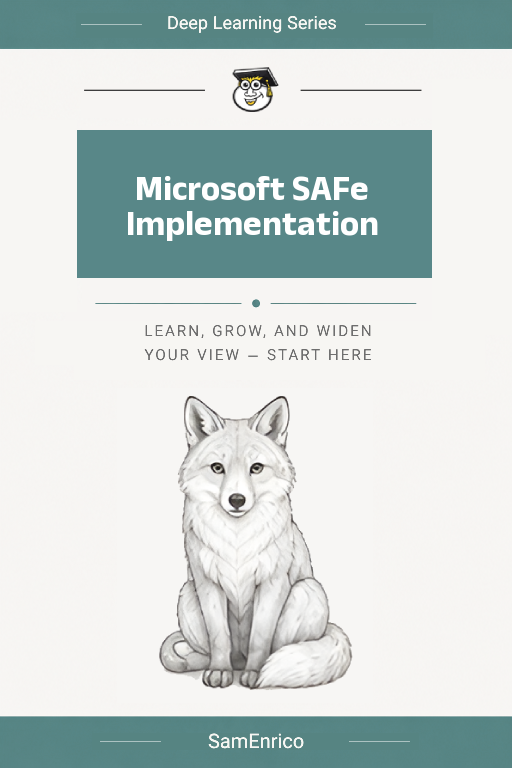
Microsoft SAFe Implementation eBook
Scale agile using Microsoft's SAFe framework for e
by Galvan Hwa
Scale agile using Microsoft's SAFe framework for enterprise products, coordinating multiple teams on Azure DevOps while preserving startup velocity.
Formats
Free sample
Chapter 1: The Cargo Cult Trap--–- The engineer was one of the best they had. In eighteen months, she had rewritten the payment reconciliation engine, reduced cloud costs by forty percent, and mentored three junior developers who were now leading their own projects. When the acquisition closed, the global bank promised everything would stay the same. "We bought you for your culture," the CEO said. "Don't change a thing."Six months later, she handed in her resignation.The exit interview was brief.
"Why?" asked the head of engineering, genuinely confused. "We gave you more headcount. We approved your cloud budget. We even promoted you."She looked at him for a long moment. "You turned us into a ticket-pushing factory," she said.
"I used to ship code that mattered. Now I spend my days in PI Planning prep, dependency log reviews, and writing status updates for stakeholders I've never met. My team hasn't deployed to production in three weeks because we're waiting for the Change Control Board to approve a release that should have been automated. You didn't buy my startup. You killed it."She walked out.
And she wasn't alone.Over the next nine months, seven more senior engineers left. The product that had once shipped features weekly now took a full Program Increment to deliver a single page refresh. The bank's leadership blamed "cultural friction" and "legacy integration challenges." But the truth was simpler and far more damning: they had implemented SAFe the way most enterprises do—by copying the framework's artifacts without understanding its purpose.This is the Cargo Cult Trap. And this book exists to help you avoid it.The False Promise of Copy-Paste Agility In the South Pacific during World War II, islanders observed military forces building airstrips, marching in formation, and using radios to summon cargo planes loaded with supplies. After the war ended, the islanders mimicked these behaviors—building mock airstrips from bamboo, carving headphones from wood, and marching with sticks as rifles.
They performed the rituals exactly as they had observed. But no cargo came. They had copied the form without understanding the function.The Scaled Agile Framework suffers from the same phenomenon at enterprise scale. Organizations facing the chaos of coordinating multiple teams on Azure Dev Ops see SAFe as a salvation—a ready-made blueprint for scaling Agile. And in their desperation for order, they copy everything: every ceremony, every artifact, every role, every reporting requirement.
They build their bamboo airstrips. They carve their wooden headphones. And then they wonder why their engineers are quitting, their velocity is collapsing, and their products are no better than before.This book argues a radical proposition: The tension between enterprise governance and startup velocity is a false dichotomy. You can have both. But not by copying SAFe.
By slicing it.The Core Conflict: Why SAFe Crushes What Makes Startups Great To understand why SAFe implementations fail in formerly fast-moving organizations, we must first understand what those organizations lose. Daniel Pink's motivational model, validated by decades of behavioral science, identifies three intrinsic drivers of high performance:Autonomy – The desire to direct our own work. Startups thrive on this. Engineers choose what to build, how to build it, and when to release it. There are no Change Control Boards.
No approval gates. Just a team, a mission, and a deadline.Mastery – The desire to get better at what we do. Startups reward this through rapid feedback loops. Ship code, measure results, learn, repeat. The cycle time is hours or days, not weeks or months.Purpose – The desire to do work that matters.
Startups excel at this because every engineer can see the direct impact of their code on customers and on the business.Traditional SAFe implementations attack all three. Autonomy is replaced by dependency mapping and cross-team coordination ceremonies. Mastery is suffocated by long feedback cycles and rigid PI boundaries. Purpose dissolves into a fog of status updates and stakeholder approvals where no individual can trace their code to customer value.But here is the crucial insight that most SAFe consultants miss: SAFe is not the enemy. The dogmatic implementation of SAFe is the enemy.The framework itself contains powerful tools for alignment, governance, and coordination at scale.
The problem is that enterprises adopt these tools instead of preserving startup DNA, rather than in addition to it. They treat SAFe as a replacement for their existing culture rather than an overlay that enhances it.Introducing the Thin Slice Philosophy The solution is the Thin Slice philosophy. Borrowed from the world of physical architecture and adapted for organizational design, Thin Slicing means implementing only the SAFe elements that provide direct, measurable value to your specific context while discarding everything that creates local waste.Think of SAFe not as a fixed menu where you must order every dish, but as an ingredient library. You select the ingredients that solve your specific coordination problems. You leave the rest on the shelf.
And you never, ever add an ingredient just because "that's how SAFe is supposed to work."What constitutes a valuable SAFe element? The answer depends on your pain points. For most organizations scaling from startup velocity to enterprise coordination, the valuable elements fall into three categories:1. Cross-Team Dependency Mapping – When you have multiple teams contributing to a single Feature or Epic, you need visibility into who depends on whom. SAFe's dependency management practices (when implemented lightly) provide this without requiring daily status meetings.2.
Audit Trail Completeness – Enterprise regulations (SOX, HIPAA, GDPR) require traceability from business requirement to deployed code. SAFe's work item hierarchy—Epics → Features → Stories → Tasks—provides a natural audit trail when properly configured in Azure Dev Ops.3. Strategic Alignment – When your organization has more ideas than capacity, you need a lightweight process for deciding what not to build. SAFe's portfolio backlog and Lean business case techniques help with this, provided they don't become bureaucratic monsters.Everything else—the full set of SAFe ceremonies, the mandatory artifacts, the prescribed roles, the heavy reporting requirements—is optional. And in a startup-derived culture, most of it is actively harmful.The Waste Audit: Identifying What to Cut Before you add a single SAFe ceremony, conduct a Waste Audit.
For each SAFe element you're considering, ask three questions:Does this element directly enable cross-team coordination that cannot be achieved through lighter means? If yes, keep it. If the answer is "maybe" or "it depends," start lighter.Does this element create traceability required by a regulator or auditor? If yes, keep the minimum version that satisfies the requirement. If no, challenge its existence.Does this element help developers ship code faster or with higher quality?
If yes, keep it and celebrate it. If no, cut it immediately.Apply this audit to the standard SAFe event palette, and you'll find most events fail. The daily standup? Keep it—it helps teams coordinate. The PI Planning event?
Keep a two-day version—it enables cross-ART alignment. The Scrum of Scrums? Replace it with an async Azure Boards query and a shared Teams channel. The System Demo? Replace it with continuous deployment and automated monitoring.
The Inspect and Adapt workshop? Replace the full-day offsite with a two-hour retrospective that focuses on actionable improvements.The result is not SAFe…
This is the end of the free sample. Get the eBook to keep going. Buy now
About this book
Details
- Author
- Galvan Hwa
- Publisher
- SamEnrico
- Language
- English
- Genre
- Non-Fiction, Startup Guide
- Released
- 2026-05-26
- Pages (approx.)
- 141
- Available as
- eBook, Audiobook

Read better in the ZLOADR app
Your eBooks on your phone or tablet. Sign in with your SamEnrico account and start reading.
More by Galvan Hwa
 Wedding Guest Name GuideGalvan Hwa$11.99
 Self Esteem for Tuberous BreastsGalvan Hwa$11.99
 Pauling Born Oppenheimer LegacyGalvan Hwa$11.99
 Streaming Service Subscription Churn AnalysisGalvan Hwa$11.99
 Smoking Cessation App GuideGalvan Hwa$11.99
 F1 Race Start NervesGalvan Hwa$11.99
 Legislative ChangeGalvan Hwa$11.99
 Product Description PersuasionGalvan Hwa$11.99
 The Bloodstained Silk: The First Forensic Fiber Case of Colonial AfricaGalvan Hwa$11.99
 Kunibiki no Tatakai: The Great Land-Pulling War of YamatoGalvan Hwa$11.99
 How to Produce Food SmokersGalvan Hwa$11.99
 A Collector's Handbook to the BMW 5-series (520 'six')Galvan Hwa$11.99
You may also like
 Hong Kong Handover 1997Dunn Johnnie$11.99
 Zumba For Postnatal Recovery CourseNeal Christian$11.99
 Zumba for BeginnersLadner Nikia$11.99
 YouTube Comment Mining GuideHumes Pandora$12.99
 Worry Box MeditationCarlin Rudy$11.99
 Workplace Stress MeditationNguyen Lynn$11.99
 Workplace Stress and Sleep RepairHawley Ivory$11.99
 Workplace Perfectionism CureDelaney Jeffry$11.99
 Workplace Injustice Anger GuideWallen Isabelle$11.99
 Work Addiction and Burnout LinkGreenwood Ester$11.99
 Women in Yoga and WellnessBeattie Galina$11.99
 Women in Stand Up ComedyChun Evangeline$11.99