
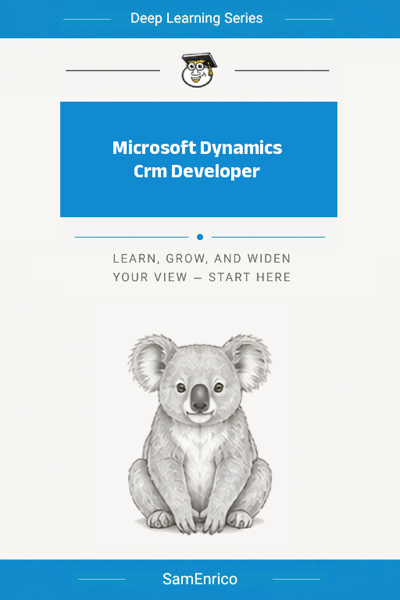
Non-FictionInformativeEducational
Microsoft Dynamics Crm Developer eBook
A Coursebook on Microsoft Dynamics Crm Developer
A Coursebook on Microsoft Dynamics Crm Developer
Formats
Free sample
Chapter 1: The x RM Mindset--–- In 2011, I watched a senior developer spend three weeks building a custom rental management system for a car-sharing startup. He wrote thousands of lines of C#, designed a SQL Server database from scratch, built an ASP.NET MVC front end, and implemented authentication, logging, and reporting. The system worked beautifully. It also cost the startup $200,000 in development time and $5,000 per month in hosting. Six months later, I built the exact same system for a competitor in five days using Microsoft Dynamics CRM.
I wrote exactly thirty-seven lines of custom code. The rest was configuration. The competitor spent $15,000 on implementation and $500 per month on licensing. That was the day I realized I had been thinking about software development completely backward.This is not a book about customer relationship management. If you came here to learn how to configure sales pipelines or marketing automation, close this book and find a functional consultant.
This is a book for developers who want to understand why traditional application development is dying and how the Microsoft Dataverse and Power Platform represent the most important shift in business application development since the relational database.You are about to learn a mindset called x RM. The "x" stands for anything. A hotel room. A maintenance request. A library book.
A patient appointment. A construction permit. A rental car. A job application. An inventory item.
A warranty claim. A classroom. A flight seat. Anything you can describe with data can become a table in Dataverse, and anything you can do with data can become an app in Dynamics 365.The Myth of the Greenfield Project For twenty years, developers have been taught a dangerous lie: that every new business application should be built from scratch. We learned this lie in computer science courses where professors handed us blank text editors and said "build a system." We learned it from tech blogs celebrating startups that rewrote everything in the latest Java Script framework.
We learned it from job interviews where whiteboard coding questions assumed we would implement sorting algorithms instead of configuring a grid view.The lie persists because building from scratch feels important. It feels like real engineering. It justifies high salaries, long timelines, and the intellectual satisfaction of solving problems that have already been solved a thousand times before.But here is the truth that experienced Dynamics developers understand: approximately eighty percent of what any business application does is identical to what every other business application does. Create records. Read records.
Update records. Delete records. Search records. Filter records. Sort records.
Assign security. Validate input. Trigger workflows. Send notifications. Generate reports.
These operations are commodities. They have been optimized by Microsoft for decades. When you build them from scratch, you are not engineering. You are performing data entry for computers.The x RM mindset begins with a radical proposition: stop writing code that Microsoft has already written. Instead, model your business domain using Dataverse tables, configure the user interface using model-driven apps, and write code only for the unique logic that makes your business different from every other business on the planet.From CRM to x RM: A Brief History of Transformation To understand where we are going, you need to understand where this platform came from.
Microsoft Dynamics CRM 1.0 launched in 2003 as a traditional customer relationship management system. It had Accounts, Contacts, Opportunities, and Activities. It competed with Salesforce and Siebel. Developers could customize it, but the customization story was painful. You wrote Java Script in a tool called the Form Editor that looked like it was designed for Windows 98.
You wrote plugins using the 2005-era .NET Framework. You deployed solutions using a tool called the Solution Packager that crashed if you looked at it wrong.Dynamics CRM 2011 was the first genuinely developer-friendly version. Microsoft introduced the Xrm object model for client-side scripting. They released the Plugin Registration Tool that actually worked. They added the REST endpoint that let external applications talk to CRM without using the heavy SOAP client.
A developer could finally build integrations without wanting to quit the profession.Dynamics CRM 2016 added the Web API, replacing the old REST endpoint with an OData v4 compliant interface. This was the turning point. Now any language that speaks HTTP could talk to CRM. Node.js, Python, Ruby, Go, even PHP. The platform stopped being a .NET-only island and became a true enterprise service bus.Then came the rebranding.
In 2019, Microsoft announced Dynamics 365 Customer Engagement, but more importantly, they announced the Power Platform as a separate product line. The Common Data Service (now Dataverse) became the data backbone for Power Apps, Power Automate, Power BI, and Dynamics 365 simultaneously. A table you created for a Dynamics Sales app could be read by a Power App, processed by a Power Automate flow, and visualized in a Power BI dashboard without any data duplication or custom synchronization.Today, Dynamics 365 is not a CRM. It is a collection of first-party applications built on the Power Platform. Sales, Service, Marketing, Field Service, and Project Operations are just pre-built solutions.
You can build your own solutions that sit alongside them, reuse their tables, and extend their logic. This is the x RM promise realized: a platform where every business domain can be modeled and automated.The Three Personas (And Why You Need All Three)If you come from traditional development, you are used to being the only technical person on the team. You write the database schema, the API endpoints, the front end, the authentication, the deployment scripts, and often the user documentation. This is not sustainable, and it is not how the Power Platform works.The Power Platform divides work among three distinct personas. Understanding where you fit and how to collaborate with the others is essential to your success.The Functional Consultant lives in the browser.
They use the Power Apps Maker Portal and the Dynamics 365 admin center. They create tables and columns. They configure security roles. They build model-driven apps by dragging tables onto the App Designer canvas. They create business process flows that guide users through steps like "Approve Quote" then "Create Order" then "Generate Invoice." They rarely write code.
When they do, it is simple Java Script inside business rules or calculated columns using Power Fx, Microsoft's Excel-like formula language. The functional consultant's superpower is speed. They can deliver a working application for a hundred-user department in a single afternoon.The Power Platform Maker is the citizen developer. This persona often comes from the business side. An operations manager who learned Excel to an expert level.
A marketing coordinator who built Access databases in the 1990s. A finance analyst who discovered Power Query and never looked back. Makers build canvas apps with drag-and-drop interfaces. They create Power Automate flows using the visual designer. They train AI Builder models to read invoices or classify support tickets.
Makers typically work on departmental solutions that serve twenty to fifty users. Their code lives in flows and canvas apps, not in plugins or web resources. When they need pro-code capabilities, they call your APIs.The Developer is you. You work in Visual Studio, VS Code, and the command line. You write C# plugins that execute inside Dataverse when…
This is the end of the free sample. Get the eBook to keep going. Buy now
About this book
Details
- Author
- Mcinnis Blaine
- Publisher
- SamEnrico
- Language
- English
- Genre
- Non-Fiction, Informative, Educational
- Released
- 2026-05-04
- Pages (approx.)
- 152
- Available as
- eBook, Audiobook

Read better in the ZLOADR app
Your eBooks on your phone or tablet. Sign in with your SamEnrico account and start reading.
More by Mcinnis Blaine
 Rapid Self Talk Reset GuideMcinnis Blaine$11.99
 Loving Kindness for Divorce Recovery WorkbookMcinnis Blaine$11.99
 Addiction Recovery for WomenMcinnis Blaine$11.99
 Cognitive Reserve Building GuideMcinnis Blaine$11.99
 Beginner Mindfulness for Public SpeakingMcinnis Blaine$11.99
 Screams on the Skyride: The 1984 AstroWorld TragedyMcinnis Blaine$11.99
 The Edge of the Sky: Joseph Kittinger and the Stratos ProjectMcinnis Blaine$11.99
 How to Become a Check CashierMcinnis Blaine$11.99
 Student Mobile Phone TurkeyMcinnis Blaine$12.99
 Crypto Asset Regulation GuideMcinnis Blaine$12.99
 Understanding Deletion 6q16 Q21Mcinnis Blaine$17.99
You may also like
 Hong Kong Handover 1997Dunn Johnnie$11.99
 Zumba For Postnatal Recovery CourseNeal Christian$11.99
 Zumba for BeginnersLadner Nikia$11.99
 YouTube Comment Mining GuideHumes Pandora$12.99
 Worry Box MeditationCarlin Rudy$11.99
 Workplace Stress MeditationNguyen Lynn$11.99
 Workplace Stress and Sleep RepairHawley Ivory$11.99
 Workplace Perfectionism CureDelaney Jeffry$11.99
 Workplace Injustice Anger GuideWallen Isabelle$11.99
 Work Addiction and Burnout LinkGreenwood Ester$11.99
 Women in Yoga and WellnessBeattie Galina$11.99
 Women in Stand Up ComedyChun Evangeline$11.99