
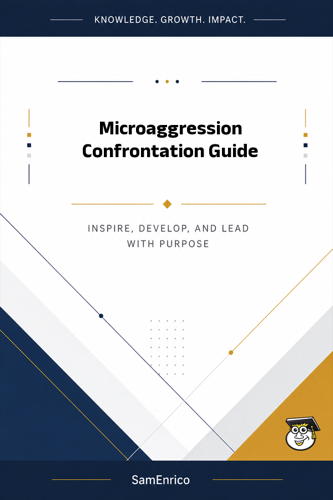
Non-FictionSelf-HelpDiversity Equity Inclusion
Microaggression Confrontation Guide Audiobook
Addresses subtle bias with education.
Addresses subtle bias with education.
Formats
Free sample
Chapter 1: The Intent Trap--–- It was 3:47 on a Tuesday afternoon when Mark, a senior engineer with seventeen years of experience, said something that would empty a desk three weeks later. He didn't raise his voice. He didn't use a slur. He thought he was being nice."You're the most articulate person on this team," Mark said to Priya, the only woman of color in the department, as she finished presenting her quarterly analysis. He smiled.
She smiled back—the tight, automatic smile of someone who has learned that showing pain costs more than hiding it. Then she excused herself, walked to the bathroom, and stood staring at the tile floor for four full minutes before returning to her seat.Mark never knew. When Priya quit, he told HR she was "a difficult fit" and "probably oversensitive." He meant no harm. He never does.This book exists because of the ten thousand Marks and the ten thousand Priyas—and because you have been both.The Most Dangerous Sentence in Human Interaction Let's start with a sentence that has ended more friendships, destroyed more workplace cultures, and silenced more legitimate pain than any other phrase in the English language. Here it is:"That's not what I meant."On its surface, this sentence seems reasonable.
It seems fair. It seems like the kind of thing a good person would say when accused of something they didn't intend. And that is precisely why it is so dangerous. The sentence "That's not what I meant" is not a neutral clarification. It is a weapon disguised as an explanation.
It takes the focus off the harm that landed on another person and places it squarely on the inner theater of your own intentions—a theater to which only you have a ticket.When you say "That's not what I meant," you are doing three things simultaneously. First, you are denying the validity of the other person's experience without using the word "deny." Second, you are centering your own feelings (defensiveness, surprise, indignation) above their pain. Third, you are implicitly accusing them of misunderstanding you—of being, in a word, wrong about their own life.This chapter will dismantle that sentence. Not because intentions don't matter—they do matter, quite a lot. But because intentions are not the final word.
They are not the closing argument. They are, at best, the opening bid in a conversation that most of us…
This is the end of the free sample. Get the Audiobook to keep going. Buy now
About this book
Details
- Author
- Spellman Darcie
- Publisher
- SamEnrico
- Language
- English
- Genre
- Non-Fiction, Self-Help, Diversity Equity Inclusion
- Released
- 2026-06-06
- Pages (approx.)
- 142
- Available as
- eBook, Audiobook

Listen in the VoxFlicks app
Audiobooks and audio dramas wherever you go. Sign in with your SamEnrico account and press play.
More by Spellman Darcie
 GAD And Personal SafetySpellman Darcie$11.99
 Self Sabotage Inner Voice CureSpellman Darcie$11.99
 Conversation Starters for Double DatesSpellman Darcie$11.99
 Family Healing After GamblingSpellman Darcie$11.99
 PGD Awareness MonthSpellman Darcie$11.99
 Workaholic Coaching GuideSpellman Darcie$11.99
 Social Skills TrainingSpellman Darcie$11.99
 The Shadow of the Silk Road: The Highwayman of the HimalayasSpellman Darcie$11.99
 Maui’s Fishing Line: The Hook That Raised the IslandsSpellman Darcie$11.99
 Mastering The Art of TinkuSpellman Darcie$11.99
 How to Produce a Hob (Hearth)Spellman Darcie$11.99
 How to Start a Electronic Scoreboards Business (Beginners Guide)Spellman Darcie$11.99
You may also like
 Hong Kong Handover 1997Dunn Johnnie$11.99
 Zumba For Postnatal Recovery CourseNeal Christian$11.99
 Zumba for BeginnersLadner Nikia$11.99
 YouTube Comment Mining GuideHumes Pandora$12.99
 Worry Box MeditationCarlin Rudy$11.99
 Workplace Stress MeditationNguyen Lynn$11.99
 Workplace Stress and Sleep RepairHawley Ivory$11.99
 Workplace Perfectionism CureDelaney Jeffry$11.99
 Workplace Injustice Anger GuideWallen Isabelle$11.99
 Work Addiction and Burnout LinkGreenwood Ester$11.99
 Women in Yoga and WellnessBeattie Galina$11.99
 Women in Stand Up ComedyChun Evangeline$11.99