
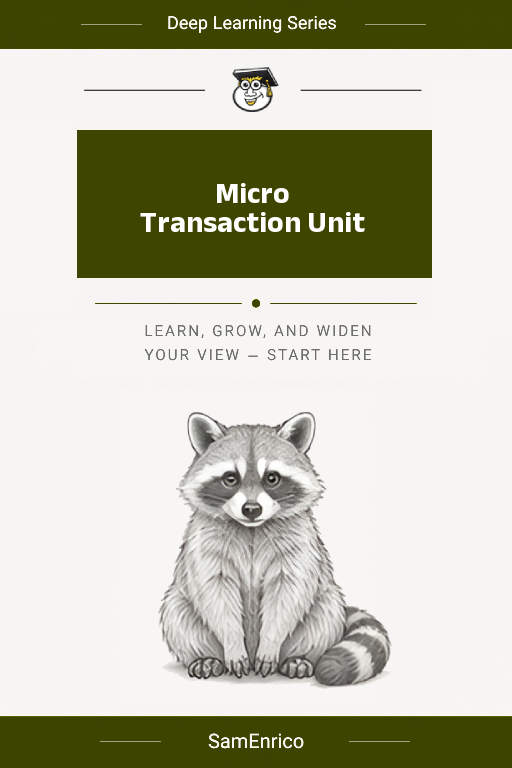
Micro Transaction Unit eBook
Design a pricing unit as low as 0.10 USD to match
by Trice Jinny
Design a pricing unit as low as 0.10 USD to match daily cash flow patterns.
Formats
Free sample
Chapter 1: The Spare Change Trap--–- On a rainy Thursday afternoon in Seattle, a forty-one-year-old logistics manager named David printed his credit card statement for the first time in eighteen months. He was not worried about fraud. He was not applying for a loan. He was simply curious about where his money went, because despite a steady income and no major debts, his savings account had stopped growing. What he found on those twelve pages made him feel equal parts foolish and furious.
His statement listed over four hundred individual transactions under five dollars. A 1.99here.A1.99 here. A 1.99here.A0.99 there. A 2.49subscriptionhehadforgottenabout.A2.49 subscription he had forgotten about. A 2.49subscriptionhehadforgottenabout.A0.10 tip that he had clicked absentmindedly while watching a live stream.
A 0.50feeforexpediteddeliveryofalate−nightsnackorder.A0.50 fee for expedited delivery of a late-night snack order. A 0.50feeforexpediteddeliveryofalate−nightsnackorder.A3.99 rental for a movie he never finished. The total came to $847. Twenty-three percent of his monthly discretionary spending—vanished into transactions so small that he had never once thought about any of them.David is not a cautionary tale. He is an average consumer.
The average American household makes over two hundred digital payments per month, and the majority of those payments are under ten dollars. The average consumer underestimates their monthly micro-spending by forty to sixty percent. They are not bad with money. They are humans with finite attention, and the modern economy has become exquisitely optimized to exploit that finite attention one dime at a time.This chapter reveals the hidden psychology of the ten-cent transaction. You will learn why your brain treats a dime differently than a dollar, why the pain of paying has nearly disappeared from modern commerce, and why the most dangerous transactions are not the ones you regret but the ones you never notice.
By the end of this chapter, you will understand the invisible architecture of micro-spending—and why the ten-cent unit represents the most powerful and most dangerous price point in the digital economy.The Cognitive Blind Spot of Small Numbers The human brain did not evolve in a world of micro-transactions. For most of human history, economic exchanges involved significant amounts of tangible value. You traded a chicken for a bag of grain. You paid a silver coin for a night's lodging. You barrowed a tool from a neighbor and returned it.
The smallest unit of exchange was meaningful enough to warrant attention. Even as recently as fifty years ago, the smallest common transaction was a dime—a literal dime that bought a newspaper or a phone call. But that dime was tangible. It was a physical coin that passed from hand to hand. You felt it leave your possession.
You heard it clink into the register.Today, the dime is invisible. It is a digital pulse, a database decrement, a line item on a statement you will never read. The cognitive effort required to notice a digital ten-cent transaction is significantly higher than the effort required to notice a physical dime. Yet the financial impact is identical. This asymmetry—low cognitive cost to the spender, full financial value to the receiver—is the foundation of the micro-transaction economy.Psychologists call this "denomination neglect." It is the tendency to treat small units of currency as psychologically different from larger units, even when the proportional value is identical.
A ten-cent transaction feels like a rounding error. A thousand ten-cent transactions feel like nothing at all—until they add up to one hundred dollars. The brain does not automatically multiply small numbers by high frequencies. It must be trained to do so, and most people never train themselves.Denomination neglect is not a flaw in human reasoning. It is an efficient heuristic.
Most of the time, a dime is not worth thinking about. The cost of evaluating every small transaction would exceed the potential loss from neglecting it. But in the specific context of digital micro-transactions, where frequency can be extremely high and automation can be complete, the heuristic fails. The cost of evaluating each dime is still low, but the cumulative loss is no longer trivial. David's $847 loss did not come from a single bad decision.
It came from four hundred decisions that were each too small to warrant attention.The Evolution of Payment Pain The pain of paying is not fixed. It varies by payment method, by context, and by individual psychology. Researchers have measured this pain using skin conductance, pupil dilation, and self-reported distress. The results form a clear hierarchy.Cash payments generate the highest pain. When you hand over a twenty-dollar bill, you experience a measurable physiological response.
Your pupils dilate slightly. Your skin conductance increases. You feel the loss because you see the loss. The bill leaves your hand. Your wallet becomes thinner.
The transaction is physically present in your awareness.Card payments generate less pain. The credit card acts as a buffer between the act of purchase and the awareness of loss. You swipe or insert, but the money does not leave your account immediately. It leaves at the end of the month, or when you pay your bill, or when you check your statement. The decoupling of payment from consumption reduces the pain by about thirty percent compared to cash.Contactless payments generate even less pain.
A tap of a card or phone takes less than a second. There is no signature. There is no PIN for small amounts. The transaction is complete before your brain has time to register that money left your account. The pain reduction from cash to contactless is approximately fifty to sixty percent.Mobile payments—Apple Pay, Google Pay, and their equivalents—generate the least pain of all.
Your phone is already in your hand. Your thumb is already on the sensor. The haptic feedback provides confirmation, but the confirmation is of success, not of loss. The money leaves your account, but your brain barely notes the event. The pain reduction from cash to mobile can exceed seventy percent.The ten-cent mobile tap represents the extreme end of this evolution.
The pain is so low that for many users, it is functionally zero. This is not an accident. Payment systems have been deliberately designed to reduce friction, and reducing friction means reducing pain. But pain served a purpose. It was a brake on spending.
Remove the brake, and spending accelerates.The Noticeability Floor Experiment In 2018, researchers at a major university conducted a simple but revealing experiment. They gave two groups of participants a fifty-dollar spending credit. Group A could only spend in increments of five dollars or more. Group B could spend in any increment, including as low as ten cents. Both groups were told that any unspent credit would be refunded as cash at the end of the experiment.
The researchers then measured how much each group spent, how many transactions they made, and how accurately they recalled their spending afterward.The results were striking. Group B spent significantly more than Group A—an average of sixty-three percent more. But when asked to recall their spending, Group B was dramatically less accurate. They underestimated their total spending by an average of forty-one percent, compared to just twelve percent for Group A.…
This is the end of the free sample. Get the eBook to keep going. Buy now
About this book
Details
- Author
- Trice Jinny
- Publisher
- SamEnrico
- Language
- English
- Genre
- Non-Fiction, Startup Guide, Pricing Strategy, Microtransactions
- Released
- 2026-05-29
- Pages (approx.)
- 138
- Available as
- eBook, Audiobook

Read better in the ZLOADR app
Your eBooks on your phone or tablet. Sign in with your SamEnrico account and start reading.
More by Trice Jinny
 Relationship Building CRM GuideTrice Jinny$11.99
 Loneliness Tennis Partner GuideTrice Jinny$11.99
 Self Awareness Development GuideTrice Jinny$11.99
 Hypnosis Meditation FusionTrice Jinny$11.99
 The Travel Tech Capital ForecastTrice Jinny$11.99
 Admitting Mistakes to BossTrice Jinny$11.99
 The Exhaustion Diary MethodTrice Jinny$11.99
 Kennedy CamelotTrice Jinny$11.99
 Bladder Cancer VictoryTrice Jinny$11.99
 The Ghost in the Machine: How AI Almost Triggered WWIIITrice Jinny$11.99
 The Timbuktu Gold Heist: The Philanthropic Gambit of the Songhai EmpireTrice Jinny$11.99
 The Jungle Alchemist: How a Forgotten Explorer Unlocked the Secrets of QuinineTrice Jinny$11.99