
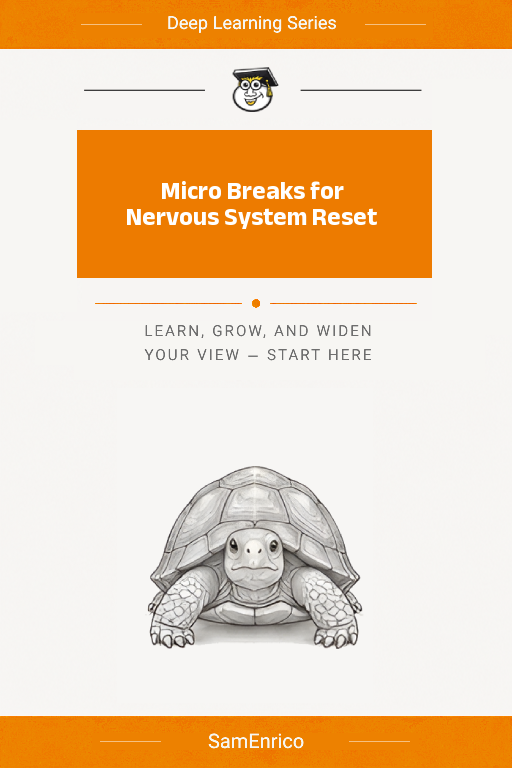
Non-FictionMental WealthStress Physiology
Micro Breaks for Nervous System Reset eBook
Uses 30-90 second micro-breaks throughout the work
by Stark Sydney
Uses 30-90 second micro-breaks throughout the workday to regulate your nervous system, reduce cortisol, and prevent burnout.
Formats
Free sample
Chapter 1: The Burnout Paradox--–- The email arrived at 11:47 PM on a Tuesday. I remember the timestamp because I was still at my desk, still in the same chair I'd been sitting in since 8:00 AM that morning, still wearing the same clothes, still not having eaten dinner. The subject line read: "Urgent – Client Request." The message inside was three sentences long, none of them kind. My chest tightened. My jaw clenched.
My vision blurred slightly around the edges. I closed my laptop, walked to the bathroom, and stood in front of the mirror for what felt like a long time, though it was probably only thirty seconds. I looked at my face – pale, pinched, older than I remembered – and thought: This is not sustainable.That moment was not a dramatic breaking point. I did not collapse. I did not cry.
I did not quit my job or write a resignation letter or book a one-way ticket to a meditation retreat in Bali. What I did was much quieter and, in some ways, much more damning. I looked at my reflection and felt nothing. Not exhaustion. Not sadness.
Not anger. Just a vast, hollow numbness – the kind that comes not from a single disaster but from a thousand small paper cuts, delivered daily, for years.If you are reading this book, I suspect you know exactly what I am describing.The Quiet Collapse No One Sees Burnout does not arrive with a bang. It arrives with a whisper that you ignore, then a murmur that you rationalize, then a steady hum that you stop noticing entirely. By the time you realize something is wrong, you are not in crisis – you are in a slow, steady decline that has become your new normal. Your caffeine intake has doubled.
Your patience has halved. Your weekends are no longer restorative; they are just two days of anxious waiting before Monday returns. You have stopped looking forward to things. You have stopped remembering what "looking forward" even feels like.The research bears this out. A 2021 Gallup study of 7,500 full-time workers found that 76% experienced burnout at least sometimes, with 28% reporting burnout "very often" or "always." Among remote workers, the numbers were even higher.
A separate study by the American Psychological Association found that chronically stressed workers have a 62% higher risk of heart disease, a 50% higher risk of obesity, and a 300% higher risk of major depressive disorder. We are not just tired. We are sick.And yet, the dominant culture of work tells us to push through. "Everyone is busy," we say. "It's just a rough patch," we tell ourselves.
"I'll rest when this project is done," we promise – but the projects never end. They multiply. They metastasize. They colonize every corner of our lives until the boundary between "work" and "not work" dissolves entirely, and we find ourselves checking email at red lights, answering Slack messages while making dinner, and lying awake at 3:00 AM mentally rehearsing a presentation that is still three weeks away.This is not a personal failing. It is a physiological trap – and the first step out of it is understanding how you fell in.Why Your Body Keeps Score (Whether You Like It or Not)Your nervous system evolved over hundreds of millions of years to solve one problem: survival.
It is exquisitely calibrated to detect threats, mobilize resources, and return to baseline once the danger has passed. This system worked beautifully when threats were sabertooth tigers – discrete, visible, and either escapable or not. But modern work has created a new kind of threat: the chronic, low-grade, never-ending stress of an always-on culture.Here is what happens inside your body during a typical workday. You wake up to a notification from your boss. Your sympathetic nervous system – the "fight or flight" branch – kicks in.
Your adrenal glands release cortisol and adrenaline. Your heart rate increases. Your blood pressure rises. Your digestion slows (because why digest food when you might need to run from a predator?). Your pupils dilate.
Your muscles tense. Your prefrontal cortex – the thinking, planning, creative part of your brain – partially shuts down to redirect energy to survival functions.This response is designed to last minutes. Maybe an hour. Not eight. Not ten.
Not twelve.But here is the problem. Another notification arrives. Then a meeting. Then an email that makes your stomach drop. Then a deadline.
Then a passive-aggressive Slack message. Your body never gets the signal that the threat has passed because the threats keep coming, one after another, in an endless conveyor belt of low-grade emergencies.So your nervous system does what it was designed to do: it stays on. It keeps releasing cortisol. It keeps your heart rate elevated. It keeps your thinking brain partially offline.
And it does this for hours, days, weeks, months, years – until staying on becomes the new default. You forget what calm feels like. You forget what it feels like to sit still without checking your phone. You forget that your body has an off switch because you have not used it in so long.This is the burnout paradox: the more you push through, the less capacity you have to push through. The more stressed you become, the less resilient you are to stress.
The harder you try, the harder everything becomes.The High-Frequency Recovery Solution Conventional wellness wisdom tells you to solve burnout with big, infrequent resets. Take a vacation. Go to a weekend yoga retreat. Sleep in on Saturday. These things are not bad – they are just insufficient.
A two-week vacation lowers cortisol for approximately 48 hours after you return. Then your levels spike back to baseline, often higher than before because you have to catch up on the work you missed. You are trying to hydrate a garden with a fire hose once a month instead of a gentle spray every day.The solution is High-Frequency Recovery: many small resets, done often, beat a few large resets done rarely.Think about how you hydrate your body. You do not drink all your water for the week on Sunday. You sip throughout the day.
Your nervous system works the same way. It does not need a two-week vacation to reset. It needs 30 to 90 seconds of intentional recovery, repeated every 90 minutes, throughout your workday. This is not a luxury. It is not self-care.
It is not soft. It is strategic biochemistry – and it is the single most underutilized performance tool in the modern workplace.The 90-Minute Rhythm You Have Been Ignoring Your body operates on a natural cycle called the ultradian rhythm. Every 90 to 120 minutes, your physiology moves from high alert to physiological fatigue. Your heart rate slows. Your brain waves change.
Your attention naturally wanders. This is not a design flaw – it is a feature. The rhythm is built into every mammal on the planet.Here is what happens in a typical workday. You arrive at your desk, caffeinated and determined. For the first 90 minutes, you are sharp.
You make progress. You feel competent. Then, somewhere around the 90-minute mark, you hit a wall. You re-read the same sentence three times. You open a tab, forget why, and close it.
You reach for your phone. You check email for the seventh time in an hour. You tell yourself you are…
This is the end of the free sample. Get the eBook to keep going. Buy now
About this book
Details
- Author
- Stark Sydney
- Publisher
- SamEnrico
- Language
- English
- Genre
- Non-Fiction, Mental Wealth, Stress Physiology
- Released
- 2026-05-30
- Pages (approx.)
- 124
- Available as
- eBook, Audiobook

Read better in the ZLOADR app
Your eBooks on your phone or tablet. Sign in with your SamEnrico account and start reading.
More by Stark Sydney
 Forgiving The Unforgivable WorkbookStark Sydney$11.99
 Internal Comms FAQ TemplateStark Sydney$11.99
 Anger in Remote TeamsStark Sydney$11.99
 Breaking Work Addiction CycleStark Sydney$11.99
 The Monster Under Bed DreamStark Sydney$11.99
 The Fall of Tiffany & Co.: The $1 Billion Scandal That Rocked High JewelryStark Sydney$11.99
 Understanding Split Hand Split Foot Mandibular HypoplasiaStark Sydney$17.99
 How to Start a Chutney Business (Beginners Guide)Stark Sydney$11.99
 East Africa Cooperative Models GuideStark Sydney$12.99
 From Freelancer to AgencyStark Sydney$11.99
You may also like
 Hong Kong Handover 1997Dunn Johnnie$11.99
 Zumba For Postnatal Recovery CourseNeal Christian$11.99
 Zumba for BeginnersLadner Nikia$11.99
 YouTube Comment Mining GuideHumes Pandora$12.99
 Worry Box MeditationCarlin Rudy$11.99
 Workplace Stress MeditationNguyen Lynn$11.99
 Workplace Stress and Sleep RepairHawley Ivory$11.99
 Workplace Perfectionism CureDelaney Jeffry$11.99
 Workplace Injustice Anger GuideWallen Isabelle$11.99
 Work Addiction and Burnout LinkGreenwood Ester$11.99
 Women in Yoga and WellnessBeattie Galina$11.99
 Women in Stand Up ComedyChun Evangeline$11.99