
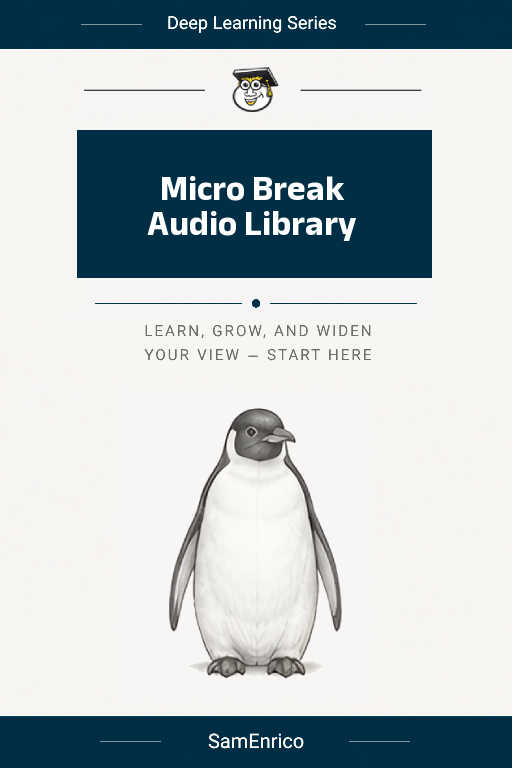
Non-FictionMental WealthGuided Practices
Micro Break Audio Library eBook
Provides 20 guided micro-break audio tracks (60-12
Provides 20 guided micro-break audio tracks (60-120 seconds each) for immediate nervous system regulation in any setting.
Formats
Free sample
Chapter 1: The 90-Second Lie--–- You have been lied to about meditation.Not maliciously. Not by anyone who wished you harm. The people who told you that you need twenty minutes of silence, a cushion, and a clear mind to regulate your nervous system were not trying to deceive you. They were repeating what they had been taught. And what they had been taught was wrong for the vast majority of human beings living through the early decades of the twenty-first century.Here is the truth: your nervous system does not know the difference between a tiger and an email.
It does not distinguish between a life-threatening event and a notification that someone has replied to a thread you were trying to ignore. To your autonomic nervous system, threat is threat. The cascade of cortisol, the activation of the sympathetic chain, the preparation for fight or flight—all of it happens whether the danger is a predator in the brush or a Slack message at 9:47 PM.And here is the second truth: the average person's nervous system is activated—low-grade, chronic, simmering activation—for approximately fourteen hours per day. That is not a typo. Fourteen hours.
From the moment the alarm clock jars you awake (activation), through the commute (activation), through the meeting where you are waiting to speak (activation), through the email that you interpret as mildly critical (activation), through the news (activation), through the social media scroll (activation), through the argument about whose turn it is to cook dinner (activation), through the attempt to fall asleep while your mind races through everything you did not get done (activation). Fourteen hours.The remaining ten hours are sleep—and for many people, sleep is not restful because the nervous system never fully down-regulates. You wake up tired because you went to bed wired.This is not a moral failure. This is not a lack of discipline. This is a design feature of a nervous system that evolved for a world that no longer exists, operating inside a world that was never supposed to exist.
You are not broken. You are overloaded.And the solution you have been offered—long meditation, extended breathwork, hour-long yoga classes, weekend retreats—is inaccessible to exactly the people who need it most. The more dysregulated you are, the harder it is to sit still. The more stressed you are, the less time you have. The more your nervous system is screaming "move, fight, run, hide," the less capable you are of closing your eyes and observing your breath for twenty minutes.This book is not about meditation.
This book is about micro breaks. Sixty to one hundred and twenty seconds of audio-guided nervous system regulation that you can do anywhere, in any state, without closing your eyes, without a cushion, and without anyone knowing you are doing it.The Problem That Cannot Be Named Before we can solve the problem, we have to name it properly. Most people cannot name what they are feeling because they have been taught a vocabulary of emotions that does not include the language of the nervous system. You say you are "stressed." But what does that mean? Stressed is a bucket word.
It holds everything from mild annoyance to full-body terror. It collapses the difference between "I have too much to do" and "I am about to have a panic attack."Let us be more precise.Your autonomic nervous system has three primary states, and you move between them constantly, usually without awareness. The first state is ventral vagal. This is the safe-and-social state. In ventral vagal, your heart rate is moderate but adaptable.
Your breathing is easy. Your facial muscles are relaxed, which means your expression is open and approachable. Your middle ear muscles are tuned to human voice frequencies, which means you can hear warmth and tone, not just threat. You feel curious, connected, capable. This is the state where good decisions happen, where creativity lives, where relationships deepen.The second state is sympathetic.
This is the fight-or-flight state. Your heart rate increases. Your breathing becomes shallow and fast. Blood moves away from your digestive system and toward your large muscle groups. Your pupils dilate.
Your hearing shifts to low-frequency sounds—the rustle of a predator, the thud of footsteps. You feel anxious, irritable, hypervigilant, or angry. In small doses, this state is useful. It helps you meet deadlines, win arguments, survive actual danger. But in chronic doses—when the sympathetic state never fully turns off—it destroys sleep, digestion, focus, and relationships.The third state is dorsal.
This is the shutdown state. When the nervous system perceives threat so overwhelming that fight-or-flight is not an option, it collapses. Heart rate drops. Breathing becomes shallow or irregular. You feel numb, disconnected, heavy, "out of your body," or frozen.
This is not relaxation. This is the nervous system playing dead. In small doses, dorsal is protective. In chronic doses, it looks like depression, dissociation, or the inability to start anything.Here is what most people do not know: you can be in multiple states in a single day. You can wake up in dorsal (heavy, slow, unable to get out of bed), move into sympathetic as soon as you check your email (racing heart, clenched jaw), have a brief window of ventral vagal during a good conversation, and then crash back into dorsal by the afternoon.
This is not a personality flaw. This is a nervous system doing exactly what it evolved to do in response to a world that never stops demanding.The question is not whether your nervous system is dysregulated. The question is: how quickly can you move back to ventral vagal when you notice you have left it?The Meditation Trap Let me tell you about Sarah. Sarah is a composite of hundreds of people I have worked with, but her story is real in aggregate. Sarah is a senior project manager at a technology company.
She has two young children. She wakes up at 5:30 AM to exercise because it is the only time she has. She commutes forty-five minutes each way. She attends six to eight hours of meetings per day. She responds to emails between meetings, during lunch, and after her children go to bed.
She is good at her job. She is a loving parent. She is exhausted and anxious and cannot remember the last time she felt truly calm.Someone told Sarah to try meditation. She downloaded an app. She committed to ten minutes per day.
For three days, she did it. On the fourth day, she could not find ten minutes. On the fifth day, she sat down to meditate and spent the entire ten minutes making a mental list of everything she was not doing. On the sixth day, she felt guilty about not meditating and then anxious about feeling guilty. On the seventh day, she stopped.Sarah is not lazy.
Sarah is not undisciplined. Sarah is a person whose nervous system is already running at full capacity, and she was asked to add another task to an overflowing plate. The meditation app did not fail because meditation does not work. Meditation works beautifully for people who are…
This is the end of the free sample. Get the eBook to keep going. Buy now
About this book
Details
- Author
- Mckee Francina
- Publisher
- SamEnrico
- Language
- English
- Genre
- Non-Fiction, Mental Wealth, Guided Practices
- Released
- 2026-05-30
- Pages (approx.)
- 140
- Available as
- eBook, Audiobook

Read better in the ZLOADR app
Your eBooks on your phone or tablet. Sign in with your SamEnrico account and start reading.
More by Mckee Francina
 Workaholism in Blue Collar JobsMckee Francina$11.99
 Traveling with Food IntoleranceMckee Francina$11.99
 Anger for AthletesMckee Francina$11.99
 Internal Comms Quick Wins ListMckee Francina$11.99
 The Bad Habit Breaking GuideMckee Francina$11.99
 The Grand Cuisine: How France Built a Global Empire of FlavorMckee Francina$11.99
 Understanding Spontaneous Pneumothorax Familial TypeMckee Francina$17.99
 Automotive Finance ManagerMckee Francina$11.99
 How to Start a Dog Food Business (Beginners Guide)Mckee Francina$11.99
You may also like
 Hong Kong Handover 1997Dunn Johnnie$11.99
 Zumba For Postnatal Recovery CourseNeal Christian$11.99
 Zumba for BeginnersLadner Nikia$11.99
 YouTube Comment Mining GuideHumes Pandora$12.99
 Worry Box MeditationCarlin Rudy$11.99
 Workplace Stress MeditationNguyen Lynn$11.99
 Workplace Stress and Sleep RepairHawley Ivory$11.99
 Workplace Perfectionism CureDelaney Jeffry$11.99
 Workplace Injustice Anger GuideWallen Isabelle$11.99
 Work Addiction and Burnout LinkGreenwood Ester$11.99
 Women in Yoga and WellnessBeattie Galina$11.99
 Women in Stand Up ComedyChun Evangeline$11.99