
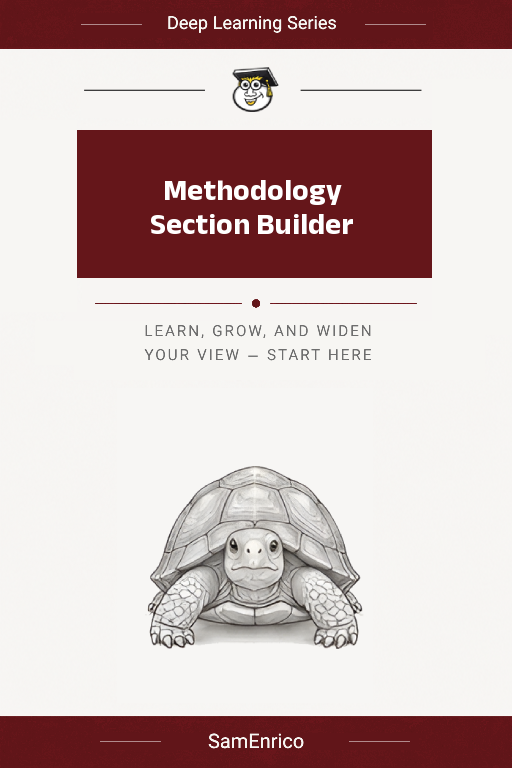
Non-FictionStudent's ShortcutResearch MethodsStudy Design
Methodology Section Builder Audiobook
Match research questions to methods, justify sampl
Match research questions to methods, justify sample sizes, and describe analysis plans using discipline-specific templates.
Formats
Free sample
Chapter 1: The Method Trap--–- Every doctoral candidate remembers the moment. You have finished your literature review. You have a research question that feels important. Then you open a blank document and type "Methodology." The cursor blinks. Three weeks later, you are still watching it blink.You have read five methodology books.
You know you need a sample size. You know you need an analysis plan. You know you need to justify your choices. But no book has told you how to connect your specific question to a specific statistical test. No book has shown you what a defensible qualitative sample size looks like for a grounded theory study versus a phenomenological study.
And certainly no book has given you a template for writing an analysis plan that a peer reviewer will not immediately shred.This book is that missing manual. But before we build anything, we must first demolish a dangerous habit that sabotages more methodology sections than any other single cause. That habit is what I call methodolatry.The Definition of Methodolatry Methodolatry is the worship of method over question. It happens when a researcher decides on a method first—"I will do a survey" or "I will conduct interviews"—and then forces their research question to fit that method, like squeezing a square peg into a round hole. The method becomes the master, not the servant.I have seen this play out hundreds of times in dissertation committees, journal peer reviews, and grant panels.
A student spends six months designing a complex quantitative survey with forty-seven items and a stratified sampling frame. Then, at the defense, someone asks: "What is your research question?" The student answers: "How do first-generation college students experience imposter syndrome?" The committee chair puts down their pen. "That is not a quantitative question. That is a question about lived experience. You needed interviews."Six months of work.
Forty-seven survey items. A beautiful sampling frame. All of it irrelevant because the question and method were never aligned.Here is another version. A different student conducts fifteen in-depth interviews with cancer survivors. The interviews are rich, emotional, detailed.
At the defense, someone asks: "What proportion of survivors report clinically significant anxiety?" The student says: "We cannot answer that with fifteen interviews." The committee chair sighs. "Then why did you not ask a question that fifteen interviews can answer?"Methodolatry wears two faces. The first is quantitative…
This is the end of the free sample. Get the Audiobook to keep going. Buy now
About this book
Details
- Author
- Mccormick Loren
- Publisher
- SamEnrico
- Language
- English
- Genre
- Non-Fiction, Student's Shortcut, Research Methods, Study Design
- Released
- 2026-05-30
- Pages (approx.)
- 156
- Available as
- eBook, Audiobook

Listen in the VoxFlicks app
Audiobooks and audio dramas wherever you go. Sign in with your SamEnrico account and press play.
More by Mccormick Loren
 Anapanasati Meditation FoundationsMccormick Loren$11.99
 Stress Communication for IntrovertsMccormick Loren$11.99
 Listening In Diplomacy GuideMccormick Loren$11.99
 The Performance ReviewMccormick Loren$11.99
 Lucid Dream Journal MethodMccormick Loren$11.99
 Workplace Mental Health AccessMccormick Loren$11.99
 The English Rose GardenMccormick Loren$11.99
 Overcoming Negativity Bias NaturallyMccormick Loren$11.99
 Muhammad Ali RopeMccormick Loren$11.99
 The Tsar’s Enlightened Court: Catherine the Great and the Russian RenaissanceMccormick Loren$11.99
 The Hollow Echoes: The Forgotten Patients of Danvers State HospitalMccormick Loren$11.99
 The Harmonic Crown: Black Composers Who Defied the SymphonyMccormick Loren$11.99
You may also like
 Hong Kong Handover 1997Dunn Johnnie$11.99
 Zumba For Postnatal Recovery CourseNeal Christian$11.99
 Zumba for BeginnersLadner Nikia$11.99
 YouTube Comment Mining GuideHumes Pandora$12.99
 Worry Box MeditationCarlin Rudy$11.99
 Workplace Stress MeditationNguyen Lynn$11.99
 Workplace Stress and Sleep RepairHawley Ivory$11.99
 Workplace Perfectionism CureDelaney Jeffry$11.99
 Workplace Injustice Anger GuideWallen Isabelle$11.99
 Work Addiction and Burnout LinkGreenwood Ester$11.99
 Women in Yoga and WellnessBeattie Galina$11.99
 Women in Stand Up ComedyChun Evangeline$11.99